


GST Technology & AI
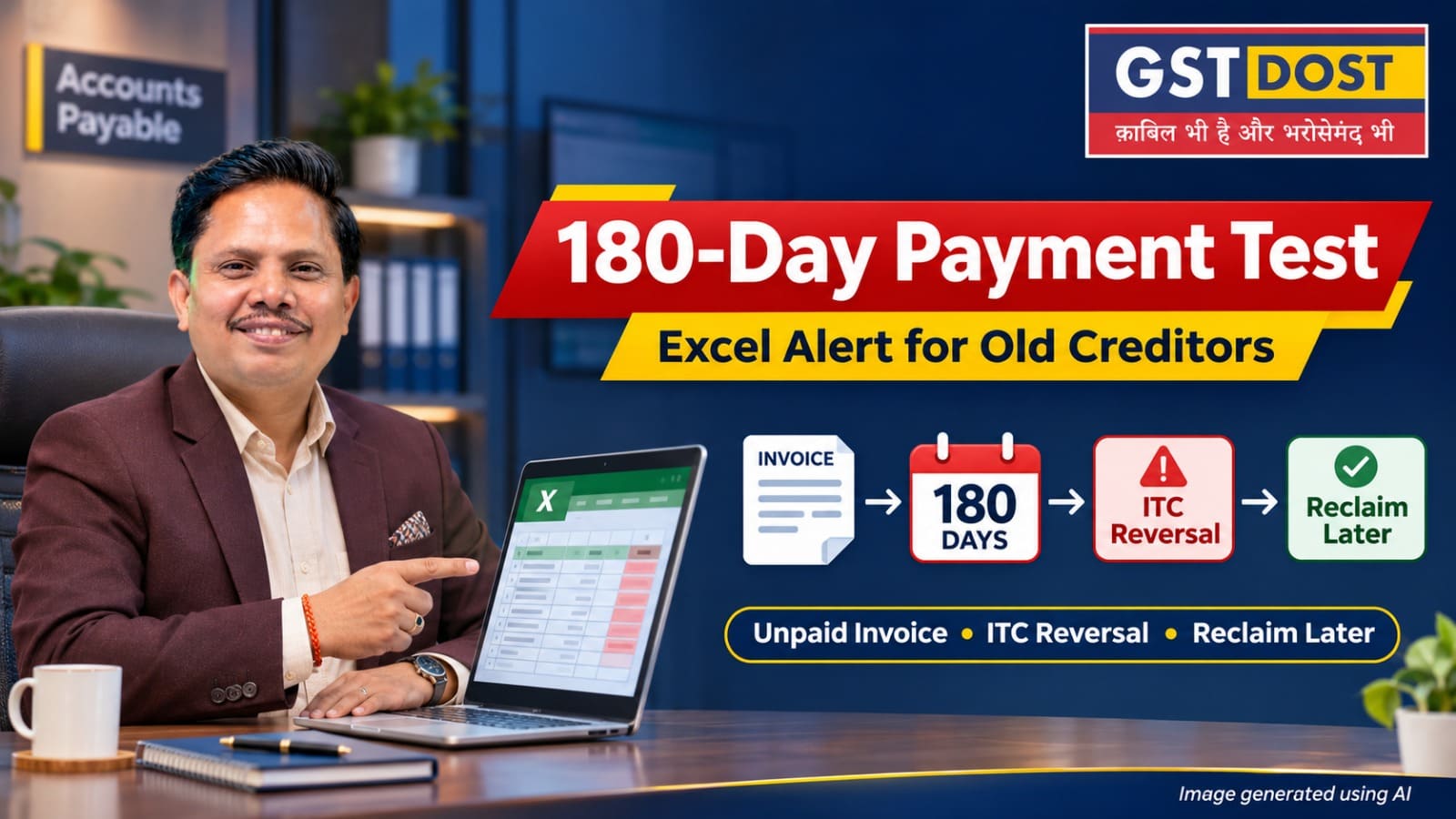
A purchase can be real, the invoice valid and the input tax credit (ITC) correctly taken, and part of that credit can still have to be given back. The CGST Act expects the buyer to pay the supplier, including the tax, within 180 days of the invoice date. If part of the invoice is unpaid at that point, a matching part of the ITC has to be reversed, and it can be taken again once the payment is made. An ordinary list of old creditors does not test this invoice by invoice. A small working in Excel does.
In simple terms
- The 180 days run from the supplier's invoice date. Each invoice has its own deadline.
- The reversal is proportionate to the part of the invoice that is unpaid on that day.
- Paying later lets the credit be taken again. It does not undo the reversal that fell due in between.
Why this matters
Creditor ageing reports are built for finance. They show how old the balance with each supplier is at a cut-off date. They usually do not show which invoice a part-payment was set against, how a credit note was adjusted, or what was unpaid on the 180th day of a particular invoice.
The GST test needs exactly those details. A supplier balance that looks small at the year end can hide an invoice that crossed 180 days unpaid in the middle of the year and was settled later.
What the law says
- The condition. Under the second proviso to section 16(2) of the CGST Act, where the recipient fails to pay the supplier the value of the supply along with the tax within 180 days from the date of issue of the invoice, an amount equal to the ITC availed has to be paid along with interest under section 50. The proviso does not apply to supplies on which tax is payable under reverse charge.
- The manner. Rule 37(1) of the CGST Rules requires the recipient to pay or reverse the ITC in proportion to the amount not paid to the supplier, with interest under section 50, while furnishing GSTR-3B for the tax period immediately following the period of 180 days from the date of the invoice.
- Amounts treated as paid. The rule treats two things as paid for this purpose: supplies made without consideration that are covered by Schedule I, and amounts added to the value of the supply under section 15(2)(b).
- Taking the credit again. Once the payment is made to the supplier, the recipient is entitled to take the credit again. Rule 37(4) says that the time limit in section 16(4) does not apply to a claim for re-availing credit that was reversed earlier.
The mistake to avoid
Do not test the balance outstanding on 31 March 2026. Find out what was unpaid when each invoice reached 180 days, and whether that amount was paid later.
A payment made after the 180 days may allow the credit to be taken again. It does not mean that the requirement to reverse never arose.
Practical example
An ordinary domestic purchase, not under reverse charge, on which the buyer took the full credit.
| Particulars | Figure |
|---|---|
| Date of the supplier's invoice | 1 July 2025 |
| Invoice value including GST | ₹1,18,000 |
| GST on the invoice, taken as ITC | ₹18,000 |
| 180th day from the invoice date | 28 December 2025 |
| Paid to the supplier up to that day | ₹59,000 |
| Unpaid on that day | ₹59,000 (50%) |
| ITC to be examined for reversal (50% of ₹18,000) | ₹9,000 |
Illustrative figures. It is assumed that there is no other valid settlement and no exception.
Half of the invoice is unpaid on the 180th day, so ₹9,000 of the credit needs a Rule 37 reversal review, together with the interest and the return period in which it should have been reported. If the balance is paid later, check that the credit is taken again lawfully and only once.
Where it goes in the returns
- GSTR-3B. CBIC Circular No. 170/02/2022-GST names Rule 37 as an example of a reversal that can be reclaimed later. Such a reversal is reported in Table 4(B)(2). The credit taken again is reported in Table 4(A)(5) and also shown in Table 4(D)(1).
- The portal statement. The Electronic Credit Reversal and Re-claimed Statement on the GST portal tracks reversals reported in Table 4(B)(2) and credit reclaimed in Table 4(D)(1). GSTN's advisory dated 29 December 2025 announced that the portal would stop allowing GSTR-3B to be filed where the credit reclaimed is more than the balance in this statement plus the reversal of the current period. A reclaim therefore needs a correctly reported reversal behind it.
- GSTR-9. GSTN's FAQs for FY 2024-25 place a Rule 37 reversal in Table 7A and the credit taken again in Table 6H, and treat the reclaimed credit as ITC of the year in which it is reclaimed. Check the FY 2025-26 form before filing.
The Excel working
- Export three sets of data invoice-wise: purchase invoices with date, gross value and GST; ITC actually claimed; and payments with their dates and the invoice they were set against.
- Keep the source data intact. Do not overwrite original invoice dates, gross values or GST amounts.
- Calculate the 180-day date. If the invoice date is in cell B2, use
=B2+180. In Power Query, the equivalent custom column isDate.AddDays([InvoiceDate],180). - Total the payments made on or before that date for each invoice, and keep later payments in a separate column.
- Work out the unpaid amount on the 180-day date and the proportionate ITC: ITC taken multiplied by the unpaid amount and divided by the invoice value.
- Flag every invoice with a positive unpaid amount on which ITC was taken.
A flag is not a conclusion: Dates, the allocation of part-payments and credit notes, the exceptions in the rule and the actual period of reversal have to be checked by a person before any amount is reversed.
Data confidentiality: Do not share confidential invoice or payment data with a public AI tool without permission and sufficient safeguards.
Action points
If you own or manage the business
- Treat old creditors as a GST matter too. An unpaid invoice older than 180 days can cost interest and block credit until it is paid.
- Ask for the invoice-wise list. Ask which invoices crossed 180 days unpaid during FY 2025-26, how much ITC is involved, and whether it was reversed.
- Plan payments around the 180th day. Where a payment is going to be made anyway, making it before the invoice crosses 180 days avoids the reversal.
- Fix the payment records. Payments and credit notes should be recorded against specific invoices and not only against the supplier's running balance.
If you prepare or review the GST returns
- Export invoice-wise accounts payable, eligible ITC claimed and the allocation of bank payments.
- Preserve original invoice dates, gross invoice values and GST amounts. Do not overwrite source data.
- Match payments and valid adjustments to individual invoices, and not merely to supplier closing balances.
- Calculate the 180-day date and the unpaid amount on that date, with part-payments captured.
- Check the exceptions in Rule 37, any earlier reversal, the interest and any later re-availment.
- Reconcile the result with the reversal and reclaim reported in GSTR-3B, and keep the evidence.
Red flag: The creditor balance is old, ITC was taken on the invoice, and there is no proof of payment, no applicable exception and no earlier Rule 37 reversal.
Records to keep: The invoice and ITC register, payment evidence allocated to invoices, the ageing working as on the 180th day, the conclusion under Rule 37 for each flagged invoice, extracts of the returns showing reversal and reclaim, and the name of the person who reviewed the working.
What you should have at the end: A supplier-wise action list: payments to prioritise, credits that need a reversal review, amounts that may be taken again, and the improvements needed in accounts-payable records.
Practical takeaway
An unpaid invoice is both a finance question and a GST question. Test the 180 days invoice by invoice, and not only from year-end creditor totals.
Terms used in this article
- ITC (input tax credit)
- Credit for GST paid on purchases of goods or services used for business, subject to the conditions in the law.
- Creditor ageing
- A report that groups amounts owed to suppliers by how long they have been outstanding.
- Reversal and re-availment
- Reversal means giving back credit already taken, through GSTR-3B. Re-availment means taking the same credit again once the condition for it is met.
- Reverse charge
- Cases where the recipient, and not the supplier, pays the GST to the Government. The 180-day condition does not apply to these supplies.
- Schedule I supplies
- Transactions that GST treats as supplies even though no consideration is charged, such as certain supplies between related persons or between two registrations of the same entity.
- GSTR-3B
- The monthly or quarterly summary return in which a taxpayer declares liability, pays tax and takes ITC.
- Power Query
- The data import and preparation tool built into Microsoft Excel, found in the Data tab.
Sources and references
- Central Goods and Services Tax Act, 2017 (India Code) - second and third provisos to section 16(2).
- CBIC - Rule 37, CGST Rules, 2017 - reversal of input tax credit in the case of non-payment of consideration.
- Notification No. 26/2022-Central Tax dated 26 December 2022 - proportionate reversal under rule 37(1), effective 1 October 2022.
- CBIC Circular No. 170/02/2022-GST dated 6 July 2022 - reporting of ITC reversal and reclaim in GSTR-3B, paragraph 4.3.
- GSTN advisory - Electronic Credit Reversal and Re-claimed Statement.
- GSTN advisory and FAQs dated 29 December 2025 on the Electronic Credit Reversal and Re-claimed Statement and the RCM Liability/ITC Statement, under News and Updates on the GST portal.
- GSTN Consolidated FAQs on GSTR-9/9C for FY 2024-25 - Tables 7A and 6H.
- Microsoft Learn - Date.AddDays (Power Query M).
Disclaimer: This article is for general information only and reflects the position as understood on the review date mentioned above. It is not legal advice and does not create a professional relationship. Whether a reversal is due, for what amount and in which period depends on the facts and documents of each case. Figures in the example are illustrative. Any formula or query should be tested on sample data before use. Please obtain professional advice before acting on this article.
GST DOST | GST Annual Return, Reconciliation and Technology-led Review

Related posts
Rule 37A Before 30 November 2026: A Supplier Can Report Your Invoice and Still Put Your ITC at Risk...
GSTR-9C Tax Reconciliation: A Zero Total Difference Can Hide a Wrong Tax Head...
180-Day Vendor Payment Test: Use Excel to Find ITC Reversals Hidden in Old Creditors...
Goods Sent to Another Factory for Processing: Who Is Responsible for GST Job Work Records and ITC-04?...
