


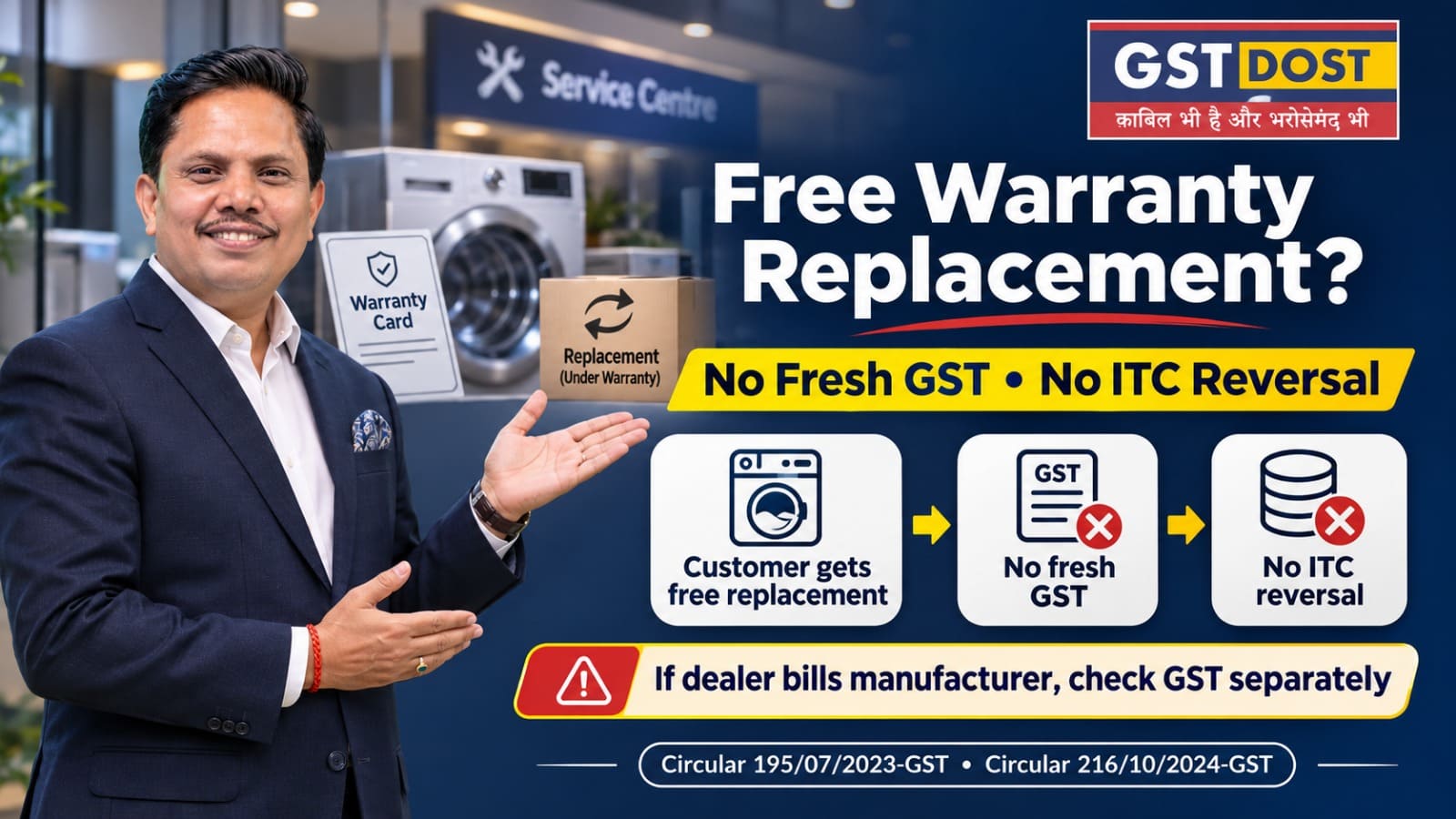
A customer buys a washing machine with a one-year manufacturer’s warranty. Six months later a manufacturing defect shows up, and the machine is replaced without charging the customer again. Is GST payable on the new machine? Does the manufacturer have to reverse input tax credit?
For a genuine warranty replacement with no extra charge to the customer, the short answer is no on both counts. But the transactions between the manufacturer, the dealer and the service centre follow their own rules, and that is where most mistakes happen.
This advisory is based on CBIC Circular No. 195/07/2023-GST dated 17 July 2023 and Circular No. 216/10/2024-GST dated 26 June 2024, read from the original circulars. It also covers the credit note rule in Section 34(2), which changed from 1 October 2025.
1. Why does a warranty replacement not attract fresh GST?
When a manufacturer sells a product with a warranty, CBIC’s view is that the selling price already includes the likely cost of replacing parts or repairing the product during the warranty. GST has been paid on that price. So when the manufacturer replaces or repairs the product under warranty without charging anything separately, no further GST is payable. (Circular 195, para 2, Sr. No. 1)
For the same reason, the free replacement is not treated as an exempt supply, and the manufacturer does not have to reverse ITC on the parts or repair services used. (Circular 195, para 2, Sr. No. 2)
Circular 195 originally spoke only of parts. Circular 216 clarified that the same treatment applies when the entire product is replaced under warranty, and that “parts” in Circular 195 is to be read as “goods or its parts”. (Circular 216, paras 3.2 and 3.3)
Two limits to keep in mind
If the manufacturer or the dealer charges the customer anything extra for the replacement or repair, GST is payable on that extra amount. (Circular 195, Sr. Nos. 1 and 3)
This is not a general exemption for free supplies, gifts, promotional items or goodwill replacements made outside the warranty. The warranty terms and the actual transaction must support the treatment.
2. What if the dealer replaces the product from its own stock?
The customer may not want to wait for the manufacturer. So the dealer or distributor hands over a machine from its own inventory to fulfil the manufacturer’s warranty, and later asks the manufacturer to make good the stock.
If the manufacturer then replenishes that stock at no additional cost, Circular 216 treats it in the same way as a manufacturer supplying parts free for warranty replacement. Where the replenishment is sent under a delivery challan, no GST is payable on it, and the manufacturer need not reverse ITC on the replenished goods or parts. (Circular 216, paras 4.2 and 4.3, inserting point (d) in Sr. No. 4 of Circular 195)
The dealer should be able to link the original sale, the customer’s complaint, the replacement and the replenishment, item by item. Serial numbers and job cards are the easiest way to do this.
3. Does the same treatment apply when the dealer charges the manufacturer?
No. The service may be free for the customer, but the dealer and the manufacturer may still be dealing with each other for consideration. Each arrangement needs its own treatment.
Free for the customer does not mean every transaction between the dealer and the manufacturer is free of GST.
4. How is an extended warranty treated?
An extended warranty is different. CBIC describes it as an assurance that the product will work without defects, sold at a time when nobody knows whether any repair will be needed. Who sells it, and when, decides the treatment. (Circular 216, para 5.2.1)
Circular 216 replaced the earlier position in Circular 195 that a later extended warranty is taxed according to whether it covers goods, services or both. Work out the rate for the actual classification and period; do not assume one “warranty rate” for every case.
5. A practical example
Take a hypothetical electronics dealer with these entries in November:
The first two entries are warranty stock movements. The last two involve separate consideration and carry GST. Accounts should not apply one treatment to all four. The figures are illustrative only.
6. Action points
Who should review this: consumer electronics and home appliance dealers, automobile dealerships, industrial machinery and computer hardware suppliers, and authorised service centres. Having a warranty programme does not mean a business has made a GST mistake; it means the flows are worth checking.
For business owners and accounts heads
- Pick three recent warranty claims. For each, find out who supplied the replacement, whether anyone received separate payment, how the stock was replenished and which GST document was issued.
- Keep original warranty and extended warranty transactions apart in the books, and note who supplied each extended warranty.
- Reconcile replacement stock given out with replenishments received from the manufacturer, month by month.
- Make sure any amount charged to the customer or billed to the manufacturer goes out with a proper tax invoice.
- Do not reverse ITC, issue credit notes or revise past returns without first checking the conditions that apply.
For GST professionals
- Map each flow to the right serial number: Sr. Nos. 1–3 of Circular 195 for free warranty work, 4(a) to 4(d) for dealer-manufacturer stock, 5 for repair services billed to the manufacturer, and the substituted Sr. No. 6 for extended warranty.
- Where the manufacturer settles through credit notes, check that the dealer has reversed the matching ITC. For credit notes from 1 October 2025, this is a statutory condition under the substituted proviso to Section 34(2).
- In a notice reply, show the link between the original taxable sale and the warranty event. The “no ITC reversal” position rests on the warranty cost being part of the original price.
- Read the dealer agreement. Who bears the warranty cost, and on what terms, decides whether a supply between dealer and manufacturer is free or for consideration.
Documents to keep ready
If a case-specific question remains open after this exercise, discuss it with your GST adviser before changing past reporting.
7. Official sources
Read Circular 195/07/2023-GST (GST Council PDF) · Read Circular 216/10/2024-GST (GST Council PDF)
Law as on 25 November 2026. These circulars are from 2023 and 2024; we found no later CBIC clarification on warranty that replaces them. This is general information, not advice on any particular business’s transactions.
GST DOST | GST Compliance & Professional Education

Related posts
Gold Coins for Dealers: Orient Cement Keeps Its ITC but Owes GST on 110% of Cost, Rules Telangana Appellate Authority...
Temple Hair Auctions and the 18% Clause: Telangana AAR Says Unworked Hair Is Exempt Goods, but the Ruling Binds the Bidder, Not the Temple...
A Three-Wheeler to the Railway Station Without Part-B: GSTAT Lucknow Refuses to Restore a Rs 4.86 Lakh E-Way Bill Penalty...
Filed Under the CrPC, Cognised Under the BNSS: Why the Jharkhand High Court Sent a GST Prosecution Back for a Hearing...
