


Namaste DOST,
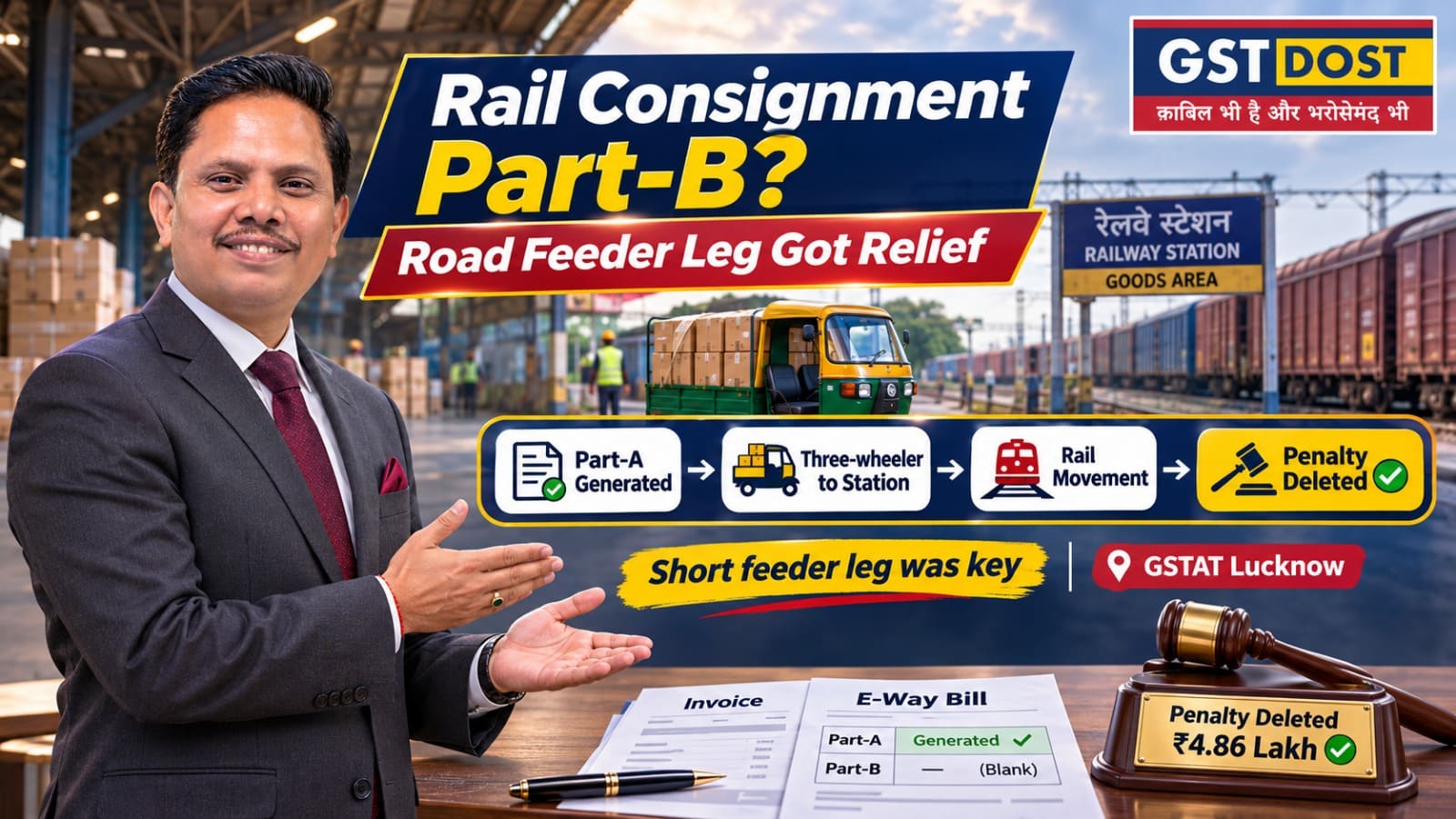
At 11:11 am on 16 November 2024, a Kanpur pan masala wholesaler generated Part-A of an e-way bill for goods going to Lucknow by rail. Forty minutes later, a mobile squad stopped the three-wheeler carrying the goods to the railway station. Part-B, which carries the vehicle details, was blank, even though the invoice itself recorded the three-wheeler's number.
Does that short road leg need Part-B? In Vikash Chandra Singh v. M/s Prabhu Aastha Enterprise Pvt. Ltd. (GSTAT, State Bench Lucknow, APL/189/LCK/2026, order signed 19.11.2026), the Tribunal said no. It dismissed the department's appeal, so the first appellate order deleting a Rs 4,85,894 penalty under Section 129(3) stands (paras 7.4–7.10 and final order). Two rules protected the movement: for rail consignments, Part-B may be furnished before or after movement begins (Rule 138(2A)), and Part-B is not needed for a feeder trip of up to 50 km within the State to the transporter's place (third proviso to Rule 138(3)) (para 7.5). That protection depended on documents showing rail transport before the vehicle left.
What did the documents say before the vehicle moved?
The taxpayer explained why the portal check came up empty: the officer searched by the local vehicle number, which was not in Part-B (para 6.1). The penalty equals twice the tax on the invoice, head by head (GST DOST's arithmetic from paras 3.2 and 3.7).
Why was the blank Part-B lawful on this trip?
The department argued that the trip from the supplier's premises in Fazalganj to the railway station was an independent road leg, and the vehicle was stopped on a public road before it reached railway premises, so a complete e-way bill was mandatory (para 5.3). It also relied on the portal stamp “Not Valid for Movement as Part B is not entered” (para 5.2).
The Tribunal read the rules together (paras 7.3–7.6):
- Rule 138(2A): for goods transported by railways, the registered person may furnish Part-B either before or after the commencement of movement, and the railways must not deliver the goods unless the e-way bill is produced at delivery.
- The railway receipt problem: Part-B for a rail consignment needs the railway receipt number, which exists only after the goods reach the station and are booked. Demanding it on the feeder trip asks for the impossible (para 7.4).
- Third proviso to Rule 138(3): for transport of up to 50 km within the State from the consignor's place of business to the transporter's place of business for further transportation, conveyance details in Part-B need not be furnished. The trip within Kanpur city was well inside that limit (para 7.5).
- Explanation 2 to Rule 138(3): the rule that an e-way bill without Part-B is not valid for road movement carves out movements covered by the third proviso. A portal message cannot override the rule (para 7.6).
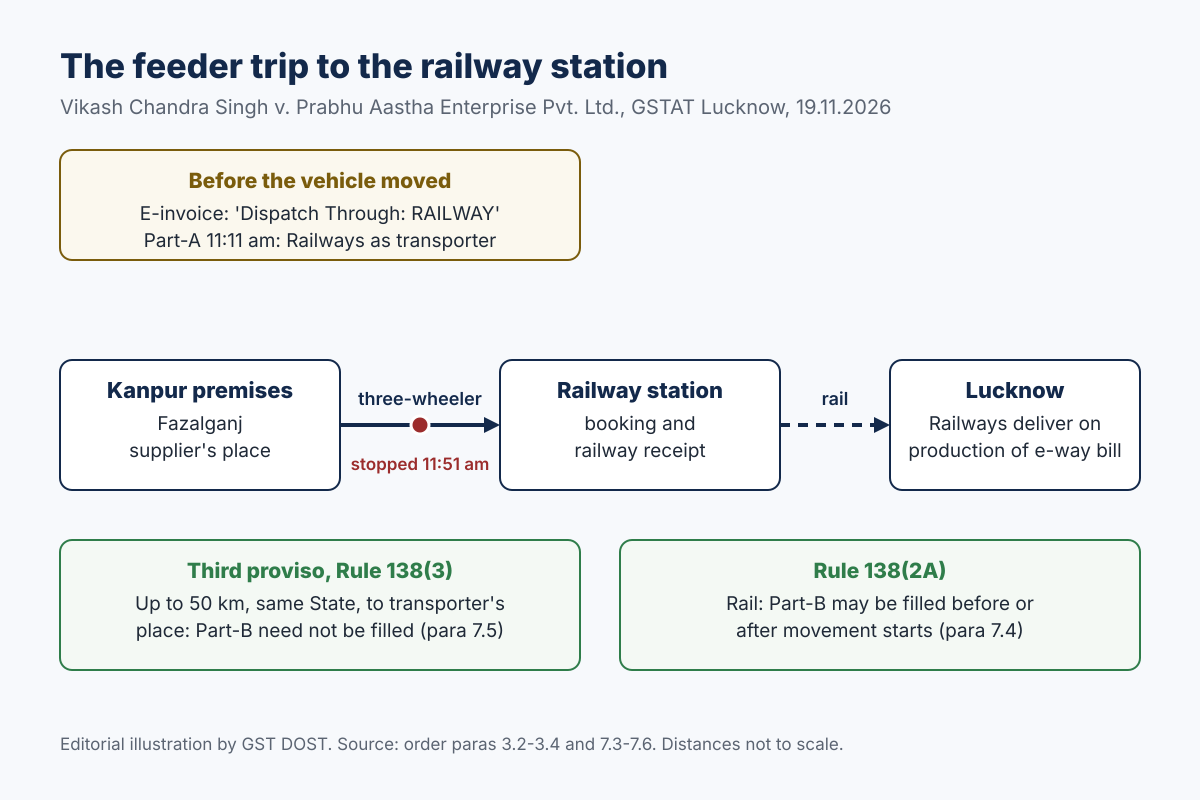
What made the rail story believable was the timing of the documents. The invoice said “Dispatch Through: RAILWAY” and Part-A named the Railways as transporter, both before movement began (para 7.4).
GST DOST's reading
The order treats the railway station as the transporter's place for the third proviso without discussing the point separately. A file with a weaker paper trail, such as an invoice silent on the mode of transport or a Part-A generated after interception, would sit much closer to the department's argument. So would a feeder leg longer than 50 km or one that crosses a State border.
Did the Tribunal need a finding on intent?
The Tribunal's primary holding is that no contravention of Section 68 read with Rule 138 occurred (para 7.10). Proof of a contravention is the foundation for Section 129 despite its non obstante opening (para 7.3).
It added a second line. The complete digital and physical match showed no intent to evade, and penalties should not follow technical breaches without deliberate defiance of law, citing Hindustan Steel Ltd. v. State of Orissa, Assistant Commissioner (ST) v. Satyam Shivam Papers and the Allahabad High Court in Citykart Retail (para 7.9).
The taxpayer also argued that MOV-09 was passed at 18:08 on 16.11.2024, four days before the hearing date fixed in MOV-07 (20.11.2024), in breach of Section 129(4) (para 6.3). The Tribunal did not rule on that ground. It remains open.
Seventeen days earlier, the same Bench decided another appeal involving the same taxpayer. In Shaily Singh v. Prabhu Aastha Enterprise Pvt. Ltd. (APL/217/LCK/2026, 02.11.2026), as reported, it upheld the deletion of a Rs 2,55,792 penalty where goods went about 5 km by road to a transporter's depot in Kanpur for onward carriage to Gorakhpur. The present order adds the rail-specific reasoning under Rule 138(2A).
Why could the department appeal a penalty below Rs 20 lakh?
Circular No. 207/01/2024-GST sets Rs 20 lakh as the monetary limit for departmental appeals before the Tribunal. Para 4 of the circular excludes cases involving an issue that is recurring in nature or that involves interpretation of the Act, Rules or notifications. The taxpayer objected that the penalty was below the limit (para 2). The Tribunal held that the dispute raised a recurring legal question affecting mobile squads' enforcement work, so the exclusion applied. It overruled the objection and heard the appeal (para 2.1).
Para 2 records the disputed penalty as Rs 4,89,960, while paras 1, 3.7 and 3.8 and the Form APL-04A summary record Rs 4,85,894. We use Rs 4,85,894, which reconciles with the head-wise figures in para 3.7.
GST DOST's practice point
A taxpayer who wins a small e-way bill penalty at the first appeal should not assume the department cannot go further. Keep the record ready for a second round.
What should each team do before the next rail consignment?
Business owner. GST DOST's practice point: make the mode of transport and the Railways' transporter details part of the invoice and Part-A template for rail dispatches, generated before the vehicle leaves.
Dispatch and accounts. Record the distance from the premises to the goods shed. Keep it within the State and within 50 km, or fill Part-B for the road vehicle. Once the goods are booked, update Part-B with the railway receipt details and keep a copy of the receipt.
GST practitioner. At interception, make sure MOV-04 records the match between goods and invoice. Reply to MOV-07 promptly with the e-invoice and Part-A slip, as the taxpayer did on the same day (para 3.6). If MOV-09 is passed before the hearing date, raise Section 129(4).
In-house or litigation team. Where the department appeals a small amount, check whether it relies on the Circular 207 exclusion and prepare the merits fully. Cite paras 7.4–7.6 for the rule-based protection and para 7.10 for the finding of no contravention.
File checklist: road feeder leg to a railway station
How to cite this order
Case name as printed: Vikash Chandra Singh v. M/s Prabhu Aastha Enterprise Pvt. Ltd., Director, 117/P1/376 Shivpuri Kakadeo, Kanpur.
Forum: GST Appellate Tribunal, State Bench Lucknow, Division Bench Court I; Santosh Kumar Srivastava, Member (Judicial) and Arvind Kumar, Member (Technical). Appeal APL/189/LCK/2026 (referred to in the operative order as Appeal No. 189/APL/2026); order reference no. ZA090371126000378H.
Date: the signed order is dated 19.11.2026; the Form APL-04A summary and the cover page record 18.11.2026, which is also the last hearing date. We did not find a neutral or reported citation as of 25.11.2026.
Vikash Chandra Singh v. Prabhu Aastha Enterprise Pvt. Ltd., GSTAT Lucknow, APL/189/LCK/2026, order dt. 19.11.2026, paras 7.4–7.6 and 7.10.
Sources and verification notes
- The order: copy used is the reproduction published by JurisHour (JURISHOUR-4249-GSTAT-2026(LCK)), 13 PDF pages. The order's own pages 1–10 are PDF pp. 4–13; paras 2–2.1 at PDF pp. 4–5, facts at PDF pp. 5–7, findings at PDF pp. 9–12, operative order at PDF p. 13. The order pages are scanned; figures were checked against the page images.
- Circular No. 207/01/2024-GST dated 26.06.2024 (monetary limits and exclusions).
- Rule 138, CGST Rules, 2017, as substituted by Notification No. 12/2018-Central Tax.
- Shaily Singh v. Prabhu Aastha Enterprise Pvt. Ltd., GSTAT Lucknow, APL/217/LCK/2026, 02.11.2026: as reported by LiveLaw Biz (reproduction).
- Verification: Rule 138 text, Circular 207 and a web search for any challenge to this order checked on 25.11.2026. Recheck before reliance.
If your dispatches use rail or a transporter's hub and you want the e-way bill workflow checked against these rules, GST DOST can help through the Contact page on gstdost.com.

Related posts
Gold Coins for Dealers: Orient Cement Keeps Its ITC but Owes GST on 110% of Cost, Rules Telangana Appellate Authority...
Temple Hair Auctions and the 18% Clause: Telangana AAR Says Unworked Hair Is Exempt Goods, but the Ruling Binds the Bidder, Not the Temple...
A Three-Wheeler to the Railway Station Without Part-B: GSTAT Lucknow Refuses to Restore a Rs 4.86 Lakh E-Way Bill Penalty...
Filed Under the CrPC, Cognised Under the BNSS: Why the Jharkhand High Court Sent a GST Prosecution Back for a Hearing...
