


Namaste DOST.
The Bombay High Court has delivered a clear and timely reminder for today’s legal and professional world: technology is welcome, but responsibility cannot be outsourced.
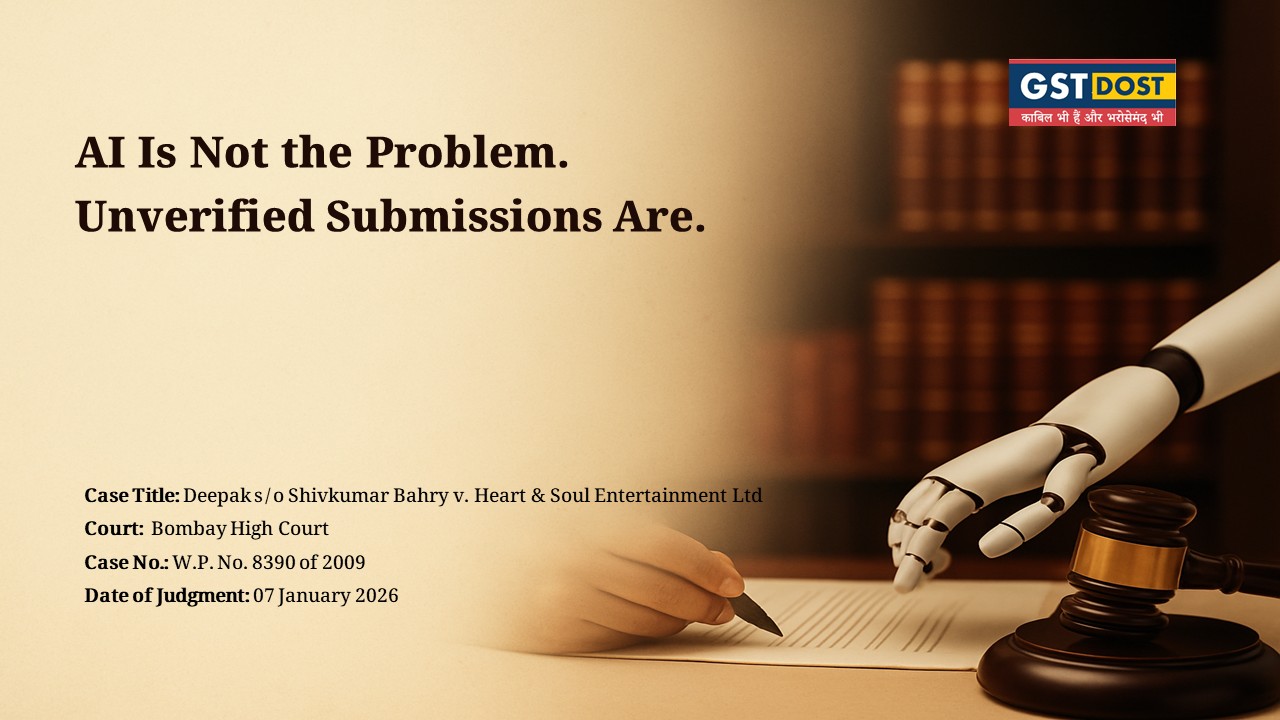
In Deepak s/o Shivkumar Bahry vs Heart & Soul Entertainment Ltd. (W.P. No. 8390 of 2009, pronounced on 7 January 2026), the Court addressed an issue that many professionals quietly struggle with—using AI tools for drafting without verifying what is finally placed before the Court.
This judgment is not anti-AI. It is anti-carelessness.
Summary
In Deepak s/o Shivkumar Bahry vs Heart & Soul Entertainment Ltd. (Bombay High Court, W.P. No. 8390 of 2009, pronounced on 7 January 2026), the Court recorded serious concerns about AI-styled written submissions filed without verification.
During the proceedings, the Respondent, appearing party-in-person, filed written submissions that looked polished and structured at first glance. However, the Court noticed multiple red flags. The submissions cited a case law that did not exist, provided no citation, and produced no copy of the judgment. Despite efforts by the Court and its law clerks, the case could not be traced.
The Court observed that these features strongly suggested the use of an AI tool such as ChatGPT or similar, without proper human verification. While affirming that AI may be used as a research aid, the Court stressed that the person filing submissions must verify accuracy, relevance, and existence. The conduct was deprecated, a warning was issued (including possible Bar Council reference for advocates), and ₹50,000 costs were imposed.
Facts of the Case (Background)
The petition before the Bombay High Court was filed under Article 227 of the Constitution of India, challenging an order passed in revision proceedings under the Maharashtra Rent Control Act, 1999.
The parties were:
-
Petitioner: Mr. Deepak s/o Shivkumar Bahry
-
Respondent: Heart & Soul Entertainment Ltd., represented by its Director, who appeared party-in-person
While the judgment primarily deals with issues under rent-control law, a separate and practical issue arose during the hearing. The Respondent filed written submissions that the Court found problematic—not because they were modern or well-formatted, but because their content lacked credibility.
Every professional can relate to this moment. Deadlines approach. Hearings are near. Fatigue sets in. The temptation to copy, paste, and file is real. That is precisely why this judgment matters.
Legal Issue (Issue at Hand)
The key issue highlighted by the Court can be stated simply:
Can parties file AI-generated or AI-styled court submissions without verifying citations, relevance, and even the existence of referenced case law—and if they do, what consequences follow?
Arguments (As Recorded)
The judgment records that the Respondent, appearing in person, relied on written submissions and accompanying case law. The Court noted “give-away features” in the submissions, such as formatting style and repetitive phrasing, suggesting the use of an AI tool such as ChatGPT or similar.
Crucially, the submissions cited a case law titled:
“Jyoti w/o Dinesh Tulsiani vs Elegant Associates”
No citation was mentioned. No copy was filed.
And despite searching, neither the Court nor its law clerks could find any such judgment.
This became the turning point.
⚖️ Court’s Decision
Bombay High Court’s Ruling (7 January 2026)
The Court addressed the issue with clarity and balance.
1 AI as a Research Aid Is Permissible
The Court expressly acknowledged:
“If an AI tool is used in aid of research, it is welcome.”
This line is important. It makes it clear that:
-
The Court does not ban AI tools
-
The Court does not object to AI-assisted drafting
-
Technology itself is not the problem
2 Responsibility Lies With the Person Filing Submissions
The Court immediately added an equally important caveat.
It held that there is a great responsibility upon the party, including an advocate, to:
-
Cross-verify references, and
-
Ensure that the material generated is relevant, genuine, and actually in existence
In simple terms:
AI may assist. Humans must verify.
The Court made it clear that signing and filing submissions without checking their contents is unacceptable.
3 Filing Unverified AI Content Wastes Judicial Time
The Court also focused on the practical damage caused.
It recorded that:
-
Judicial time was wasted searching for a non-existent case law
-
Submissions were filed by simply signing them, without verification
-
Dumping such material on the Court is not assistance, but a hindrance to justice
The Court strongly deprecated this practice and issued a formal warning:
-
Such conduct will not be taken lightly, and
-
In the case of advocates, may even lead to reference to the Bar Council
Consequences Imposed by the Court
The Court backed its words with action.
Because of this conduct:
-
The Respondent was saddled with costs of ₹50,000
-
The Court expressly recorded its displeasure
-
The warning was placed on record as a future deterrent
This makes one thing clear.
AI-related negligence is not theoretical.
It carries real financial and legal consequences.
What This Judgment Does Not Say
It is equally important to understand what the judgment does not say:
❌ It does not ban ChatGPT or AI tools
❌ It does not treat AI use itself as misconduct
❌ It does not prohibit AI-assisted drafting
What the Court condemns is blind reliance on AI without human verification.
Important Message for Professionals and Business Owners
Based strictly on this judgment:
-
AI tools may assist research, not replace judgment
-
Every citation must be verified
-
Non-existent case law is unacceptable
-
Signing submissions without checking content is risky
-
Courts may impose costs and take stricter action going forward
There is a simple truth here:
Once you sign and file, the content becomes yours, not AI’s.
Why This Matters
This judgment sends a wider message for the future.
Courts are not resisting technology.
They are demanding discipline, accuracy, and accountability in its use.
The justice system runs on trust. And trust depends on verification.
Conclusion
This Bombay High Court judgment sends a clear and balanced message:
Technology is welcome. Carelessness is not.
AI can improve drafting speed and efficiency.
But legal responsibility cannot be outsourced to an algorithm.
Ultimately, the person filing submissions remains fully accountable for what is placed before the Court.
📞 Need help with a similar issue or professional drafting support? GST DOST is here to help.
FAQ
Q: Did the Bombay High Court ban AI tools like ChatGPT?
A: No. The Court clearly stated that AI tools used as research aids are welcome.
Q: What was the Court’s main concern in this case?
A: The filing of unverified submissions citing a case law that did not exist.
Q: Why were costs imposed?
A: Because unverified content wasted judicial time and hindered justice delivery.
Q: Can advocates face disciplinary consequences?
A: The Court warned that such conduct may even lead to Bar Council reference.
Q: Is using AI wrong in court matters?
A: No. Using AI is allowed. However, filing submissions in court without verifying AI-generated content is not acceptable.
References
Deepak s/o Shivkumar Bahry vs Heart & Soul Entertainment Ltd.
Bombay High Court, W.P. No. 8390 of 2009
Judgment dated 7 January 2026
Written by CA Vikash Dhanania | Reviewed by GST DOST Legal Research Team | Updated on 22/01/2026
© GST DOST | When courts clarify the law, we help you apply it with confidence.

Related posts
Yes, Police Can Attach Bank Accounts in GST Cases. But Only If They Follow the Law...
Nairson Multiventures Case: Why GST Cancellation Without Due Process Failed...
GST Summons Is Not a Punishment — Don’t Panic Before the Law Does...
Sale of Business as a Going Concern Is GST-Exempt — And ITC Transfer Is Allowed...
