


GSTR-9/9C Practical Guide
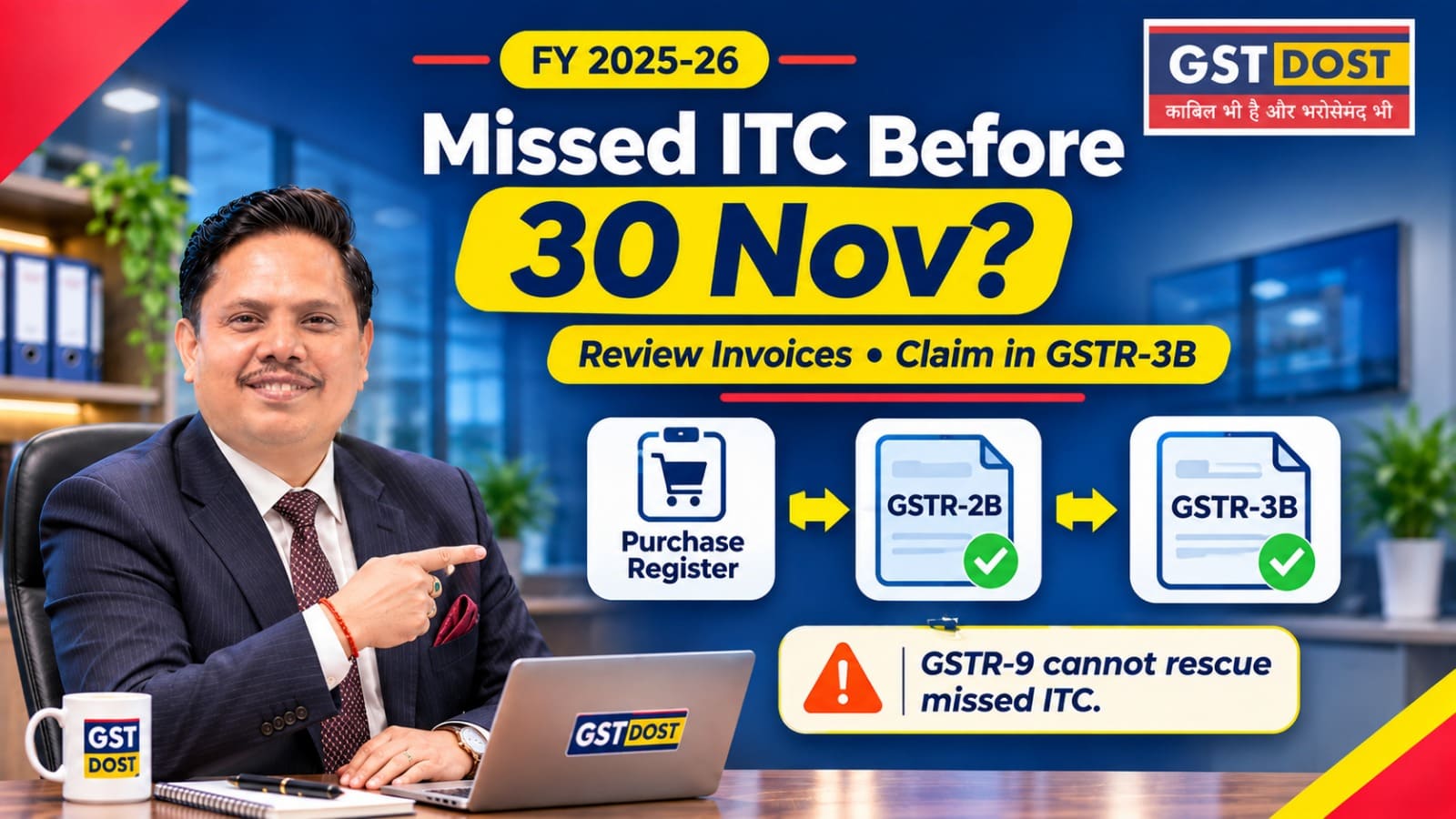
Input tax credit (ITC) on invoices and debit notes of FY 2025-26 cannot normally be taken after 30 November 2026, or after the annual return for the year is filed, whichever is earlier. GSTR-9 is not a route for claiming credit that was missed. This article explains how to find unclaimed credit while the window is still open, and how to keep the financial-year identity of each credit clear for GSTR-9.
Key dates for FY 2025-26
- 30 November 2026 (or the date of furnishing the FY 2025-26 annual return, if earlier): outer time limit under section 16(4) of the CGST Act for taking ITC on FY 2025-26 invoices and debit notes.
- 31 December 2026: due date for GSTR-9 and GSTR-9C for FY 2025-26, unless extended.
- 8 October 2026: date from which GSTR-9/9C for FY 2025-26 has been enabled on the GST portal, as per the GSTN advisory dated 13 October 2026. The tile opens only after all GSTR-1 and GSTR-3B returns for the year are filed.
Why this matters
A business may hold valid purchase invoices, may have received the goods or services and paid its suppliers, and may still have failed to take the eligible credit in its returns. If the gap is noticed only while preparing GSTR-9 in December, the normal statutory time limit may already be over.
The time limit, and the return that can still carry the claim
Section 16(4) of the CGST Act, 2017 bars ITC on an invoice or debit note after the thirtieth day of November following the end of the financial year to which it pertains, or after the relevant annual return is furnished, whichever is earlier. For FY 2025-26 documents, the outer date is therefore 30 November 2026. A business that files its FY 2025-26 annual return before that date closes the window on the date of filing.
Sub-sections (5) and (6) of section 16 contain narrow exceptions: one for financial years 2017-18 to 2020-21, and one for returns filed after a cancelled registration is revoked. CBIC explained them in Circular No. 237/31/2024-GST. They do not move the normal cut-off for a regular taxpayer with an active registration.
Which return? ITC is taken through GSTR-3B. For a monthly filer, the GSTR-3B for October 2026, due on 20 November 2026, is normally the last return that can be filed on or before 30 November 2026, because the November return can be filed only in December. A quarterly (QRMP) filer should check the position at once, because the GSTR-3B for the October to December quarter is filed only in January 2027. If the last available return has already been filed, do not assume that the credit can be taken later. Have the position examined before acting.
GSTR-9 will not rescue a missed claim. CBIC clarified in its press release dated 3 July 2019 that input tax credit cannot be availed or reversed through the annual return. The annual return reports what was done in the periodic returns. It does not create a new claim.
The practical problem: totals can match and still be wrong
Many accountants compare the total ITC in GSTR-3B with GSTR-2B and treat a matching figure as proof of correctness. That approach is unsafe, because the GSTR-3B returns filed during a financial year can contain credit belonging to more than one year.
GSTR-9 separates these layers:
| Table | What it shows | Why it matters |
|---|---|---|
| 6A | Total ITC availed through GSTR-3B during the year, auto-populated from Table 4A of GSTR-3B | It can include credit of an earlier year taken in this year's returns |
| 6A1 | ITC of the preceding financial year availed during the reporting year, other than reclaims under Rule 37 or Rule 37A | It takes prior-year credit out of the current-year figure |
| 6A2 | Net ITC of the reporting year (6A minus 6A1) | This is the figure to be classified in Tables 6B to 6H |
| 8A | ITC as per GSTR-2B, auto-populated | It is a supplier-reported figure, not a substitute for the purchase register |
GSTN explained these rows in its consolidated FAQs on GSTR-9/9C for FY 2024-25, the year in which Tables 6A1 and 6A2 were introduced. Those FAQs were written for FY 2024-25. Check the FY 2025-26 form and the live portal before filing.
A proper review therefore traces invoices, eligibility, actual claims and financial-year allocation. Totals alone are not enough.
Practical example
Suppose a company's GSTR-3B returns for FY 2025-26 show gross ITC availed of ₹12,40,000. Of this, ₹90,000 relates to invoices of FY 2024-25 and belongs in Table 6A1.
| Table | Particulars | Amount |
|---|---|---|
| 6A | Gross ITC availed through GSTR-3B | ₹12,40,000 |
| 6A1 | Less: ITC of the preceding year (FY 2024-25) availed this year | (₹90,000) |
| 6A2 | Net ITC of FY 2025-26 | ₹11,50,000 |
Illustrative figures only.
During further reconciliation, the team finds a service invoice of FY 2025-26 carrying GST of ₹36,000 that was never claimed in any GSTR-3B. If every eligibility condition is satisfied and the credit has not been taken earlier, the business should urgently examine taking it through a GSTR-3B that can still be filed within the statutory time limit.
Caution: Do not treat the ₹36,000 as automatically recoverable merely because the invoice appears in GSTR-2B. Appearance in GSTR-2B is one condition. It is not the whole test of eligibility.
Action points
For business owners and finance heads
- Ask for the gap list now. Ask your accounts team or GST advisor for an invoice-wise list of FY 2025-26 purchase invoices on which ITC has not been taken in any GSTR-3B.
- Decide before the last return, not before the last date. The credit has to go into a GSTR-3B that is filed in time. Confirm which return is still open for your business.
- Do not file GSTR-9 ahead of the ITC review. Furnishing the annual return closes the section 16(4) window if it happens before 30 November 2026.
- Approve doubtful items in writing. For each credit proposed to be taken, see the invoice, the proof of receipt of goods or services and the eligibility note before you approve.
For accountants and GST professionals
- Download the FY 2025-26 purchase register, the relevant GSTR-2B statements, the GSTR-3B returns and the ITC ledgers.
- Tag every invoice with its invoice financial year and the period in which ITC was actually claimed.
- Identify purchase-register invoices that have not been claimed in any GSTR-3B.
- Verify the conditions of section 16, the restrictions of section 17, reversals already made and duplicate claims.
- Separate preceding-year ITC, current-year ITC and reclaims under Rule 37 and Rule 37A correctly.
- Prepare an urgent client approval sheet for potentially claimable credits before the cut-off.
Red flag: A supplier invoice appears in the purchase register and in GSTR-2B, but no corresponding claim exists in the filed returns.
Working paper evidence: Maintain an invoice-wise exception register with GSTIN, invoice number, tax amount, GSTR-2B period, claim period, eligibility conclusion, reviewer approval and final filing evidence.
What management should receive: A quantified statement showing how much eligible credit can still be considered for a lawful claim, and what action is required immediately.
Practical takeaway
Do not start the annual-return ITC reconciliation from totals alone. Start from invoices and their financial-year identity.
Sources and references
- Section 16(4), read with sub-sections (5) and (6), of the Central Goods and Services Tax Act, 2017 - time limit for taking input tax credit.
- CBIC Circular No. 237/31/2024-GST dated 15 October 2024 - implementation of sub-sections (5) and (6) of section 16.
- CBIC Press Release dated 3 July 2019 - clarifications on annual return and reconciliation statement (copy hosted on the Karnataka GST website).
- GSTN advisory dated 13 October 2026 - GSTR-9/9C for FY 2025-26 enabled on the GST portal.
- GSTN Consolidated FAQs on GSTR-9/9C for FY 2024-25 (17 December 2025) - Tables 6A, 6A1, 6A2 and 8A.
- GSTN user manual - Create and Submit GSTR-3B.
Disclaimer: This article is for general information only and reflects the position as understood on the review date mentioned above. It is not legal advice and does not create a professional relationship. Eligibility of input tax credit depends on the facts and documents of each case. Figures in the example are illustrative. Portal behaviour and form instructions can change, so confirm against the live GST portal and the notified form before filing. Please obtain professional advice before acting on this article.
GST DOST | GST Annual Return, Reconciliation and Professional Advisory

Related posts
Build a GST Exception Dashboard in Excel: Let Data Analytics Find the Mistakes First...
GSTR-9C: A Turnover Difference Does Not Always Mean GST Was Underpaid...
Before 30 November 2026: Find the ITC Your Business May Still Be Entitled to Claim...
You Received an Advance Today, but the Service Will Be Delivered Next Month. When Is GST Payable?...
