


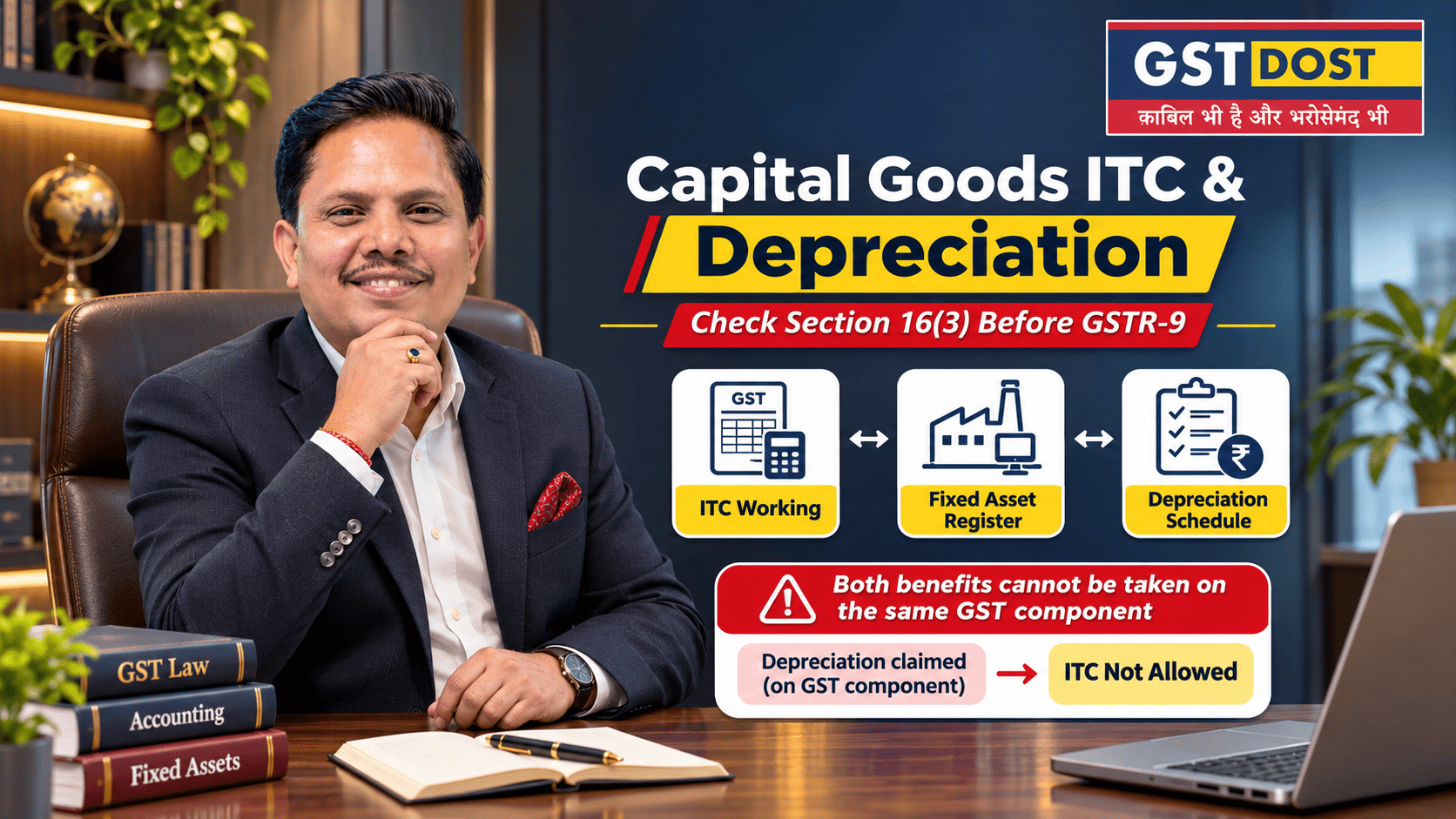
When a business buys a machine, the GST on the invoice can be used in one of two ways. It can be taken as input tax credit (ITC) and set off against the GST on sales. Or it can be added to the cost of the asset, on which depreciation is claimed for income-tax. The law does not allow both on the same tax amount. In practice both sometimes happen, because the GST returns and the asset records are prepared by different people from different registers. The annual return is a good time to put the two side by side.
In simple terms
- Section 16(3) of the CGST Act denies ITC on the GST component of capital goods if depreciation has been claimed on that component under the Income-tax Act.
- GST shown as part of an asset's cost in the books is a warning sign. The legal test is whether income-tax depreciation was actually claimed on it.
- The check needs three records together: the ITC working, the fixed-asset register and the income-tax depreciation schedule.
Why this matters
The amounts are large. One machine can carry more GST than a month of ordinary purchases. And the problem cannot be seen from the purchase register, where the entry looks like any other valid invoice with a valid credit. It appears only when the asset records are opened next to it.
If both benefits were taken, the credit on that tax amount is not allowed. It has to be reversed, with interest where the credit was also used to pay tax.
What the law says
- Capital goods. Section 2(19) of the CGST Act defines them as goods whose value is capitalised in the books of account of the person claiming the credit, and which are used or intended to be used in the course or furtherance of business.
- The either-or rule. Section 16(3) says that where a registered person has claimed depreciation on the tax component of the cost of capital goods and plant and machinery under the Income-tax Act, 1961, ITC on that tax component shall not be allowed.
- Only the tax component. The rule concerns the GST included in the cost. Depreciation on the basic value of the asset is not affected.
Which Income-tax Act? Depreciation for FY 2025-26 is claimed under the Income-tax Act, 1961. That Act continues to govern FY 2025-26, although the Income-tax Act, 2025 came into force on 1 April 2026. For assets bought in later years, read section 16(3) as it stands at that time.
A separate question: is the credit eligible at all?
Section 16(3) is not the only test. An item does not become eligible for credit merely because the accounts call it a capital asset.
- Blocked credits. Section 17(5) blocks credit on certain purchases even when they are capitalised. Clause (c) covers works contract services for construction of immovable property. Clause (d) covers goods or services received for construction of immovable property on the taxpayer's own account. Neither block applies to plant and machinery.
- Plant and machinery. The Explanation to section 17 covers apparatus, equipment and machinery fixed to earth by foundation or structural support and used for making outward supplies, including the foundation and supports. It excludes land, buildings and other civil structures, telecommunication towers and pipelines laid outside the factory premises. The Finance Act, 2025 replaced the words "plant or machinery" in clause (d) with "plant and machinery", with effect from 1 July 2017.
- Mixed use. Under section 17(1) and (2), credit is limited to the part used for business and for taxable supplies. Rule 43 of the CGST Rules gives the method for capital goods.
Three records, four possible results
For each asset bought during the year, compare the ITC working, the cost recorded in the fixed-asset register and the cost on which income-tax depreciation was claimed.
| What the records show | What it means |
|---|---|
| ITC taken. Asset recorded at cost without GST. Depreciation claimed on cost without GST. | Consistent. No conflict under section 16(3). Eligibility under section 17 is still a separate check. |
| ITC not taken. GST added to the asset's cost. Depreciation claimed on the full cost. | Consistent. Confirm that no credit for this invoice has entered GSTR-3B. |
| ITC taken. GST also added to the cost in the books. Income-tax depreciation claimed on cost without GST. | The books need attention, but depreciation was not claimed on the tax component for income-tax. Keep the depreciation computation as evidence. |
| ITC taken. GST added to the cost. Income-tax depreciation claimed on the full cost. | Conflict under section 16(3). The credit on that tax component is not allowed. |
Practical example
A manufacturer buys a machine during FY 2025-26.
| Particulars | Amount |
|---|---|
| Basic value of the machine | ₹10,00,000 |
| GST at 18% | ₹1,80,000 |
| Invoice total | ₹11,80,000 |
| ITC taken in GSTR-3B | ₹1,80,000 |
| Cost in the fixed-asset register | ₹11,80,000 |
| Cost on which income-tax depreciation was claimed | ₹11,80,000 |
| GST component on which both benefits were taken | ₹1,80,000 |
Illustrative figures only.
This is the fourth result in the table above. The depreciation gained on the tax component is small. If the rate is taken as 15% for illustration, it is a deduction of ₹27,000 in the first year. The credit that section 16(3) puts at risk is the whole ₹1,80,000.
If the depreciation schedule filed for income-tax had used ₹10,00,000 in spite of the book entry, the conclusion would be different. That is why the schedule actually filed has to be seen, and not only the ledger.
If a conflict is found
- Confirm the facts. Obtain the depreciation computation that went into the income-tax return, and list the tax component asset by asset.
- Decide which claim to give up, with advice under both laws. Reversing the credit is the direct correction on the GST side. Whether changing the depreciation claim would resolve the matter is a question for the GST adviser and the income-tax adviser together, before anything is filed.
- Reverse correctly. CBIC Circular No. 170/02/2022-GST says that Table 4(B)(2) of GSTR-3B may be used to reverse credit taken in an earlier period by mistake. Payment through FORM GST DRC-03 is the other route. Confirm the route before using it.
- Compute interest where it applies. Under section 50(3), interest is payable where credit has been wrongly availed and utilised. Rule 88B calculates it from the date of utilisation to the date of reversal.
- Do not use GSTR-9 as the correction. GSTN's FAQs say that ITC cannot be claimed through GSTR-9. A reversal made in a GSTR-3B of FY 2025-26 belongs in Table 7 of GSTR-9. Credit of FY 2025-26 reversed in a return of the next year belongs in Table 12.
Where it shows in the annual return
- GSTR-9, Table 6. The credit taken during the year is split between inputs, capital goods and input services. The instructions allow inputs and input services to be shown together, but credit on capital goods has to be shown separately. Notification No. 05/2026-Central Tax has extended these instructions to FY 2025-26 onwards. The capital goods figure should agree with the asset-wise list.
- GSTR-9C, Table 12. This table reconciles the ITC as per the audited financial statements with the ITC in the annual return. A difference caused by GST capitalised in the books will surface here and should be explained.
- GSTR-9C, Table 14. The expense-wise break-up of ITC, which has a row for capital goods, remains optional for FY 2025-26.
Action points
If you own or manage the business
- Ask for one list of assets bought in the year. For each asset it should show the basic value, the GST, whether ITC was taken and the cost on which depreciation is claimed.
- Make both teams work from that list. The person who files the GST returns and the person who prepares the income-tax computation should see the same figures.
- Decide the treatment at the time of purchase. For every asset, the GST is either taken as credit or added to cost. Write the choice into the approval for the purchase.
- Ask about the risky categories. Vehicles, building-related work and assets used for exempt activity need a separate eligibility check.
- Do not sign GSTR-9 with an open conflict. Have the decision on each flagged asset recorded first.
If you prepare or review the returns
- Export the fixed-asset additions ledger, the purchase register and the asset-wise ITC claims for FY 2025-26.
- Match each asset invoice to the supplier's GSTIN, the invoice number, the tax head and the GSTR-3B period in which the credit was taken.
- Compare the cost in the fixed-asset register with the basic value on the invoice, and then with the income-tax depreciation schedule.
- Flag every asset where both ITC and depreciation on the GST component appear to have been claimed.
- Check sections 16 and 17, the use of the asset and rule 43 for each flagged or doubtful item.
- Reconcile the final capital goods credit with GSTR-3B, Table 6 of GSTR-9 and Table 12 of GSTR-9C.
- Record the conclusion asset by asset, with the working for any reversal and interest.
Red flag: The same GST amount appears in the ITC register and in the depreciable cost used for income-tax, and nobody has reconciled the two.
Records to keep: The tax invoice, the link between the invoice and the asset number, the fixed-asset register, the depreciation computation as filed, the GSTR-3B period of the claim, the note on eligibility and the decision taken on each flagged asset.
What you should have at the end: An asset-wise list showing the claims that are supported, the assets where both benefits were taken with the amount involved, and the records that need correction.
Practical takeaway
Do not review GST on capital goods from the purchase register alone. Match it with the fixed-asset register and the income-tax depreciation schedule.
Terms used in this article
- Input tax credit (ITC)
- The credit a registered business takes for GST paid on its purchases, which it sets off against the GST payable on its sales.
- Capital goods
- Goods whose value is capitalised in the books, such as machinery, equipment and furniture, and which are used in the business.
- Fixed-asset register
- The record of each asset owned by the business, with its cost, date of purchase and depreciation.
- Depreciation
- The yearly deduction allowed for the cost of an asset. The income-tax law has its own rates and rules for it.
- Tax component
- The GST included in the cost of an asset, as distinct from its basic value.
- GSTR-3B
- The summary return in which tax is paid and ITC is taken for a tax period.
- GSTR-9 and GSTR-9C
- GSTR-9 is the annual return. GSTR-9C is the self-certified reconciliation statement filed with it by larger taxpayers.
Sources and references
- Central Goods and Services Tax Act, 2017 (India Code, as on 11 June 2026) - sections 2(19), 16(3), 17(1), 17(2) and 17(5) with its Explanation.
- Section 50 of the CGST Act (CBIC) and rule 88B of the CGST Rules (CBIC) - interest on credit wrongly availed and utilised.
- Rule 43, Central Goods and Services Tax Rules, 2017 - input tax credit on capital goods and its reversal in certain cases.
- CBIC Circular No. 170/02/2022-GST dated 6 July 2022 - reporting of reversals in Table 4(B) of GSTR-3B.
- GSTN FAQs on FORM GSTR-9 - ITC cannot be claimed through the annual return.
- GSTN FAQs on GSTR-9 and GSTR-9C - Tables 7 and 12 of GSTR-9, and Table 12 of GSTR-9C.
- Notification No. 05/2026-Central Tax dated 26 October 2026 (Gazette copy) - instructions for Tables 6B to 6D of GSTR-9 and Table 14 of GSTR-9C extended to FY 2025-26 onwards.
- CBDT press release dated 1 April 2026 - the Income-tax Act, 2025 in force from 1 April 2026.
Disclaimer: This article is for general information only and reflects the position as understood on the review date mentioned above. It is not legal advice and does not create a professional relationship. Whether credit on a particular asset is allowed, and how a conflict between a credit claim and a depreciation claim should be corrected, depends on the facts, the documents and the law applicable to each case, including the income-tax law. Figures in the example are illustrative. Please obtain professional advice before acting on this article.
GST DOST | GST Annual Return, Reconciliation and Technology-led Review

Related posts
Could a GST Officer Turn ‘Can’ Into ‘Must’? The ₹53.36 Crore Solar Case...
Duplicate ITC Claims: An Excel Power Query Test to Run Before GSTR-9...
Export IGST Refund Not Moving? Check the Export Ledger on the GST Portal Before Blaming Customs...
Capital Goods ITC and Depreciation: Check the Fixed-Asset Register Before GSTR-9...
