


Namaste DOST,
If a GST circular says you “can” use a formula, who gets to choose — you or the officer who has to follow the circular? Sterling and Wilson faced that question when an officer applied a 70:30 split to its old solar contracts. The demand came to ₹53.36 crore in tax and penalties.
The Supreme Court held that the choice belonged to the taxpayer. For the solar supplies in this case, made from 1 July 2017 to 31 December 2018, the officer could not insist on treating 70% of the price as goods and 30% as services. The Court set aside the demand. (paras 2, 6, 16–17, 33 and 40)
The officer saw a solar plant fixed to the ground. The Court recorded a narrower fact as undisputed. The panels could come off their concrete base and be used elsewhere. What, then, was permanently fixed? (paras 18 and 35–36)
Who was the word “can” written for?
Sterling and Wilson supplied and installed solar power generating systems under engineering, procurement and construction (EPC) contracts. The customer bought a system ready to work. The original goods entry, serial number 234, covered the whole system. The company paid 2.5% central GST and 2.5% state GST. (paras 6–9 and 18)
Notification 24/2018–Central Tax (Rate) added the 70:30 valuation rule to goods entry 234. Notification 27/2018–Central Tax (Rate) added service entry 38, carrying 9% central tax and referring back to entry 234. Both took effect on 1 January 2019. The new split had no compulsory retrospective effect. (paras 11–13 and 33)
At its 45th meeting on 17 September 2021, the GST Council considered a request to use the split for earlier supplies. CBIC Circular 163/19/2021-GST of 6 October 2021 gave taxpayers that option. The notice of 29 March 2023 treated it as compulsory. The Court rejected that reading. (paras 14–17 and 33)
Section 168 required officers to follow the Board’s directions. The Court then identified the taxpayer as the holder of the option in this circular. (paras 16–17)
GST DOST’s reading. In a reply, ask two questions separately. Who must follow the direction, and who is allowed to exercise the choice? Cite the words that identify each.
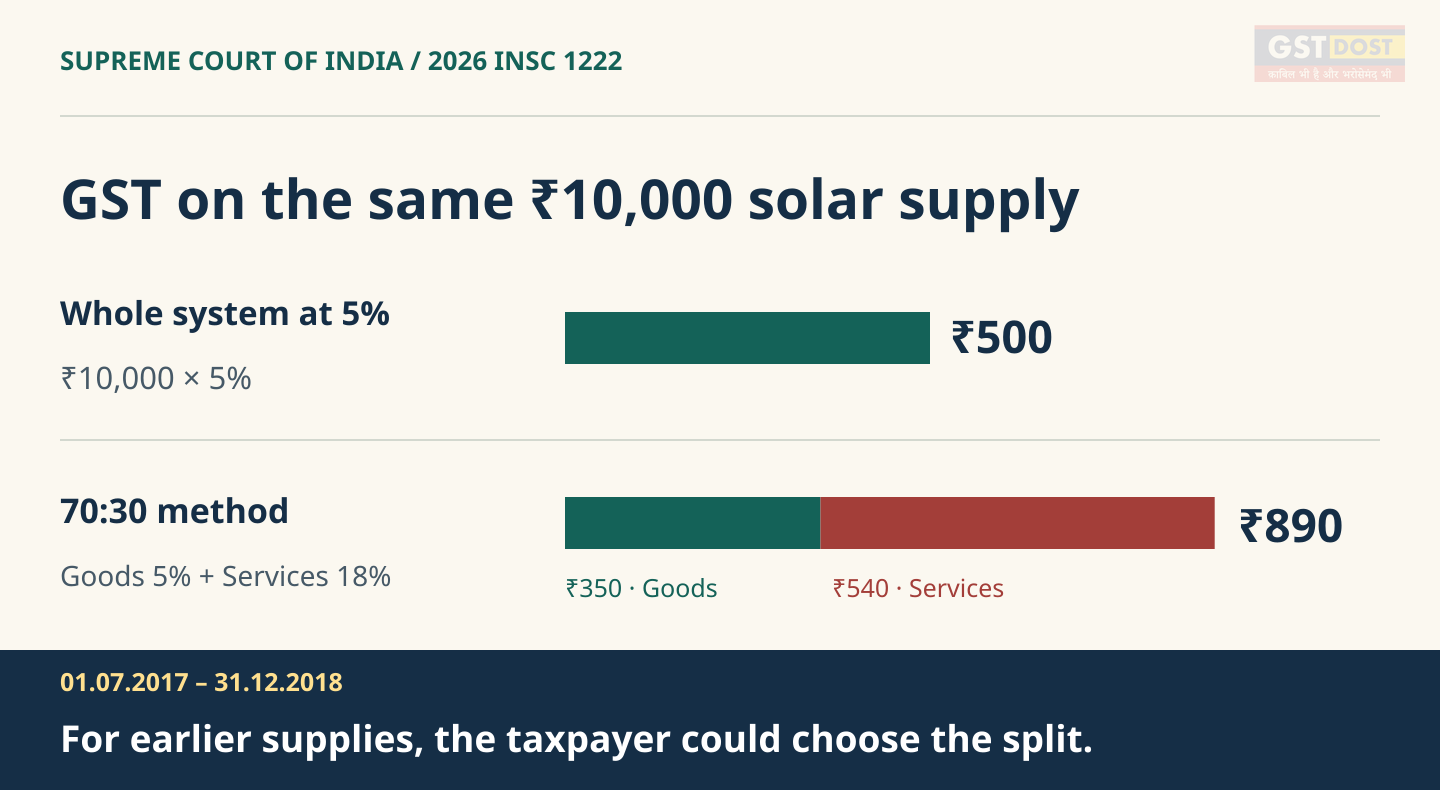
Why did the same ₹10,000 produce ₹500 or ₹890 in GST?
The Court used a ₹10,000 supply to show the difference. At 5% on the whole system, the GST came to ₹500. Under the split, tax on ₹7,000 of goods came to ₹350. Tax on ₹3,000 of services at 18% added ₹540. The total rose to ₹890. The extra ₹390 explains why applying the formula to an earlier year mattered. These were the rates in the Court’s historical example.
Paragraph 2 gives the figures by tax head. CGST of ₹13,33,95,241 plus its penalty came to ₹26,67,90,482. The equivalent SGST and penalty brought the combined demand to ₹53,35,80,964. The ₹10,000 above is the Court’s worked example.
GST DOST’s practice point for a CFO. Reconcile the tax and the penalty to separate lines in the demand schedule before briefing the board.
The circular also addressed taxpayers who had already paid more than the split would produce. Paragraph 13.3 ruled out a refund of that excess. Sterling and Wilson challenged a demand. The Court set the orders aside without deciding a refund claim. (circular para 13.3 and judgment paras 2, 15 and 40)
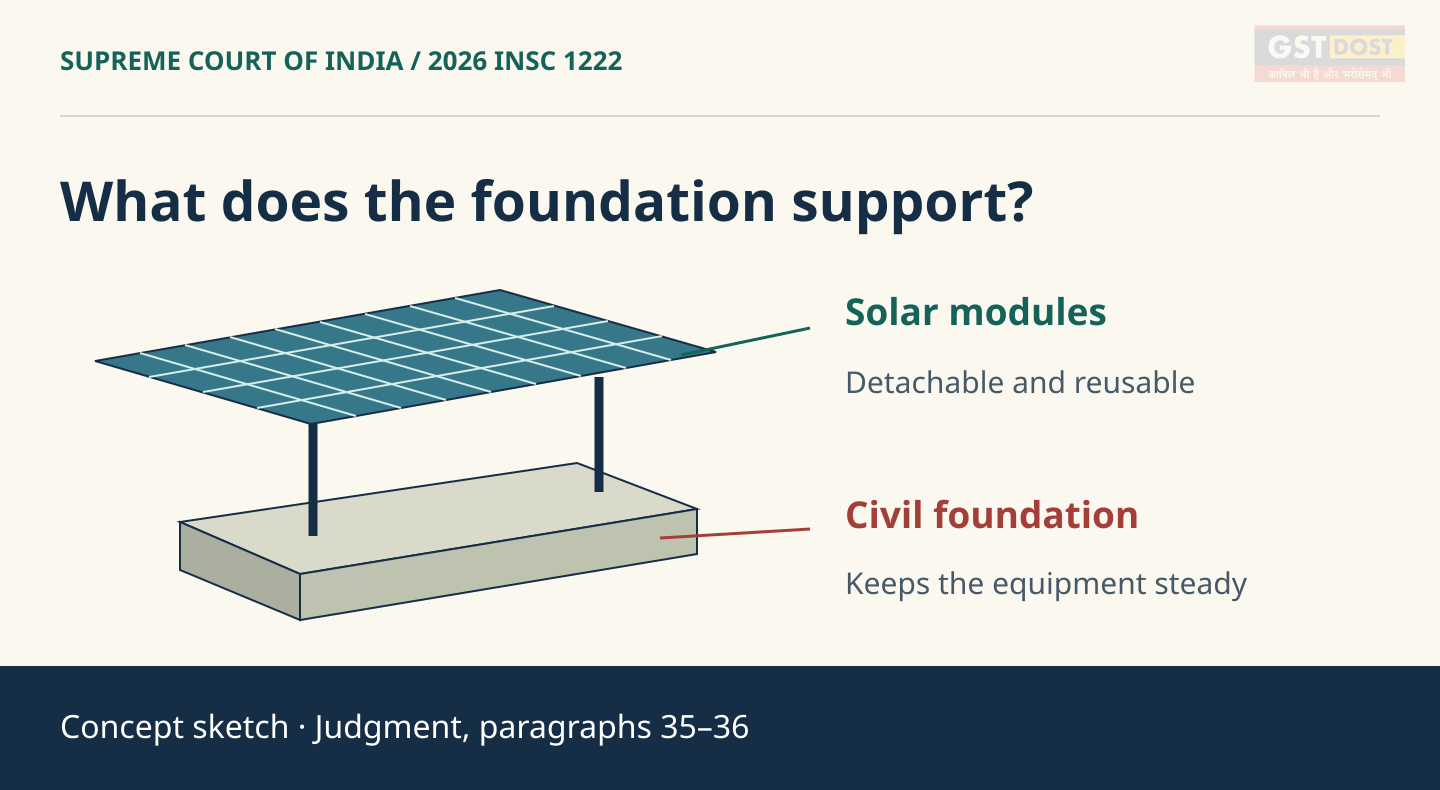
What did the concrete foundation actually do?
The officer pointed to the foundations, cable trenches and other civil work. For a works contract under Section 2(119), the work must concern immovable property as its end product. An agreement may bundle goods and installation under Section 2(30) and still produce equipment that can be moved.
The Court recorded that the modules could be detached and reused elsewhere, a fact that was undisputed. The concrete kept them steady. The Court approved the Andhra Pradesh High Court’s reasoning in the company’s earlier case and rejected the works-contract classification on these facts. The Revenue had left that earlier decision unchallenged, so it had attained finality. (paras 28 and 35–36)
The Revenue relied on the Madhya Pradesh High Court’s Rudraksha Allied Chemicals decision. That case concerned a tender policy. The Supreme Court explained why its setting and facts did not answer the classification question for this solar plant. (para 32)
A question for the project engineer. If the system came off the base tomorrow, what could the customer install at another site? Ask the engineer to mark those parts on the drawing. If removal would destroy the equipment, one of the facts that mattered to the Court has changed. (GST DOST’s
Could declining an option amount to suppression?
The officer alleged deliberate misstatement and suppression, invoked Section 74 for the extended period and cited Section 122(2)(b) for penalties. The Court held that failing to use the later, optional split for earlier supplies could not support those allegations. Citing Tata Steel, it explained that the notice must disclose the facts behind an allegation of fraud, wilful misstatement or suppression.
Why did the Supreme Court decide the appeal itself?
The Bombay High Court dismissed the writ petition because a statutory appeal was available. On appeal, the Supreme Court held that the High Court should have considered the arguable issues. The Supreme Court had stayed the 17 January demand order on 25 August 2025. (paras 2–5)
Ordinarily, the Supreme Court would have sent the matter back to the High Court. It decided the merits itself because counsel had argued them fully and the Andhra Pradesh High Court had already decided the issue. These were the reasons for taking that course on this appeal.
Before you cite Sterling and Wilson, check these four records
On your own file, start where the ₹390 difference started. Put the supply date beside the officer’s calculation. For the separate works-contract question, ask the engineer to mark what can be detached and reused on the project drawing.
Bring those two records and the notice to your review with GST DOST.
here to find the holding
M/s. Sterling and Wilson Pvt. Ltd. v. Union of India and others, 2026 INSC 1222, Supreme Court of India, 16 November 2026, arising out of SLP (C) No. 23844 of 2025. Bench: Sanjay Kumar and Sanjeev Sachdeva JJ. Cite paragraphs 17 and 33 for the taxpayer’s option, 34 for Section 74, 35–36 for detachability and 40 for the relief.
The Court set aside the 17 January 2025 demand order and the 24 January 2025 summary. The combined tax and penalties were ₹53,35,80,964. (paras 2 and 40)
For the historical rate change, see Central Tax (Rate) Notifications 24/2018 and 27/2018, both dated 31 December 2018, set out in paragraphs 11–13. For the option and refund condition, see CBIC Circular 163/19/2021-GST of 6 October 2021, paragraph 13.3.
One date to check before quoting. Paragraph 33 prints 1 January 2017. Paragraphs 6, 15 and 17 and circular paragraph 13.3 identify 1 July 2017 as the start of the period. A separate 2021 amendment removed “system” from the goods entry. The Court explained why that change could not govern these earlier supplies. (paras 37–38)
Sterling and Wilson Pvt. Ltd. v. Joint Commissioner, State Tax, Vijayawada, 2025 (95) G.S.T.L. 402 (A.P.), decided 10 January 2025. Earlier litigation involving the same taxpayer. (paras 19 and 28)
Bharti Airtel Ltd. v. Commissioner of Central Excise, Pune, (2024) 19 SCC 1. Paragraph 29 traces six tests through the Andhra Pradesh wind-turbine case: how and why the item is fixed, the parties’ intention, its function, the permanence of the attachment and whether it can be removed and sold.
Siemens Gamesa Renewable Power Pvt. Ltd. v. Assistant Commissioner ST, Kavali Circle, 2025 (12) TMI 1888 (A.P.). The High Court applied the tests to wind turbines. The Supreme Court later declined to interfere in Assistant Commissioner, ST v. Siemens Gamesa Renewable Power Pvt. Ltd., 2026 (8) TMI 847 (SC). (paras 29–30)
Arka Green Power Pvt. Ltd. v. State of Andhra Pradesh, W.P. No. 11989 of 2022 and batch, decided 24 December 2025 (A.P.). The High Court followed its earlier solar ruling for supplies including pumping systems in July 2017–December 2018. (para 31)
Rudraksha Allied Chemicals Pvt. Ltd. v. Ordnance Factory, Itarsi, W.P. No. 29929 of 2025, decided 22 May 2026 (M.P.). Distinguished in para 32. Tata Steel Ltd. v. Union of India, 2026 (8) TMI 1587 (SC). Cited in para 34 on what the notice must disclose.

Related posts
One Head Office Pays for Services Used by Several Branches. Who Can Claim the GST Input Tax Credit?...
Rule 42 Annual True-Up: The September Date Has Passed, but the GSTR-9 Review Has Not...
Stock Transfers Between Two GSTINs: Match Dispatch and Receipt Before GSTR-9...
GSTR-9 Table 8C Is Not a Reclaim Register: Getting Tables 8A, 8C and 13 Right...
