


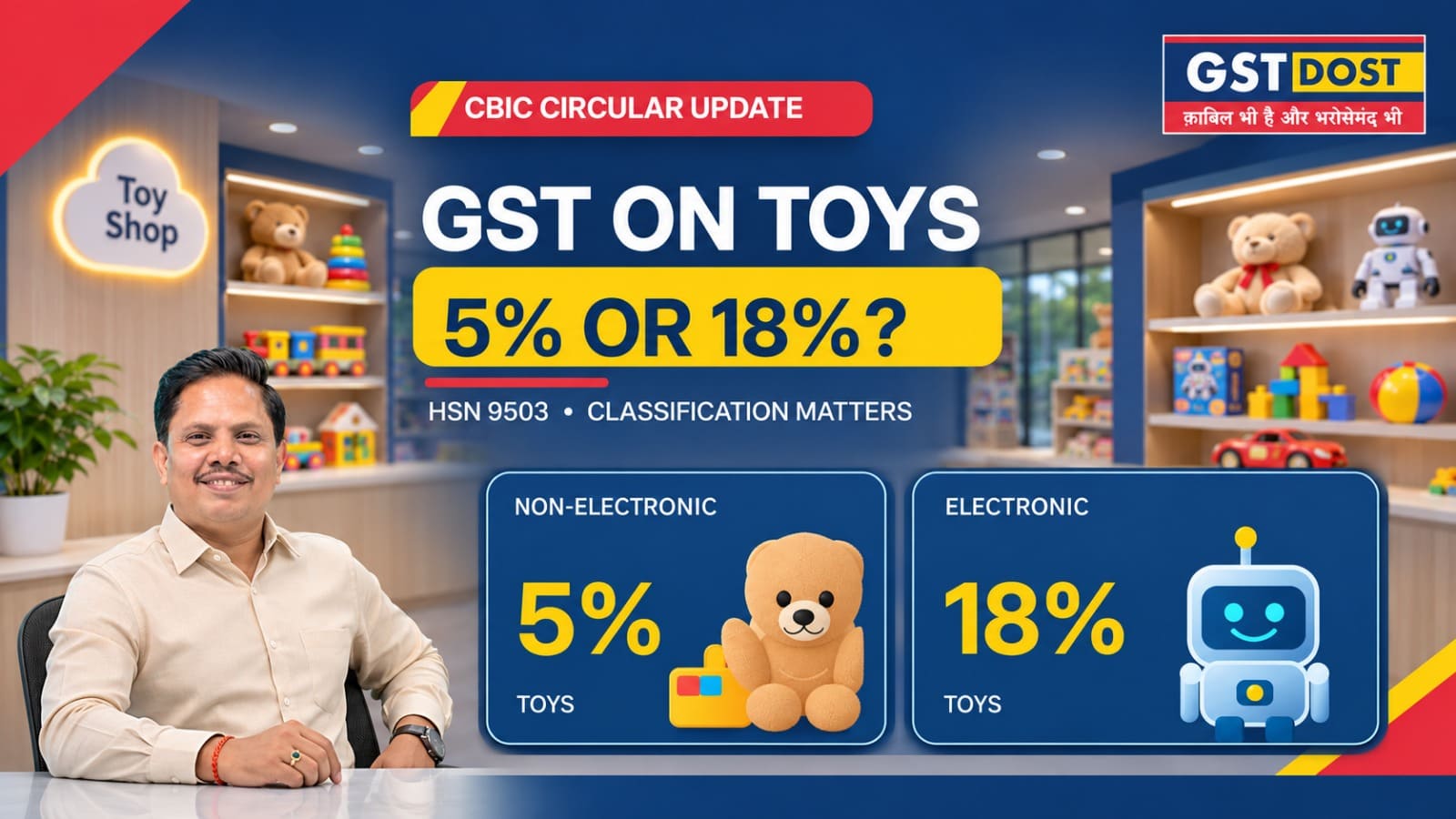
CBIC has clarified that the GST rate entries for toys are not limited to tricycles, scooters and pedal cars. They extend to the other categories of toys covered by Heading 9503 of the Customs Tariff, such as dolls, scale models and puzzles. This article explains what the clarification says, what it does not say, and what toy businesses and their advisors should check now.
The clarification is contained in Paragraph 2 of CBIC Circular No. 265/11/2026-GST dated 28 October 2026, issued under section 168(1) of the CGST Act, 2017 on the recommendations of the GST Council in its 57th meeting held on 8 October 2026. The same Circular also deals with sublimation paper, the margin scheme for old and used motor vehicles, and sea-weed extract based bio-stimulants. This article covers only the portion on toys.
Key takeaways
- The toy entries in Notification No. 09/2025-Central Tax (Rate) use the words "like tricycles, scooters, pedal cars etc.". The Circular clarifies that "etc." refers to all other categories of toys in Heading 9503 (Para 2.4).
- Non-electronic toys covered by Schedule I, S. No. 497 attract 5% GST. Electronic toys covered by Schedule II, S. No. 616 attract 18% GST (Para 2.2).
- The Circular does not introduce a new rate or a new effective date. It explains the scope of entries that have applied from 22 September 2025.
- The toy portion of the Circular does not contain any "as is where is" regularisation of past periods. That language appears only in the paragraphs on sublimation paper (Para 1.3) and sea-weed bio-stimulants (Para 4.3).
- The electronic / non-electronic distinction, and the question whether a product falls in Heading 9503 at all, still have to be decided product by product.
1. The two rate entries in question
Paragraph 2.2 of the Circular reproduces the two entries of Notification No. 09/2025-Central Tax (Rate) dated 17 September 2025:
| Entry | Description (as reproduced in Para 2.2 of the Circular) | GST rate |
|---|---|---|
| Schedule I, S. No. 497 | Toys like tricycles, scooters, pedal cars etc. (including parts and accessories thereof) [other than electronic toys] | 5% |
| Schedule II, S. No. 616 | Electronic Toys like tricycles, scooters, pedal cars etc. (including parts and accessories thereof) | 18% |
The Central Tax notification prescribes the CGST portion (2.5% under Schedule I and 9% under Schedule II). The total rates of 5% and 18% apply through the corresponding State Tax (Rate) notifications for intra-State supplies and Notification No. 09/2025-Integrated Tax (Rate) for inter-State supplies. Both entries also cover parts and accessories of the toys concerned.
2. What was the confusion?
Representations were received asking whether all toys classifiable under Heading 9503 are covered by these two entries, or only toys similar to the named examples, namely tricycles, scooters and pedal cars (Para 2.1).
The Circular records that the wording of the notification was being read restrictively by certain field formations. Toys not expressly named in the entry were being excluded, which led to ambiguity and inconsistent tax treatment (Para 2.3). In practice, the question was whether a doll, a puzzle or a scale model under Heading 9503 could be denied the toy entry merely because it is not a wheeled toy.
3. What the Circular clarifies
The categories listed in Para 2.4 follow the description of Heading 9503 itself. The result is that a product correctly classified under Heading 9503 falls within one of the two toy entries: S. No. 497 (5%) if it is not an electronic toy, or S. No. 616 (18%) if it is an electronic toy.
4. What the Circular does not say
Several summaries in circulation go further than the Circular. Before relying on it, note its limits:
The Circular does
- Clarify that the two entries cover all categories of toys under Heading 9503.
- Name dolls, dolls' carriages, other toys, scale and recreational models (working or not) and puzzles of all kinds.
- Instruct Central Tax field formations to act accordingly (Para 5).
The Circular does not
- Define what an "electronic toy" is.
- Say that every product sold in a toy shop falls under Heading 9503.
- Change any rate or create a new effective date.
- Regularise past periods on an "as is where is" basis for toys.
- Address refunds, credit notes or pending proceedings.
Caution: Do not quote the "as is where is" regularisation for toys. In Circular No. 265/11/2026-GST, that wording appears only for sublimation paper and sea-weed extract based bio-stimulants. Relying on it for a toy dispute would weaken an otherwise sound reply.
Also note that the Circular is addressed to the Central Tax field formations. Where a taxpayer is administered by the State GST department, check whether a corresponding State circular or instruction has been issued, and cite it alongside the CBIC Circular.
5. Product-wise position at a glance
| Product category | Position after the Circular | What to verify |
|---|---|---|
| Non-electronic toys under HSN 9503 | Schedule I, S. No. 497 - 5% | That the product is correctly classified under 9503 and is not an electronic toy |
| Electronic toys under HSN 9503 | Schedule II, S. No. 616 - 18% | Technical features showing the product is an electronic toy |
| Dolls and dolls' carriages | Covered by the toy entries (Para 2.4) | Electronic or non-electronic, based on actual features |
| Scale models and similar recreational models, working or not | Covered by the toy entries (Para 2.4) | Electronic or non-electronic; confirm 9503 and not another heading |
| Puzzles of all kinds under 9503 | Covered by the toy entries (Para 2.4) | That the product is a puzzle under 9503 |
| Parts and accessories of the above toys | Included in the wording of both entries | Whether the part or accessory is of a toy covered by the entry |
| Board games, video game products, playing cards, sports goods, decorative or educational articles | Not addressed by the Circular | Classify separately; these may fall under other headings with their own rate entries |
A battery-operated or "smart" product should not be classified only from its marketing description. Examine its technical characteristics, the manufacturer's specifications and the tariff description before fixing the rate.
6. A simple illustration
Consider a toy wholesaler that sells two dolls, both classifiable under Heading 9503:
- Product A: an ordinary doll with no electronic features. It falls under Schedule I, S. No. 497 at 5%.
- Product B: a doll that is an electronic toy. It falls under Schedule II, S. No. 616 at 18%.
Both are dolls, but the rate differs. The Circular settles that a doll is not excluded from the toy entries merely because it is not a wheeled toy. It does not decide which of the two entries applies to a given doll. That depends on the product's actual characteristics. This is a hypothetical illustration and not an assessment of any particular product.
7. Is this a new rate effective from 28 October 2026?
No. The rate entries are contained in Notification No. 09/2025-Central Tax (Rate) dated 17 September 2025, which came into force on 22 September 2025. The Circular dated 28 October 2026 explains the scope of those entries. It is not an amendment to the rate notification.
Keep three things separate in your records and replies:
- The rate notification (in force from 22 September 2025).
- The CBIC Circular that interprets it (dated 28 October 2026).
- Any later notification that actually amends a rate entry. Always check the notification as amended up to date.
8. Action points for business owners
For toy manufacturers, importers, wholesalers, distributors, online sellers and retailers:
- Review FY 2025-26 sales before 30 November 2026.Urgent
If, after review, you find that tax was charged at a higher rate than payable on any supply, the time for declaring a GST credit note is limited. Under section 34(2) of the CGST Act, a credit note must be declared not later than 30 November following the end of the financial year of the supply, or the date of filing the annual return, whichever is earlier. For supplies made in FY 2025-26, that is 30 November 2026 (or earlier if GSTR-9 is filed before that). Decide with your GST advisor whether a credit note is appropriate; it is not automatic. - List every product you treat as HSN 9503.This week
Pull the SKU list from your ERP or billing software. Mark each item as 9503 or "other heading", and as electronic or non-electronic. - Add an "electronic toy: Yes / No" flag in the item master.This week
The rate depends on this distinction. Make it a mandatory field for new SKUs so that the rate is not chosen by product name alone. - Re-check dolls, puzzles and scale models.This week
These are the categories most likely to have been treated inconsistently. Confirm the heading and the electronic / non-electronic status of each. - Match your rate with your suppliers' rate.Ongoing
Compare the HSN and rate on purchase invoices with your own sales invoices for the same product. Where they differ, find out why before the next billing cycle. - Align every place where HSN appears.Ongoing
Item master, tax invoices, e-invoices, e-way bills, marketplace listings and GSTR-1 should all show the same classification for the same product. - Keep a product evidence file.Ongoing
Specifications, photographs, packaging, manuals and manufacturer declarations support your classification if an officer questions it later. - Check your input tax credit position.Ongoing
Where outward supplies are at 5% and inputs carry a higher rate, credit may accumulate. Ask your advisor whether an inverted duty structure refund is available, subject to section 54(3), the prescribed formula and any notified restriction. - Name one responsible person.Ongoing
One person should own unclear products, collect specifications from the procurement team and close each item with the GST advisor.
9. Action points for GST professionals
For Chartered Accountants, advocates, tax practitioners and in-house tax teams advising toy businesses:
- Use Paras 2.3 and 2.4 in pending matters.
Where an SCN, audit observation, scrutiny notice or order has denied the toy entry to a doll, puzzle or scale model only because it is not a wheeled toy, cite Paras 2.3 and 2.4, and Para 5, which instructs field formations accordingly. Check whether the State has issued a corresponding instruction where the matter is with State GST. - Do not overstate the Circular.
It settles the scope of the entries, not the electronic / non-electronic question and not the heading. Where the department disputes either of those, the reply needs product evidence, not only the Circular. - Do not cite "as is where is" for toys.
That regularisation is limited to Paras 1.3 and 4.3 of the Circular. Quoting it for toys is an avoidable error. - Evaluate correction routes for excess tax with care.
For excess tax charged on non-electronic 9503 toys, consider the section 34(2) time limit (30 November 2026 for FY 2025-26 supplies), the recipient's corresponding ITC reversal, and, where a refund route is considered instead, the principle of unjust enrichment. Advise the client before the deadline, not after. - Quantify short payment where an electronic toy was billed at 5%.
Identify the products, periods and differential tax, and advise on voluntary payment with interest where the classification is clearly 18%. Keep the working on file. - Check the heading first, then the rate.
Board games, video game products, sports goods, decorative and educational articles may fall outside Heading 9503. Apply the rate entry only after the heading is settled. - Consider an advance ruling for high-volume, genuinely uncertain products.
Where a large product line turns on the electronic / non-electronic question, an advance ruling under section 97 may give the client certainty for future supplies. - Document the review.
Record the sample selected, the evidence examined, the conclusion for each product and the reason. A documented review is easier to defend than an undocumented change of rate.
10. Five-minute self-check
Ask your finance or product manager to answer YES, NO or NOT SURE:
| # | Question | Response |
|---|---|---|
| 1 | Have our major toy products been assigned a verified HSN heading? | |
| 2 | Have we identified the products that actually fall under HSN 9503? | |
| 3 | Have electronic and non-electronic toys been separately identified? | |
| 4 | Are dolls, puzzles and scale models mapped to the correct entry? | |
| 5 | Do supplier invoices support the classification we have adopted? | |
| 6 | Is our ERP / item master consistent with our sales invoices and e-invoices? | |
| 7 | Have our rates been checked against the notification as amended up to date? | |
| 8 | Are goods falling under other headings separately identified? | |
| 9 | Have FY 2025-26 supplies been reviewed before the 30 November 2026 time limit? | |
| 10 | Is one person responsible for resolving uncertain products? |
A NO or NOT SURE does not by itself mean tax has been short paid or overpaid. It marks an item for verification.
11. Documents to keep ready
- Product catalogue and SKU master: names, descriptions, HSN and GST rate.
- Product specifications: manufacturer information, photographs, technical features, packaging and instructions showing the product's actual nature.
- Purchase invoices: HSN and rate adopted by suppliers.
- Sales invoices and e-invoices: descriptions, product codes, HSN and GST charged.
- ERP rate-mapping records: the current mapping used in billing and inventory.
- Return records: relevant GSTR-1 and GSTR-3B details.
- Earlier classification work: any previous HSN review, correction or departmental communication.
- Exception sheet: products still to be confirmed, the person responsible and the next step.
Not every document is needed for every review. The evidence required depends on the product and the scope of the review.
12. What if you find a difference?
| Situation | Suggested next step |
|---|---|
| A doll, puzzle or model was kept out of the toy entry only because it is not a wheeled toy | Re-examine it under Heading 9503 and Para 2.4 of the Circular. |
| An electronic toy was billed at 5% | Verify whether it is an electronic toy covered by S. No. 616 (18%). If so, quantify the differential and take professional advice on regularising it. |
| A non-electronic 9503 toy was billed at 18% | Confirm the classification, correct the rate for future supplies, and evaluate the credit note option within the section 34(2) time limit. |
| The product description is unclear | Obtain genuine specifications from the manufacturer before finalising the rate. |
| The ERP applies different rates to similar products | Check whether there is a legally relevant difference in their characteristics or heading. |
| Historical transactions look inconsistent | Identify the periods, products, invoices and applicable law. Do not issue retrospective corrections or promise refunds without a reviewed position. |
13. Official sources
- CBIC Circular No. 265/11/2026-GST dated 28 October 2026 (F. No. CBIC-190354/142/2026-TRU), Paragraphs 2.1 to 2.4 and 5. Available on the CBIC portals: cbic-gst.gov.in and taxinformation.cbic.gov.in (Circulars section).
- Notification No. 09/2025-Central Tax (Rate) dated 17 September 2025, in force from 22 September 2025: Schedule I, S. No. 497 and Schedule II, S. No. 616. The text of both entries is reproduced in Para 2.2 of the Circular.
- Notification No. 09/2025-Integrated Tax (Rate) dated 17 September 2025 for inter-State supplies, and the corresponding State Tax (Rate) notification of the relevant State for intra-State supplies.
- Heading 9503, First Schedule to the Customs Tariff Act, 1975, which the GST rate entries follow for classification.
- Section 34 of the CGST Act, 2017 for credit notes and their time limit.
Scope of this article: the toy entries have been read from the Circular, which reproduces them. Product-specific classification, individual ERP systems and historical invoices have not been examined. Readers should check the rate notification as amended up to date before applying it.
One small step for today: ask your accounts team to pick one non-electronic toy, one electronic toy and one puzzle from the product master. Check the heading, the rate entry, the sales invoice and the purchase invoice for each. If all three line up, extend the same check to the rest of the catalogue.
Need help with a toy classification review?
GST DOST offers a focused GST Toy Product Classification and HSN Health Check for manufacturers, importers, distributors and retailers. The review covers:
- A selected sample of products and their technical characteristics
- HSN mapping in the item master, invoices, e-invoices and returns
- Electronic / non-electronic classification and the applicable rate entry
- Exposure or correction options for past periods, including time-limited steps
The objective is a legally supportable classification and a clear list of genuine differences. We do not promise tax savings or refunds.
Disclaimer: This article is for general information only and reflects the position as understood on the review date mentioned above. It is not legal advice and does not create a professional relationship. GST classification depends on the facts of each product. Please obtain professional advice before acting on this article.
GST DOST | GST Product Classification, HSN Review and Professional Advisory

Related posts
Two GST Deadlines for FY 2025-26: Review Input Tax Credit Before Filing the Annual Return...
Dolls, Puzzles and Toy Cars: Is Your Business Applying the Correct GST Rate of 5% or 18%?...
ITC on Demo Vehicles under the Dealer-Agency Model: What CBIC Circular 262/08/2026-GST Changes for Automobile Dealers...
Export of Services: Can Payments Received in Indian Rupees or Through Set-off Qualify Under GST?...
