


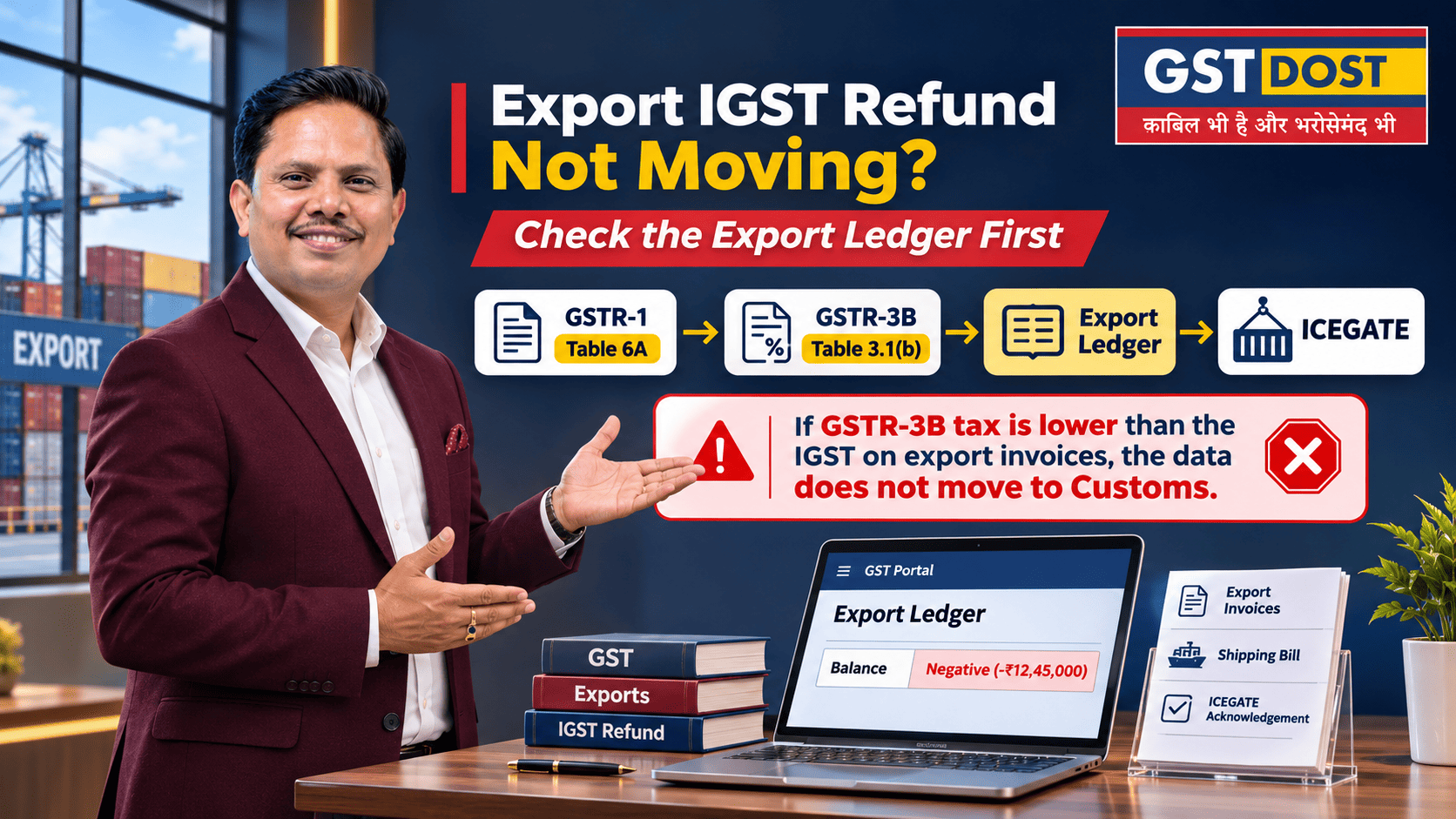
An exporter who pays integrated tax (IGST) on exported goods does not file a separate refund application. The shipping bill is treated as the application, and the refund is paid through the Customs system after the GST portal sends it the invoice data. When the money does not arrive, the first suspicion usually falls on Customs or the bank. Often the data never left the GST portal, because the tax shown for exports in GSTR-3B was lower than the tax on the export invoices in GSTR-1. The portal has a screen that shows exactly this. It is called the Export Ledger.
In simple terms
- The GST portal sends export invoices to ICEGATE, the Customs system, only when the total IGST in Table 3.1(b) of GSTR-3B is at least equal to the IGST on export and SEZ invoices in GSTR-1.
- The running difference between the two is the Export Ledger balance. If it is negative, no eligible invoice is sent.
- A negative balance is a reporting difference that has to be traced. It does not by itself prove that more tax is payable.
Why this matters
A stuck refund is working capital locked up. Time is lost when the exporter follows up with the wrong office. A refund held on the GST portal cannot be released by Customs, and a refund held for a missing export manifest cannot be released by amending a GST return.
It is also an annual return matter. The same GSTR-1 and GSTR-3B figures give the export turnover and tax reported in GSTR-9. A difference found in the Export Ledger usually means that one of those figures needs a second look.
Which exporters this concerns
Under section 16 of the IGST Act, exports are zero-rated supplies. An exporter can work in one of two ways:
- Without payment of tax, under a letter of undertaking (LUT) or bond, and claim a refund of unutilised input tax credit by application.
- On payment of IGST, and get that IGST back.
This article is about the second way, for goods. Two limits on it are worth knowing:
- Since 1 October 2023, the IGST-paid route is open only to the persons and supplies notified under section 16(4). Notification No. 01/2023-Integrated Tax notifies all goods and services, except a list of excluded goods.
- Section 16(5), in force from 1 November 2024, bars the refund where the exported goods are subject to export duty.
How the refund travels
- The exporter reports each export invoice, with the shipping bill details, in Table 6A of GSTR-1.
- The IGST on those invoices is shown in Table 3.1(b) of GSTR-3B, the row for zero-rated outward supplies, and paid.
- The GST portal validates the data and sends the invoices to ICEGATE.
- The Customs system matches them with the shipping bill and the export manifest. Under rule 96 of the CGST Rules, the shipping bill counts as a refund application only when the export manifest has been filed and a valid GSTR-3B has been furnished. If the shipping bill and GSTR-1 do not match, the application is treated as filed only when the mismatch is rectified.
- The refund is credited to the exporter's bank account.
A refund can stop at step 3, inside the GST portal, or at steps 4 and 5, with Customs or the bank. Each has a different cause and a different person who can fix it.
The Export Ledger
Path on the GST portal: Services > Refunds > Track status of invoice data to be shared with ICEGATE > View Export Ledger. No tax period has to be selected.
| Item | What GSTN's manual and FAQs say |
|---|---|
| Credit side | IGST and cess from Table 3.1(b) of GSTR-3B. |
| Debit side | IGST and cess on export and SEZ invoices in Tables 6A, 6B and 9A of GSTR-1 and GSTR-1A. |
| Balance | Credits less debits, added up across all return periods. It is shown as Net IGST Balance and Net Cess Balance. |
| If negative | The portal does not send any eligible invoice to ICEGATE. |
| Downloads | The ledger and a period-wise break-up can be downloaded as CSV files. On the tracking screen, Download Failed Invoices gives the validation error for each invoice that was not sent. |
| Quarterly filers | Select the last month of the quarter on the tracking screen. |
Note what the debit side includes. Supplies to SEZ in Table 6B and amendments in Table 9A are counted along with the export invoices in Table 6A. The ledger is therefore wider than the goods exported through a port, and an error in any of these tables can pull the balance down.
Practical example
An exporter's returns for May 2025 show the following.
| Particulars | IGST |
|---|---|
| IGST on export invoices in Table 6A of GSTR-1 (debit) | ₹5,00,000 |
| IGST shown in Table 3.1(b) of GSTR-3B (credit) | ₹4,40,000 |
| Export Ledger balance, if there are no other entries | (-) ₹60,000 |
Illustrative figures only.
While the balance stays negative, the invoices wait on the GST portal. The exporter should not be told to pay ₹60,000 merely because two totals differ. First find the cause.
| Possible cause | What to check |
|---|---|
| The IGST on exports was paid, but shown in another row of Table 3.1 of GSTR-3B. | The GSTR-3B of that month, row by row. The tax may be fully paid and only wrongly placed. |
| The GSTR-1 figure is too high. | A wrong tax amount in Table 6A, or an export made under LUT reported as an export with payment of tax. |
| The invoice and the tax fell in different months. | Whether the tax was shown in the GSTR-3B of a later period. The balance then corrects itself. |
| The tax was really paid short. | The payment record. Only in this case is there an amount to pay. |
How a difference is corrected now
- Shortfall in Table 3.1(b). GSTN's FAQs say that the deficiency should be taken care of in the next return, in GSTR-1 or GSTR-1A and GSTR-3B. The invoices are validated again in the next cycle and sent to ICEGATE once the deficiency is cleared.
- Invoice-level errors. Where the shipping bill or port details are missing or wrong, or ICEGATE has rejected an invoice, the FAQs say the invoice can be amended in Table 9A of a later GSTR-1. It is then validated again.
- The route starts from GSTR-1. GSTN announced in its advisory of 7 June 2025 that, from the July 2025 tax period, the liability auto-populated in GSTR-3B from GSTR-1, GSTR-1A and IFF cannot be edited. A correction therefore has to be made in GSTR-1 or GSTR-1A, from where it flows into GSTR-3B.
- Older differences. A negative balance carried from an earlier period may not be correctable in the way it once was. Prepare the period-wise working and take advice. ICEGATE's FAQs point to the GSTN helpdesk for data that has not been sent from the GST portal.
Time limit: Errors in the details of FY 2025-26 can be rectified through GSTR-1 only in returns filed by 30 November 2026, or before the annual return for the year is filed, whichever is earlier.
If the data has reached Customs
Once the invoices are sent, the status is on ICEGATE under Enquiries, in IGST Validation Enquiry and IGST Scroll Sanctioned Status. ICEGATE's FAQs explain the codes.
| Code | Meaning | Who acts |
|---|---|---|
| SB000 | Successfully validated. | Nobody. See the note below if no refund comes. |
| SB001 | Invalid shipping bill details. The shipping bill number, date and port code in the invoice sent by the GST portal do not match the shipping bill. | The exporter, by amending the invoice details in GSTR-1. |
| SB002 | Export manifest (EGM) not filed. | The shipping line, airline or carrier. |
| SB003 | GSTIN mismatch. | The exporter. Check the GSTIN used on the shipping bill. |
| SB004 | Record already received. | Usually nobody, if the earlier record is SB000. |
| SB005 | Invalid invoice number. | The exporter. Compare the invoice number in GSTR-1 with the shipping bill. |
| SB006 | Gateway EGM not available. | The carrier, and Customs at the gateway port if needed. |
SB000 but no refund: ICEGATE's FAQs give these reasons: the export was under LUT or bond, the refund amount is below ₹1,000, or the bank account is not validated with PFMS. They also say that a refund is held while the exporter's IEC is suspended or under alert.
The link with GSTR-9
- Table 4 of GSTR-9 has separate rows for exports and for SEZ supplies made on payment of tax, 4C and 4D. Table 5 has the rows for those made without payment of tax, 5A and 5B. These figures should agree with the corrected GSTR-1 data.
- Filing GSTR-9 does not send any invoice to ICEGATE and does not release any refund. The annual return cannot be used to correct GSTR-1 or GSTR-3B.
- The refund details in Table 15 of GSTR-9 remain optional. Notification No. 05/2026-Central Tax has extended that option to FY 2025-26 onwards.
Action points
If you own or manage the business
- Ask for today's Export Ledger balance. It is one screen on the GST portal, for IGST and for cess.
- Ask for a list of pending refunds by stage. Each shipping bill should be marked as not sent from the GST portal, held at Customs with a code, or validated but not yet credited.
- Check the bank account and the IEC. The account for refunds has to be validated with PFMS, and the IEC has to be active.
- Do not pay a shortfall until its cause is known. A difference between two totals is not a tax demand.
- Give each stage an owner. Return errors belong to the accounts team. Manifest and shipping bill errors belong to the logistics team and the customs broker.
If you prepare or review the returns
- Separate exports of goods on payment of IGST from exports under LUT, exports of services and SEZ supplies.
- Download the export tables of GSTR-1 and GSTR-1A, Table 3.1(b) of GSTR-3B for each period, and both CSV files of the Export Ledger.
- Reconcile IGST and cess separately, period by period, including Tables 6B and 9A.
- Download the failed invoices and record the validation message for each.
- Note the ICEGATE code for each shipping bill that has been sent.
- Prepare one action list that separates return corrections, Customs follow-up and bank issues.
- Tie the corrected export figures to Tables 4C and 4D of GSTR-9.
Red flag: The Export Ledger shows a negative IGST balance, while the management assumes that filing GSTR-9 will release the pending refunds.
Records to keep: Dated downloads of the Export Ledger, the GSTR-1 and GSTR-3B extracts, the list of failed invoices, shipping bills and manifest details, proof of tax payment and a note on how each issue was resolved.
What you should have at the end: For every pending refund, a clear statement of where it is held, who has to act, and whether a return correction is needed and still possible.
Practical takeaway
Reconcile the Export Ledger on the GST portal before concluding that a delayed IGST refund is a Customs problem.
Terms used in this article
- IGST
- Integrated tax, the GST charged on supplies between States, on imports and, where the exporter chooses that route, on exports.
- Zero-rated supply
- An export or a supply to an SEZ. The supply bears no GST in the end, either because no tax is charged or because the tax paid is refunded.
- LUT
- Letter of undertaking, which allows an exporter to export without paying IGST.
- Shipping bill
- The export declaration filed with Customs for goods leaving India.
- EGM
- Export General Manifest, filed by the carrier, which confirms that the goods have left India.
- ICEGATE
- The electronic gateway of Indian Customs, which receives export invoice data from the GST portal and processes the IGST refund.
- Export Ledger
- A screen on the GST portal that compares the IGST and cess shown for zero-rated supplies in GSTR-3B with the IGST and cess on export and SEZ invoices in GSTR-1.
- PFMS
- Public Financial Management System, the Government system through which the refund is paid into the bank account.
- IEC
- Importer-Exporter Code, the registration needed to export or import.
- SEZ
- Special Economic Zone. Supplies to an SEZ unit or developer are treated like exports.
Sources and references
- GSTN user manual - Track Refund Status for IGST paid on account of Export of Goods - the Export Ledger, its credit and debit entries and the CSV downloads.
- GSTN FAQs - Track Refund Status - deficiency in Table 3.1(b), amendment in Table 9A and the Export Ledger.
- GSTN FAQs - Refund on Account of Export of Goods (With Payment of Tax).
- Rule 96, Central Goods and Services Tax Rules, 2017 (CBIC) - refund of integrated tax paid on goods exported.
- Section 16, Integrated Goods and Services Tax Act, 2017 (CBIC) - zero-rated supply.
- Notification No. 01/2023-Integrated Tax dated 31 July 2023 - goods and services that may be exported on payment of integrated tax, from 1 October 2023.
- ICEGATE - IGST Refund FAQs and FAQs on ICEGATE - validation codes SB000 to SB006 and reasons for a pending refund.
- GSTN advisory dated 7 June 2025 - auto-populated liability in GSTR-3B not editable from the July 2025 tax period.
- GSTN user manual - GSTR-3B and GSTR-1 - Table 3.1(b), and Tables 6A, 6B and 9A.
- Notification No. 05/2026-Central Tax dated 26 October 2026 (Gazette copy) - option for Table 15 of GSTR-9 extended to FY 2025-26 onwards.
- Sections 37(3) and 39(9), Central Goods and Services Tax Act, 2017 - time limit for rectifying errors in returns.
Disclaimer: This article is for general information only and reflects the position as understood on the review date mentioned above. It is not legal advice and does not create a professional relationship. Why a particular refund is pending, and whether and how a return can be corrected, depends on the facts and documents of each case. Figures in the example are illustrative. Portal screens, validation codes and procedures can change. Please obtain professional advice before acting on this article.
GST DOST | GST Annual Return, Reconciliation and Technology-led Review

Related posts
Could a GST Officer Turn ‘Can’ Into ‘Must’? The ₹53.36 Crore Solar Case...
Duplicate ITC Claims: An Excel Power Query Test to Run Before GSTR-9...
Export IGST Refund Not Moving? Check the Export Ledger on the GST Portal Before Blaming Customs...
Capital Goods ITC and Depreciation: Check the Fixed-Asset Register Before GSTR-9...
