


Namaste DOST,
A GST intelligence unit files a criminal complaint on 25 June 2024. The court takes cognizance on 23 August 2024. In between, on 1 July 2024, the Bharatiya Nagarik Suraksha Sanhita, 2023 (BNSS) replaced the Code of Criminal Procedure. The BNSS added a step the old Code did not have: the accused must be heard before the court takes cognizance of a complaint. Which law applied here?
In Gyaan Chandra Jaiswal & Anr. v. Union of India & Anr. (Cr.M.P. No. 3728 of 2025, decided 19.11.2026, 2026:JHHC:33073), the Jharkhand High Court applied the BNSS. Because the accused were not heard, it quashed the cognizance order of 23.08.2024 (paras 8–9). The prosecution itself survives. The complaint goes back to the Special Magistrate, Economic Offences, East Singhbhum, Jamshedpur, for a fresh order after hearing the accused (para 10).
What was the complaint about?
The trial court had taken cognizance of offences punishable under Section 132(1)(i) of the CGST Act and under Sections 201 (Part 3), 204, 420, 465, 467, 468, 471 and 120B of the Indian Penal Code (para 2). The opposite parties were officers of the Directorate General of GST Intelligence, Regional Unit, Jamshedpur. The petition was filed under Section 528 of the BNSS, which preserves the High Court's inherent powers (para 2).
Section 132(1)(i) is the punishment clause for the most serious tier: where the tax evaded, input tax credit wrongly availed or utilised, or refund wrongly taken exceeds Rs 500 lakh, the term of imprisonment may extend to five years, with fine. The High Court's order does not state the amount alleged and does not examine the allegations. Nothing in it is a finding on the merits.
Why did the date of cognizance matter more than the date of filing?
It was undisputed that the complaint was filed on 25.06.2024, when the Code of Criminal Procedure was in force, and that cognizance was taken on 23.08.2024, after the BNSS came into force (para 3).
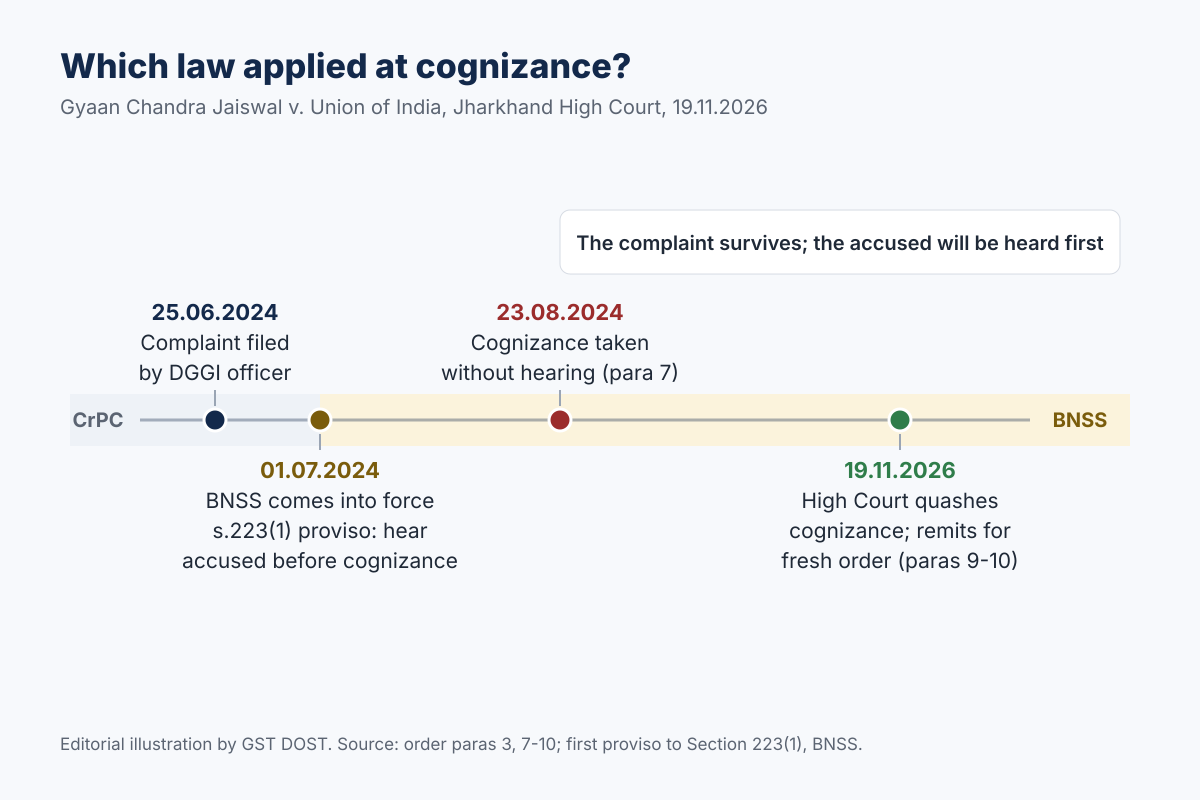
The first proviso to Section 223(1) BNSS bars a Magistrate from taking cognizance of an offence without giving the accused an opportunity of being heard. The petitioners relied on two Supreme Court decisions, both quoted in the order:
- Parvinder Singh v. Directorate of Enforcement, 2026 SCC OnLine SC 903, paras 37–38 (quoted at para 4). There too the complaint was filed before the BNSS and cognizance taken after it. The Supreme Court held that not hearing the accused at the cognizance stage is not a mere irregularity but an illegality that vitiates the proceedings.
- Kushal Kumar Agarwal v. Directorate of Enforcement, 2025 SCC OnLine SC 1221, para 6 (quoted at para 5): the proviso puts an embargo on the court's power to take cognizance without hearing the accused.
Both Supreme Court cases arose from complaints under the Prevention of Money Laundering Act. The Jharkhand High Court applied the same rule to a complaint alleging an offence under the CGST Act together with IPC offences (para 8). It held that by 23.08.2024 the Magistrate was bound to comply with the proviso, and the cognizance order was not sustainable without it (para 8).
What did the department concede, and why does that matter?
Para 17 of the petition stated that no pre-cognizance hearing was given, and this remained uncontroverted (para 6). Counsel for the opposite parties opposed the petition but fairly submitted that no hearing under the first proviso to Section 223(1) BNSS had been given before cognizance (para 7).
GST DOST's reading
The concession removed any factual dispute, which is why the order is short. In a file where the order sheet shows that notice was issued and the accused was heard, or where cognizance was taken before 1 July 2024, this ruling will not help. The first task in any review is to read the order sheet.
What happens next in the trial court?
The High Court quashed the cognizance order dated 23.08.2024 in Complaint Case No. 2360 of 2024 (para 9) and remitted the case to the Special Magistrate, Economic Offences, East Singhbhum, Jamshedpur, to pass a fresh order in accordance with law after complying with the first proviso to Section 223(1) BNSS (para 10). The petition was allowed “to the aforesaid extent only” (para 11).
“Remitted” means the matter is sent back for a fresh decision. In practical terms:
- The complaint is not quashed. The accused will be heard, and the court will then decide again whether to take cognizance.
- The High Court fixed no time limit for the fresh order (para 10).
- The order does not describe what the pre-cognizance hearing should cover. That question is left open.
The order uses two descriptions for the trial court. Para 3 refers to the Special Magistrate, Economic Offences; paras 2, 8 and 9 refer to the Special Judge, Economic Offences, as the court that took cognizance; para 10 remits the matter to the Special Magistrate. Use the description in the certified order sheet when you file anything in the trial court.
Which GST prosecution files should be reviewed now?
Business owner or director named as an accused. Obtain a certified copy of the order sheet in the complaint case. Check two dates: when the complaint was filed and when cognizance was taken. If cognizance came after 1 July 2024 without a hearing, speak to your counsel early. The relief, if any, is a hearing before cognizance. It does not end the case.
Accounts and finance. GST DOST's practice point: keep a reconciliation of the amount alleged, any amounts paid and any adjudication orders. The punishment clause invoked depends on whether the amount crosses Rs 500 lakh, so the figure will matter at every stage.
GST practitioner. Keep the adjudication file and the prosecution file aligned. Check that the prosecution sanction under Section 132(6) is on record, since a person may not be prosecuted without the previous sanction of the Commissioner.
In-house or litigation team. If the order sheet shows no hearing, consider an application before the trial court or a petition before the High Court, relying on paras 3, 7, 8 and 10 of this order and paras 37–38 of Parvinder Singh. Raise it early. In Parvinder Singh the Supreme Court noted that the accused had applied for recall of the cognizance order at the earliest point (para 38, as quoted at para 4).
File checklist: complaint filed before, cognizance taken after, 1 July 2024
How to cite this order
Case name as printed: Gyaan Chandra Jaiswal and another v. Union of India represented by Shri Dinesh Kumar, Intelligence Officer, Directorate General of GST Intelligence, Regional Unit, Jamshedpur, and another.
Court: High Court of Jharkhand at Ranchi; Anil Kumar Choudhary, J.; Cr.M.P. No. 3728 of 2025 (with I.A. No. 15961 of 2026); decided 19.11.2026; neutral citation 2026:JHHC:33073; marked AFR in the order.
Gyaan Chandra Jaiswal v. Union of India, Cr.M.P. No. 3728 of 2025, 2026:JHHC:33073 (Jhar.), decided 19.11.2026, paras 3, 7–10.
Sources and verification notes
- The order: copy used is the reproduction published by JurisHour (JURISHOUR-4230-HC-2026(JHR)), 6 PDF pages; paras 2–3 at PDF pp. 2–3, paras 4–6 at PDF pp. 3–4, paras 7–12 at PDF pp. 4–6. The order records that it was uploaded on 20.11.2026.
- Kushal Kumar Agarwal v. Directorate of Enforcement, Criminal Appeal No. 2749 of 2025, decided 09.05.2025, 2025 INSC 760: Supreme Court copy.
- Parvinder Singh v. Directorate of Enforcement, SLP (Crl.) No. 12055 of 2025, decided 19.05.2026, 2026 INSC 519: copy reproduced by LiveLaw. The High Court cites it as 2026 SCC OnLine SC 903.
- Section 223(1), BNSS, first proviso, as quoted and applied in paras 4, 5 and 8 of the order; Section 132(1)(i) and 132(6), CGST Act.
- Verification: Supreme Court citations and dates checked, and a web search for any challenge to this order run, on 25.11.2026. Recheck before reliance.
If you or your company face a GST prosecution complaint and need the file checked for dates, sanction and the cognizance stage, GST DOST can help through the Contact page on gstdost.com.

Related posts
Gold Coins for Dealers: Orient Cement Keeps Its ITC but Owes GST on 110% of Cost, Rules Telangana Appellate Authority...
Temple Hair Auctions and the 18% Clause: Telangana AAR Says Unworked Hair Is Exempt Goods, but the Ruling Binds the Bidder, Not the Temple...
A Three-Wheeler to the Railway Station Without Part-B: GSTAT Lucknow Refuses to Restore a Rs 4.86 Lakh E-Way Bill Penalty...
Filed Under the CrPC, Cognised Under the BNSS: Why the Jharkhand High Court Sent a GST Prosecution Back for a Hearing...
