



Namaste DOST,
A cement maker credits a dealer's account with Rs 9 a bag once the dealer lifts 500 MT. At the end of the quarter it does not issue a credit note. It buys gold coins worth the credit in its own name, takes input tax credit on them, and hands the coins to the dealer (Brief Facts, PDF pp. 2–3). Is that a gift, a discount, or a sale?
In M/s Orient Cement Limited (Order-in-Appeal No. AAAR/3/2026, dated 10.11.2026), the Telangana State Appellate Authority for Advance Ruling held it is a supply of goods made for consideration, namely the dealer's act of reaching the target, valued at 110% of the cost of acquisition (Discussion para 13, First and Second). Credit on the coins and white goods is allowed because that outward supply is taxed (para 13, Fourth and Fifth). The company's appeal was rejected (PDF p. 26). What decided it was the company's own choice to give goods instead of adjusting the dealer's dues or issuing credit notes (para 2).
How did the dealer scheme work?
The company makes Ordinary Portland Cement and Pozzolana Portland Cement and sells through dealers. Under its Monthly/Quarterly Quantity Discount Scheme and Dealer White Goods Scheme (para 2):
- Quantity slabs were fixed for different markets, and a dealer reaching a slab earned a credit at a set rate per bag.
- The credit was not deducted from the cement invoice and was not passed through a tax invoice or a tax credit note on the cement sale.
- After the scheme period the company bought gold coins or white goods, such as air-conditioners, microwave ovens and vehicles, in its own name, availed input tax credit, and handed them to eligible dealers. The coins carried the company's brand.
- Growth in purchases raised the points and de-growth reduced them. Dealers with dues outstanding for more than 90 days were not eligible.
- Dealers signed a declaration that the gold was offered in proportion to the sales achieved.
The Telangana AAR had ruled on 30.09.2023 (TSAAR Order No. 20/2023) that this was a supply of goods, valued under Section 15 read with Rule 30, not a gift, with credit admissible (PDF p. 13; para 3). The company appealed against the finding of an outward supply. It did not contest the credit, which had already been allowed (para 4).
Gift, discount or sale: which reading won?
The Authority read Circular No. 92/11/2019-GST as setting out this structure. A free gift outside Schedule I attracts no output tax and the credit is blocked. Once the giveaway is brought within supply, because there is consideration or because Schedule I applies, output tax is payable and credit is allowed. The company wanted the credit without the output tax, which the Act does not permit (para 11).
Why was the dealer's target treated as consideration?
Section 2(31)(b) includes in “consideration” the monetary value of any act or forbearance in respect of, in response to, or for the inducement of, the supply. The Authority found that the scheme was announced before the dealer bought, that eligibility depended on quantity, grade and growth, and that the dealer's declaration tied the gold to sales achieved. The scheme was designed to induce dealers to reach the threshold. That act had a monetary value and was consideration, so Section 7(1)(a) was satisfied (para 5).
The company argued that the dealer pays only for cement. The Authority held that this ignored how the company itself had structured the transaction. The cement invoice was raised and paid at full value, GST was paid on it, and no credit note under Section 34 was issued. Having consciously not used the credit-note route, the company made a later supply of different goods; that could not be treated as a revision of the cement price (para 6). The plea of double taxation also failed. The company produced no evidence that the scheme cost was built into the cement price, and commercial pricing creates no exemption or set-off in any case (para 9).
GST DOST's reading
The finding rests on the documents the company chose to use: full-value cement invoices, no credit notes, goods bought in the company's name, and dealer declarations linking the gold to sales. Change those documents and the analysis may change. The order does not decide how a scheme run through cash or credit notes should be treated.
What does “110% of cost” mean in rupees?
Because the dealer paid no separate price for the coins, the price was not the sole consideration and Section 15(1) could not give a nil value. The value was determined under Section 15(4) read with Rule 27 and, failing that, Rule 30: 110% of the cost of acquisition, which is known from the company's purchase invoices (paras 7–8; para 13, Second).
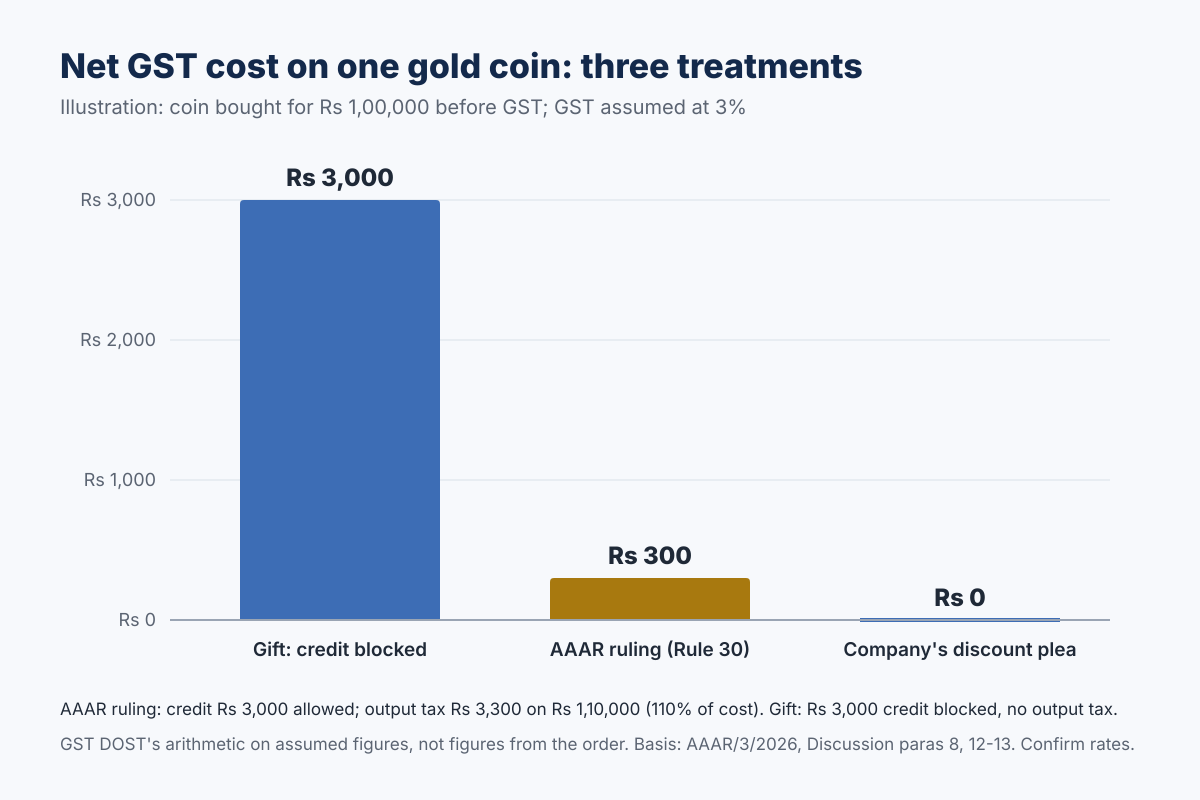
This is GST DOST's arithmetic on assumed figures. Confirm the rate for each item and period; white goods carry different rates from gold. On these assumptions the ruling costs the company far less than gift treatment would. The appeal was about the 10% uplift on the output side, not about losing the credit.
Does the November 2026 credit-note amendment change the answer?
From 01.11.2026, sections 153 and 154 of the Finance Act, 2026 (brought into force by Notification No. 03/2026-Central Tax dated 26.10.2026) amended Section 15(3)(b) and Section 34(1). A post-supply discount can now be excluded from value through a GST credit note under Section 34, provided the recipient reverses the attributable credit. A prior agreement and invoice-wise linkage are no longer required.
The Appellate Authority quoted and applied the earlier text of Section 15(3)(b) (para 7). Its main reason, however, was different: the company supplied different goods instead of reducing the cement price (para 6).
GST DOST's reading
The amendment makes the credit-note route easier for a genuine price discount. It does not turn a gold coin handed over as goods into a discount on cement. A company redesigning a scheme now has a clearer choice: reduce value through a credit note, with the dealer reversing credit, or supply goods as a separate taxable supply at the Rule 30 value. Under Section 103(2), an advance ruling stops binding when the law, facts or circumstances supporting it change; whether this amendment is such a change for future periods is arguable, and we think the core reasoning survives it.
The order relied on Circular No. 92/11/2019-GST (para 11). It did not refer to Circular No. 251/08/2025-GST dated 12.09.2025 on post-sale discounts.
What should each team do with a dealer scheme?
CFO and business owner. Decide the scheme design deliberately. Rewards in goods carry output tax at the Rule 30 value with credit on purchase; price reductions through credit notes reduce output tax and require the dealer to reverse credit. Cost both before announcing the next scheme.
Accounts and finance. If goods are given, keep the purchase invoices in the company's name, compute 110% of the cost of acquisition, and raise the outward tax document on that value. Track the credit separately for gold and for each class of white goods.
GST practitioner. Read the scheme circular, the dealer agreement and the dealer declarations together. These documents decided the consideration finding (paras 2 and 5). Check whether any credit notes were issued and whether they meet the Section 15(3)(b) conditions in force on their date.
In-house or litigation team. If an officer proposes to block credit on such goods as gifts, paras 12–13 support the credit, but the same paragraphs carry the output tax with them. This is an advance ruling: it binds the applicant and its jurisdictional officers (PDF p. 26). For other businesses it is persuasive only.
File checklist: goods given under dealer schemes
How to cite this order
Name as printed: M/s Orient Cement Limited (GSTIN 36AABCO5420A1Z2), Devapur Cement Works, Devapur, District Mancherial, Telangana. (Brief Facts, para 1 of the order spells it “Orient Cements Limited”.)
Authority: Telangana State Appellate Authority for Advance Ruling (Goods and Services Tax), Hyderabad, comprising the Chief Commissioner of State Tax, Telangana and the Chief Commissioner of Central Tax, Hyderabad Zone. AAAR.COM/02/2024; Order-in-Appeal No. AAAR/3/2026 under Section 101(1) of the TGST Act; dated 10.11.2026; against TSAAR Order No. 20/2023 dated 30.09.2023.
Orient Cement Ltd., In re, Order-in-Appeal No. AAAR/3/2026 (Telangana AAAR) dt. 10.11.2026, Discussion paras 5–6, 8 and 12–13.
Sources and verification notes
- The order: copy used is the reproduction published by JurisHour, a 27-page scanned PDF. Brief facts and the AAR ruling at PDF pp. 2–13; grounds of appeal at PDF pp. 13–16; Discussion paras 1–3 at PDF pp. 16–17, paras 4–6 at PDF pp. 18–20, para 7 at PDF pp. 20–21, para 8 at PDF pp. 22–23, paras 9–10 at PDF pp. 23–24, paras 11–12 at PDF pp. 24–25, para 13 and the order at PDF pp. 25–26. Paragraph numbers were read from the page images.
- Circular No. 92/11/2019-GST dated 07.03.2019 (sales promotion schemes).
- Circular No. 251/08/2025-GST dated 12.09.2025 (copy circulated by the Department of Trade and Taxes, Delhi).
- Finance Act, 2026, sections 153–154, and Notification No. 03/2026-Central Tax dated 26.10.2026 (commencement from 01.11.2026): checked against published reproductions of the notification on 25.11.2026.
- Illustration figures are GST DOST's own; the assumed 3% rate for gold coins was checked against published rate summaries on 25.11.2026. Confirm the rate for the item and period before use.
- Verification: web check for any further challenge to this order run on 25.11.2026. Recheck before reliance.
If your business runs dealer incentive schemes and wants the GST treatment checked before the next scheme period, GST DOST can review the scheme documents with you through the Contact page on gstdost.com.

Related posts
Gold Coins for Dealers: Orient Cement Keeps Its ITC but Owes GST on 110% of Cost, Rules Telangana Appellate Authority...
Temple Hair Auctions and the 18% Clause: Telangana AAR Says Unworked Hair Is Exempt Goods, but the Ruling Binds the Bidder, Not the Temple...
A Three-Wheeler to the Railway Station Without Part-B: GSTAT Lucknow Refuses to Restore a Rs 4.86 Lakh E-Way Bill Penalty...
Filed Under the CrPC, Cognised Under the BNSS: Why the Jharkhand High Court Sent a GST Prosecution Back for a Hearing...
