


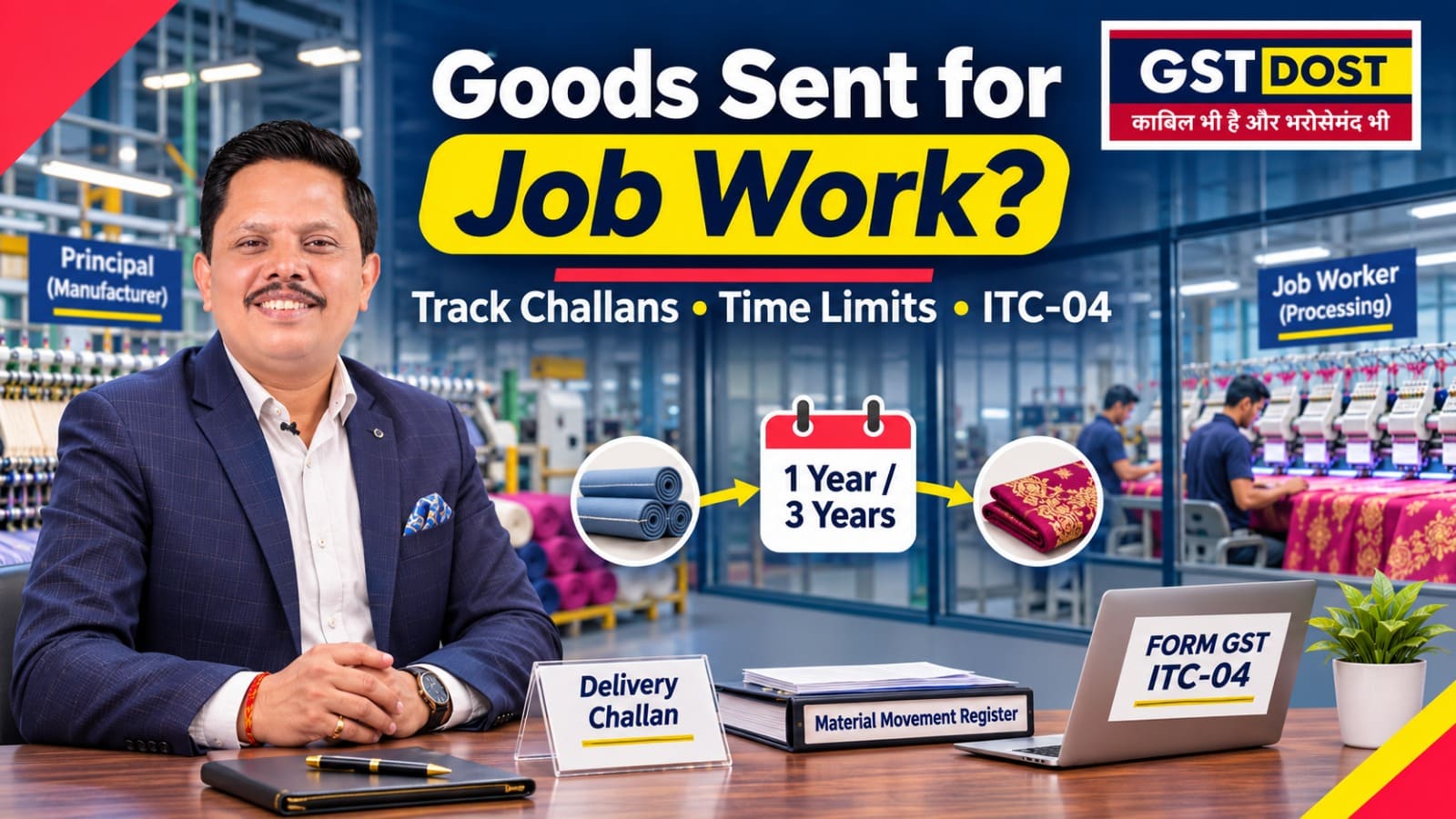
Manufacturers often send fabric for embroidery, components for machining or material for coating to an outside unit. Under GST, a registered principal can send such goods to a job worker without paying tax on the movement. In return, the principal must bring the goods back or supply them within fixed time limits, keep proper challans and records, and report the movements in FORM GST ITC-04. The responsibility for the goods stays with the principal throughout.
Key takeaways
- Section 143 allows inputs and capital goods to be sent to a job worker without payment of tax, under a delivery challan (rules 45 and 55).
- Inputs must be brought back or supplied within one year, and capital goods within three years. Moulds and dies, jigs and fixtures, and tools are outside these limits.
- The Commissioner may extend the periods by up to one year (inputs) and two years (capital goods) on sufficient cause.
- If goods are not returned or supplied in time, they are deemed to have been supplied by the principal to the job worker on the day they were sent out.
- For inter-State job work, an e-way bill is required irrespective of the value of the consignment.
- ITC-04 is half-yearly (due 25 October and 25 April) if the previous year's aggregate turnover exceeded Rs. 5 crore, and annual (due 25 April) otherwise.
1. What is job work?
Section 2(68) of the CGST Act defines job work as any treatment or process undertaken by a person on goods belonging to another registered person. The registered person who sends the goods is the principal; the person who carries out the process is the job worker.
The goods remain the principal's goods. Sending them for job work under section 143 is not a sale of those goods. The processing charges, however, are a supply of service by the job worker and are taxed in the normal way. Calling an arrangement "outsourcing" does not by itself make it job work; the goods must belong to the principal and be processed and returned or supplied under the section 143 conditions.
2. What section 143 allows
Under section 143(1), a registered principal may, under intimation and subject to conditions, send inputs or capital goods without payment of tax to a job worker, and from there to another job worker. Within the time limits, the principal must either:
- bring back the inputs (after job work or otherwise) or capital goods to any of its places of business, without payment of tax; or
- supply them from the place of business of a job worker, on payment of tax within India, or with or without payment of tax for export.
Goods can be supplied from a job worker's premises only if the principal declares that place as its additional place of business, except where the job worker is registered under section 25, or where the principal supplies goods notified by the Commissioner.
Inputs and capital goods can also be sent directly from the supplier to the job worker. Section 19 deals with the principal's ITC on goods sent for job work, including such direct deliveries, where the time limits run from the date the job worker receives the goods.
3. Time limits
| Goods | Time to bring back or supply | Extension by Commissioner |
|---|---|---|
| Inputs | 1 year from being sent out | Up to 1 further year |
| Capital goods | 3 years from being sent out | Up to 2 further years |
| Moulds and dies, jigs and fixtures, tools | No time limit | Not applicable |
Where goods are sent directly to the job worker, the period runs from the date of receipt by the job worker (section 19). The extension is available only on sufficient cause being shown to the Commissioner; it is not automatic.
4. If goods are not returned in time: deemed supply
Under section 143(3) and (4), if inputs are not received back or supplied within one year, or capital goods within three years, it is deemed that the principal supplied them to the job worker on the day they were sent out. The principal then has to pay tax on that deemed supply, with interest. CBIC Circular No. 38/12/2018-GST dated 26 March 2018 explains this.
An open challan in the books is not by itself proof of a deemed supply. Before concluding that tax is due, check whether the goods were returned, moved to another job worker, supplied from the job worker's premises, consumed as process loss or waste, or covered by an extension.
5. Waste and scrap at the job worker's premises
Under section 143(5), waste and scrap generated during job work may be supplied by the job worker directly from its place of business on payment of tax, if the job worker is registered, or by the principal, if the job worker is not registered. Account for normal process loss and scrap in the reconciliation of quantities sent and received.
6. A simple illustration
| Particulars | Quantity |
|---|---|
| Fabric sent to embroidery unit (inputs) | 1,000 metres |
| Received back as embroidered fabric | 800 metres |
| Balance to be explained | 200 metres |
Before treating the 200 metres as a deemed supply, the manufacturer should check whether they are still under process, were sent to another job worker, were returned under another challan, were supplied from the job worker's premises, or are normal process loss or scrap. Only the quantity that remains unexplained beyond one year from dispatch (or the extended period) is at risk of deemed supply. This is a hypothetical illustration.
7. Documents for each movement
- Delivery challan: goods sent to a job worker, and between job workers, move under a challan issued by the principal with the particulars in rule 55, as required by rule 45.
- Return or onward supply: keep the challan or invoice for goods returned to the principal, and the tax invoice for goods supplied from the job worker's premises.
- E-way bill: required as per rule 138. Where goods are sent by a principal in one State or Union territory to a job worker in another, the e-way bill must be generated by the principal or the registered job worker irrespective of the value of the consignment.
- Job work invoice: the job worker issues a tax invoice for its processing charges.
A delivery challan and a tax invoice are different documents and are not interchangeable.
8. FORM GST ITC-04
ITC-04 is the statement in which the principal reports goods sent to and received from job workers. Its main tables are:
| Table | What is reported |
|---|---|
| 4 | Inputs and capital goods sent for job work |
| 5A | Goods received back from the job worker to whom they were sent |
| 5B | Goods received back from a job worker other than the one to whom they were sent |
| 5C | Goods supplied from the job worker's premises |
From 1 October 2021, rule 45(3) (as amended by Notification No. 35/2021-Central Tax dated 24 September 2021) fixed the frequency by the principal's aggregate turnover in the immediately preceding financial year:
| Aggregate turnover in FY 2025-26 | ITC-04 for FY 2026-27 | Due dates |
|---|---|---|
| More than Rs. 5 crore | Half-yearly | April-September 2026: 25 October 2026 October 2026-March 2027: 25 April 2027 |
| Up to Rs. 5 crore | Annual | FY 2026-27: 25 April 2027 |
The due date for the April-September 2026 half-year has passed. Principals who were required to file it and have not done so should file it now. Older material that refers to quarterly ITC-04 relates to the position before 1 October 2021.
9. Action points for principals (manufacturers)
- File any pending ITC-04 for April-September 2026.Now
If your FY 2025-26 aggregate turnover exceeded Rs. 5 crore and the half-yearly ITC-04 due on 25 October 2026 is not filed, file it without further delay. - Build an open-challan ageing report.This month
List every challan with dispatch date, job worker, quantity sent, received and balance, and the one-year or three-year due date. - Act on challans close to the time limit.This month
Bring the goods back, supply them, or apply for an extension with reasons before the period ends. - Reconcile quantities with process loss and scrap.Monthly
Agree normal loss norms with each job worker and record scrap generated and how it was supplied. - Generate e-way bills for inter-State job work.Every movement
Irrespective of value, by you or the registered job worker. - Declare job worker premises where needed.Before supply
Before supplying goods from an unregistered job worker's premises, add it as an additional place of business. - Keep factory and finance records aligned.Ongoing
Stores challans, inventory at job workers and ITC-04 data should come from one register.
10. Action points for job workers
- Keep the principal's goods separately.Ongoing
Maintain challan-wise stock of goods received, processed, returned and sent onward. - Raise tax invoices for job work charges.Every job
Charge GST at the rate applicable to the job work service. - Handle waste and scrap correctly.Ongoing
If registered, supply scrap on payment of tax, or agree in writing that the principal will supply it.
11. Action points for GST professionals
- Check ITC-04 filing status for the half-year just ended.
Confirm clients' turnover category and filing for April-September 2026. - Test deemed supply before agreeing to it.
In audits or notices treating open challans as supply, examine returns, onward movement, process loss, scrap, direct supply and extensions. - Use the extension provision in time.
Help clients apply to the Commissioner with reasons before the one-year or three-year period expires. - Check whether the arrangement is job work at all.
Where goods do not belong to the principal or are not returned, section 143 may not apply. - Review e-way bill compliance for inter-State movements.
Low-value inter-State job work consignments are a common gap. - Reconcile ITC-04 with books and section 19 ITC.
Differences between ITC-04, stock records and ITC claimed on goods at job workers invite questions.
12. Five-minute self-check
Ask your factory, stores or GST manager to answer YES, NO or NOT SURE:
| # | Question | Response |
|---|---|---|
| 1 | Do we have a list of all job workers holding our goods? | |
| 2 | Is every movement covered by a rule 55 challan? | |
| 3 | Do we have an ageing report of open challans with due dates? | |
| 4 | Are quantities sent and received reconciled, including loss and scrap? | |
| 5 | Are moulds, dies, jigs, fixtures and tools identified separately? | |
| 6 | Are e-way bills generated for all inter-State job work movements? | |
| 7 | Are supplies from job workers' premises properly invoiced and declared? | |
| 8 | Do we know our ITC-04 frequency for FY 2026-27? | |
| 9 | Is the ITC-04 for April-September 2026 filed, if applicable? | |
| 10 | Is one person responsible for job work compliance? |
A NO or NOT SURE is a signal to review, not an established GST default.
13. Documents to keep ready
- Job work agreements or work orders describing the process and responsibility for goods.
- Delivery challans for goods sent, transferred and returned.
- Job worker master: names, addresses and GST registration status.
- Material movement register with goods, quantities, dates and challan numbers.
- Stock at job workers and process loss or scrap records.
- E-way bills and transport records.
- ITC-04 filings and acknowledgements.
- Job work invoices and invoices for supplies from job workers' premises.
- Extension applications and orders, if any.
14. What if you find a problem?
| Situation | Suggested next step |
|---|---|
| Goods outstanding close to the time limit | Bring back, supply, or apply for an extension before the period ends. |
| Goods outstanding beyond the time limit | Verify the actual position; if a deemed supply has arisen, take advice on tax, interest and documentation. |
| Returned quantity does not match the challan | Reconcile with process loss, scrap and onward movements. |
| ITC-04 not filed | Check the applicable frequency and file the pending statement. |
| Goods moved to a second job worker without records | Obtain the challans and update the movement register. |
| Inter-State movement without e-way bill | Review the movements and fix the process for future consignments. |
15. Official sources
- CGST Act, 2017: sections 2(68), 19 and 143.
- CGST Rules, 2017: rules 45, 55 and 138.
- Notification No. 35/2021-Central Tax dated 24 September 2021: amendment of rule 45(3) on ITC-04 frequency, from 1 October 2021.
- Circular No. 38/12/2018-GST dated 26 March 2018: job work procedure (its references to quarterly ITC-04 are superseded by the 2021 amendment).
- GST portal user manual: FORM GST ITC-04.
The Act, Rules, notification and circular are available on taxinformation.cbic.gov.in and cbic-gst.gov.in; the portal manual on tutorial.gst.gov.in.
Scope of this article: the article explains the general framework as on the review date. Rates of job work services, individual arrangements and records have not been examined.
One small step for today: pick the three oldest open job work challans, and for each check the dispatch date, balance quantity, where the goods are now, and how many days remain before the time limit.
Need help with job work compliance?
GST DOST offers a focused Job Work Challan and ITC-04 Health Check. The review covers:
- Open-challan ageing and time-limit tracking
- Quantity reconciliation with process loss and scrap
- E-way bill and documentation for job work movements
- ITC-04 filing and reconciliation with books and ITC
The objective is reliable records and supportable compliance. We do not assume that open stock creates tax liability.
Disclaimer: This article is for general information only and reflects the position as understood on the review date mentioned above. It is not legal advice and does not create a professional relationship. The treatment depends on the facts of each case. Please obtain professional advice before acting on this article.
GST DOST | GST Manufacturing Compliance, Reconciliation and Professional Advisory

Related posts
Goods Sent to Another Factory for Processing: Who Is Responsible for GST Job Work Records and ITC-04?...
One HSN, Two GST Rates: A Power Query Check for FY 2025-26 Annual Returns...
RCM Paid in Cash, ITC Claimed Separately: A Two-Ledger Test for GSTR-9...
Build a GST Exception Dashboard in Excel: Let Data Analytics Find the Mistakes First...
