


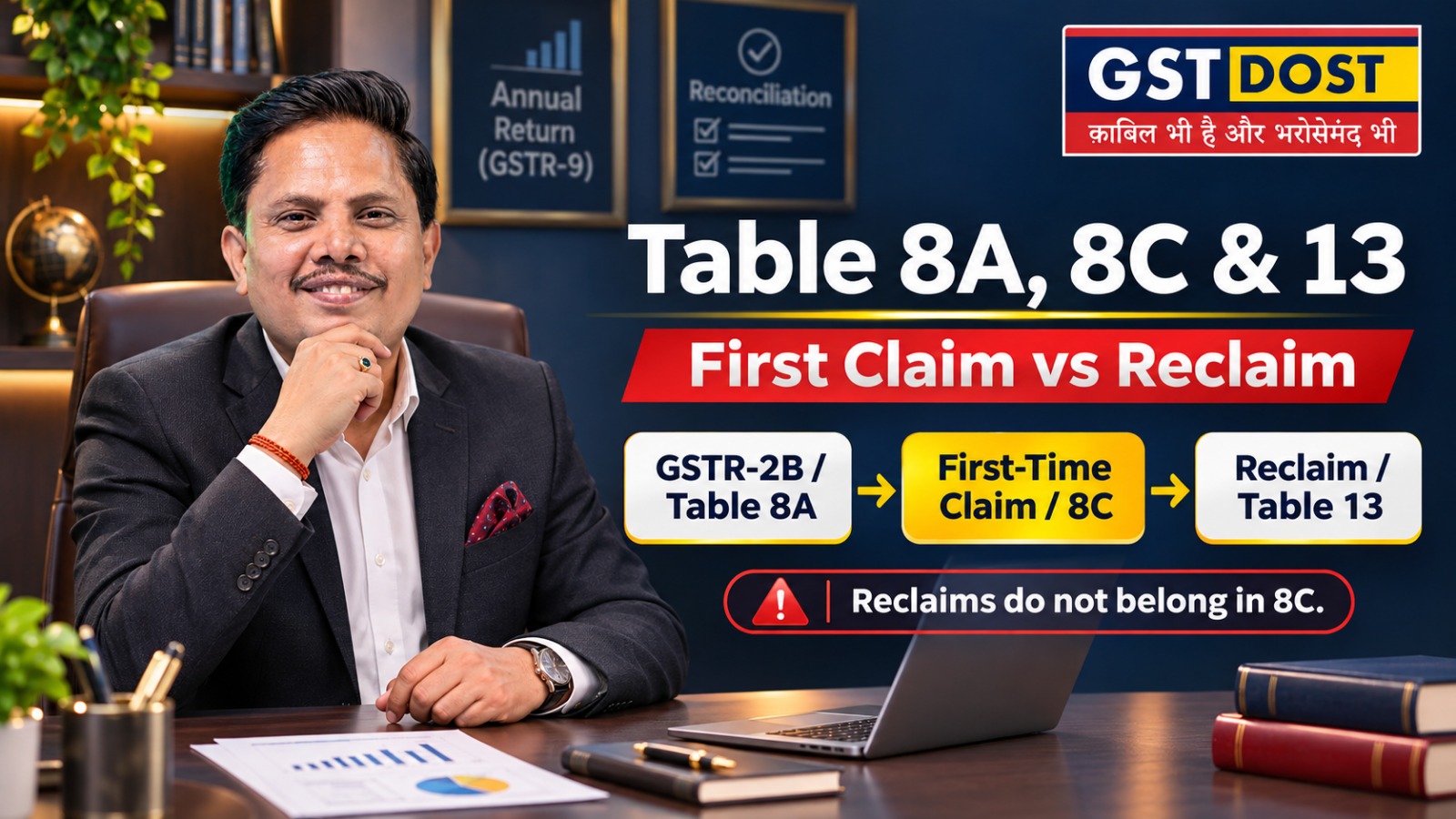
Table 8 of the annual return compares two figures: the input tax credit (ITC) that suppliers' filings made available in GSTR-2B, and the ITC the business actually took. If they do not agree, row 8D shows a difference. The easy way to make that difference disappear is to put every credit taken after March into row 8C. That is also the wrong way. Row 8C is meant for one kind of credit only, and using it for anything else creates the very difference it was supposed to remove.
In simple terms
- Table 8A is filled in by the portal from GSTR-2B. It shows what suppliers reported for invoices of the year. It is not a statement of eligible credit.
- Table 8C is only for credit of FY 2025-26 taken for the first time in a return of the next year, within the time limit.
- Credit that was taken, reversed and taken again is never entered in 8C. It goes to Table 13, or to Table 6H of the next year's return, depending on why it was reversed.
Why this matters
One FY 2025-26 invoice can pass through the returns in different ways. It may appear in GSTR-2B in one month and be claimed in another. It may be claimed, reversed and claimed again. GSTR-9 has a separate place for each of these. When they are mixed up, Table 8D shows a difference that does not exist in the books, and the business ends up explaining an error of presentation as if it were an error of credit.
Where this guidance comes from: GSTN explained these tables in its consolidated FAQs dated 17 December 2025. Those FAQs were written for FY 2024-25, the year in which the tables were redesigned. This article applies them to FY 2025-26 by moving each date forward by one year. Check the FY 2025-26 form and the portal before filing.
What each row holds
The specified period follows the time limit in section 16(4) of the CGST Act. For FY 2025-26 it ends on 30 November 2026, or on the date the annual return is filed, if that is earlier. A supplier's late-reported invoice reaches Table 8A after the recipient files its own GSTR-3B for the period in which it appears.
Where each kind of credit goes
Based on GSTN's consolidated FAQs for FY 2024-25, with the years moved forward. Table 6A1 holds credit of the preceding year taken during the year, other than rule 37 and rule 37A reclaims.
Why a reclaim does not belong in 8C
The invoice appears once in Table 8A. Its original claim is already in Table 6B, and therefore in 8B. If the later reclaim is also entered in 8C, the same invoice is counted twice on the credit-taken side, and 8D turns negative by that amount.
Practical example
Two invoices of FY 2025-26 are taken for illustration.
- Invoice 1: GST of ₹45,000. It was in GSTR-2B during the year. The credit was taken for the first time in July 2026.
- Invoice 2: GST of ₹25,000. The credit was taken in March 2026 and reversed in the same return because the goods had not been received. It was taken again in July 2026 when the goods arrived. Rules 37 and 37A are not involved.
Illustrative figures only. The table shows the effect of these two invoices alone.
Invoice 1 belongs in 8C and in Table 13. Invoice 2 belongs in Table 13 but not in 8C. Adding the two together in 8C produces a difference of ₹25,000 that has nothing to do with the credit itself.
Table 8A online and the Excel download
The GSTR-9 dashboard offers an invoice-wise file under Download Table 8A Document Details. Its total often differs from the figure shown online. GSTN's FAQs say that the online figure is correctly populated and that the Excel file can hold additional records. The reasons they give include:
- Reverse charge supplies appear in the Excel file only.
- A document amended from forward charge to reverse charge appears in the Excel file and not online.
- Where the place of supply was amended, so that IGST became CGST and SGST, the records appear in the Excel file only.
- Where an amendment moved a document from one financial year to another, the Excel file can still show the original record.
- Where the value was amended, the Excel file shows the original and the amended value, and the online figure takes only the amended value.
Do not edit the download to make the totals agree. Keep the file as downloaded, and explain each difference document by document.
If Table 8D is still not nil
A difference that remains after correct classification is not automatically an error. Credit that was available in GSTR-2B but was not taken, or was not eligible, is a real difference. The form has rows 8E and 8F for these two reasons. What matters is that every rupee of 8D can be traced to named documents.
A screening column in Excel
Keep one row for each document, with these columns: A for the invoice year, B for the year of first claim, C for whether the credit was reversed in FY 2025-26, D for the reason for reversal and E for the month of reclaim. A simple formula separates the rows that may belong in 8C from the rest:
This is a filter. It does not decide eligibility, and it does not replace reading the reason for each reversal.
Action points
If you own or manage the business
- Ask for the cross-year credit list. It should show every FY 2025-26 credit taken after March 2026, marked as a first-time claim or a reclaim, with the reason.
- Ask what Table 8D shows. Each part of the difference should be explained by a list of documents.
- Do not accept a difference that was simply cleared. A nil figure reached by moving amounts into 8C is weaker than a difference that is properly explained.
- Remember the time limit. Credit of FY 2025-26 can be taken only in a return filed by 30 November 2026, or before the annual return if that is filed earlier.
If you prepare or review the return
- Download the invoice-wise GSTR-2B, the Table 8A document details and the register of claims, reversals and reclaims.
- Tag each document with its invoice year, GSTR-2B period, month of first claim, reason for reversal and month of reclaim.
- Separate first-time claims of the next year from credits that were claimed, reversed and reclaimed.
- Tie Table 8C and Table 13 to the GSTR-3B returns in which the credit was actually taken.
- Explain differences between the online Table 8A and the Excel file document by document.
- Trace what remains in 8D to rows 8E and 8F.
- Carry forward a schedule of what must go into Tables 6A1 and 6H of the FY 2026-27 return.
Red flag: Every credit entry of the next year, reclaims included, has been placed in Table 8C to bring the difference in 8D to nil.
Records to keep: A document-wise bridge linking GSTR-2B, the original claim, the reversal, the reclaim and the return period of each, together with the Table 8A file as downloaded on the date of filing.
What you should have at the end: An explanation of Table 8D that can be defended, and one list that separates first-time claims, reclaims, credit not taken and credit not eligible.
Practical takeaway
Keep first-time claims, reversals and reclaims apart. A table that shows nil is worth less than a trail that shows what happened.
Terms used in this article
- Input tax credit (ITC)
- The credit a registered business takes for GST paid on its purchases, which it sets off against the GST payable on its sales.
- GSTR-2B
- The auto-drafted statement on the GST portal that shows the credit available to a recipient, based on what suppliers have reported.
- GSTR-3B
- The summary return in which tax is paid and ITC is taken for a tax period.
- Reversal and reclaim
- A reversal gives back credit already taken, for example because goods have not arrived. A reclaim takes the same credit again once the condition is met.
- Rule 37 and rule 37A
- Rule 37 requires reversal of credit where the supplier is not paid within 180 days. Rule 37A requires reversal where the supplier has not filed its own GSTR-3B. Both allow the credit to be taken again later.
- Specified period
- The period after the end of the year within which credit of that year can still be taken. For FY 2025-26 it ends on 30 November 2026, or on the filing of the annual return if earlier.
Sources and references
- GSTN consolidated FAQs on GSTR-9 and GSTR-9C dated 17 December 2025 - Tables 6A1, 6H, 7, 8A, 8B, 8C, 8H1 and 13, and the Table 8A download. Written for FY 2024-25.
- GSTN advisory dated 13 October 2026 - GSTR-9 and GSTR-9C for FY 2025-26 enabled on the portal.
- GSTN FAQs on GSTR-2B.
- CBIC Circular No. 170/02/2022-GST dated 6 July 2022 - reversal and reclaim of credit in Table 4 of GSTR-3B.
- Central Goods and Services Tax Act, 2017 (India Code) - section 16(4), time limit for taking credit.
- Rule 37, Central Goods and Services Tax Rules, 2017 (CBIC), and rule 37A.
Disclaimer: This article is for general information only and reflects the position as understood on the review date mentioned above. It is not legal advice and does not create a professional relationship. The table-wise treatment is based on GSTN's FAQs for FY 2024-25 and should be checked against the FY 2025-26 form, its instructions and the portal before filing. Whether a particular credit is eligible depends on the facts and documents of each case. Figures in the example are illustrative. Please obtain professional advice before acting on this article.
GST DOST | GST Annual Return, Reconciliation and Technology-led Review

Related posts
Rule 42 Annual True-Up: The September Date Has Passed, but the GSTR-9 Review Has Not...
Stock Transfers Between Two GSTINs: Match Dispatch and Receipt Before GSTR-9...
GSTR-9 Table 8C Is Not a Reclaim Register: Getting Tables 8A, 8C and 13 Right...
Could a GST Officer Turn ‘Can’ Into ‘Must’? The ₹53.36 Crore Solar Case...
