


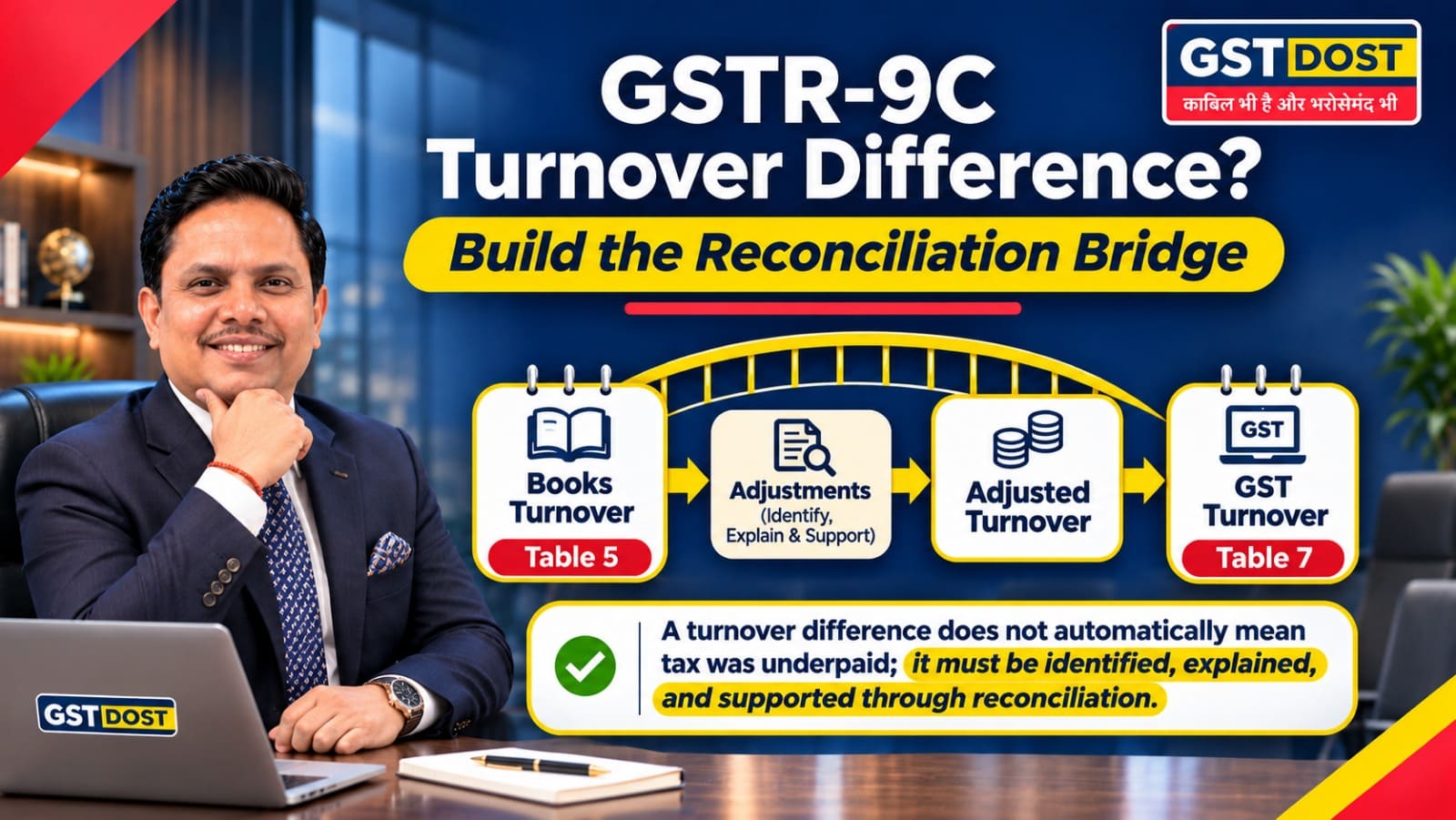
GSTR-9C | Reconciliation & Review
A company's audited financial statements may show one turnover figure and its GST returns another. That difference is not, by itself, an error or a tax shortfall. Accounting and GST recognise transactions at different times and under different rules. What matters is whether every difference is identified, explained and supported by evidence. That is the job of the reconciliation statement in FORM GSTR-9C.
Key points
- GSTR-9C is a self-certified reconciliation statement. Rule 80(3) requires it where aggregate turnover during the financial year exceeds five crore rupees.
- Table 5 reconciles gross turnover. Table 7 reconciles taxable turnover. These are two separate exercises.
- For FY 2025-26 onwards, the option not to fill Tables 5B to 5F, 5H to 5N and Table 14 separately continues. The underlying working is still needed.
Why this matters
A company may report revenue of ₹5 crore in its financial statements and a different turnover in its GST returns. The first question from management is usually the same: why do the books and the returns not agree?
The important question is not whether the two opening figures match. It is whether every adjustment between them has a valid explanation and supporting evidence.
Understand the reconciliation bridge
Table 5 of GSTR-9C starts with turnover as per the audited financial statements for the State or Union Territory and moves, adjustment by adjustment, to the turnover declared in the annual return.
| Table | What it contains |
|---|---|
| 5A | Turnover (including exports) as per the audited financial statements for the State or Union Territory |
| 5B to 5O | Adjustments, such as unbilled revenue, unadjusted advances, deemed supplies under Schedule I, credit notes, trade discounts, foreign exchange differences and other reasons |
| 5P | Annual turnover after adjustments |
| 5Q | Turnover as declared in the annual return (GSTR-9) |
| 5R | Unreconciled turnover (5Q minus 5P). Reasons are given in Table 6 |
Table 7 is a separate exercise. It starts from the adjusted turnover in Table 5P and removes the parts on which the supplier does not pay tax: exempted, nil-rated, non-GST and no-supply turnover (7B), zero-rated supplies without payment of tax (7C) and supplies on which the recipient pays tax under reverse charge (7D). The result is taxable turnover (7E), which is compared with the taxable turnover as per the liability declared in GSTR-9 (7F). Reasons for any unreconciled amount are given in Table 8.
Reconciling total turnover and determining which part of it is taxable are two different questions. A file can pass the first and fail the second.
Who signs GSTR-9C
Notification No. 30/2021-Central Tax dated 30 July 2021 substituted rule 80 of the CGST Rules with effect from 1 August 2021. Under rule 80(3), a registered person whose aggregate turnover during a financial year exceeds five crore rupees furnishes a self-certified reconciliation statement in FORM GSTR-9C along with the annual return. The same notification omitted the earlier certification part of the form.
GSTR-9C is therefore a self-certified statement and not a GST audit report certified by a chartered accountant or cost accountant. Professional review remains valuable, because the person who signs takes responsibility for every figure in it.
Practical example
A company that is required to file GSTR-9C shows revenue of ₹5,00,00,000 for one State in its audited accounts. The review identifies three adjustments.
| Table | Particulars | Amount |
|---|---|---|
| 5A | Turnover as per audited financial statements for the State | ₹5,00,00,000 |
| 5B | Add: Unbilled revenue at the beginning of the year, invoiced during the year | ₹9,00,000 |
| 5D | Add: Deemed supplies under Schedule I, not booked as revenue | ₹3,00,000 |
| 5H | Less: Unbilled revenue at the end of the year, not yet invoiced | (₹12,00,000) |
| 5P | Annual turnover after adjustments | ₹5,00,00,000 |
| 5Q | Turnover as declared in GSTR-9 | ₹5,00,00,000 |
| 5R | Unreconciled turnover (5Q minus 5P) | Nil |
Illustrative figures. It is assumed that these are the only adjustments and that the GST treatment of each transaction is supported.
Notice that the first and last figures are identical, although adjustments with a gross movement of ₹24,00,000 sit between them. A bare comparison of totals would have shown no difference and raised no questions. The bridge shows what the totals hide.
The adjusted figure agrees with the turnover declared in GSTR-9. That still does not prove that the tax liability is correct. Suppose the adjusted turnover includes exempt supplies of ₹20,00,000 and zero-rated supplies without payment of tax of ₹10,00,000.
| Table | Particulars | Amount |
|---|---|---|
| 7A | Annual turnover after adjustments (from 5P) | ₹5,00,00,000 |
| 7B | Less: Exempted, nil-rated, non-GST and no-supply turnover | (₹20,00,000) |
| 7C | Less: Zero-rated supplies without payment of tax | (₹10,00,000) |
| 7D | Less: Supplies on which the recipient pays tax under reverse charge | Nil |
| 7E | Taxable turnover as per adjustments | ₹4,70,00,000 |
Illustrative figures. Reverse-charge supplies are assumed to be nil.
₹4,70,00,000 is the starting point for the taxable-turnover and rate-wise liability reconciliation, subject to any other adjustments and categories that apply to the business.
What continues for FY 2025-26
Paragraph 57 of Notification No. 05/2026-Central Tax dated 26 October 2026 (G.S.R. 919(E)) amends the instructions to FORM GSTR-9C. Against Tables 5B to 5F and 5H to 5N, and against Table 14, the financial-year reference now reads "2023-24, 2024-25 and 2025-26 onwards". In practical terms, the existing option not to fill these tables separately continues for FY 2025-26 and later years. Turnover adjustments that are not shown row by row are reported in Table 5O.
Reporting option, not a working-paper exemption: Consolidated reporting does not remove the need for the underlying reconciliation. If the three adjustments in the example are reported together in Table 5O, where they net off to nil, the working paper must still show each one separately with its evidence.
Action points
For business owners, CFOs and accounts heads
- Ask for the bridge, not a matched figure. Do not ask your team to change GSTR-9 so that it agrees with the books. Ask for a schedule that explains each difference.
- Keep the evidence ready. Unbilled revenue workings, advance registers, credit notes and details of supplies made without consideration under Schedule I are common sources of difference.
- Read the reasons before you sign. GSTR-9C is self-certified. Review the reasons recorded for any unreconciled amount before the statement is filed.
- Separate timing from tax. For each difference, ask for a clear conclusion: timing difference only, tax correction needed, accounting correction needed, or further legal examination required.
For accountants and GST professionals
- Obtain the audited financial statements and the GSTIN-wise revenue ledger.
- Reconcile State-wise revenue with the relevant turnover in the accounts.
- Review opening and closing unbilled revenue, advances, credit notes and Schedule I supplies.
- Check whether any turnover adjustment has already been accounted for elsewhere, so that nothing is adjusted twice.
- Prepare a transaction-wise bridge from Table 5A through Tables 5P and 5Q.
- Reconcile the adjusted figure with taxable turnover and rate-wise tax liability.
Red flag: Large turnover adjustments are entered under "other reasons" without supporting documents, or the same transaction is adjusted twice.
Working paper evidence: Keep a signed turnover bridge with transaction references, ledger extracts, invoices, contractual evidence, accounting treatment and GST treatment.
Review discipline: ICAI's SA 230, Audit Documentation, is written for audits of financial statements. Its documentation principle is a useful model for designing a GSTR-9C review file. Using it does not convert the self-certified GSTR-9C into a statutory audit or certification.
What management should receive: A clear explanation of whether an apparent mismatch is only a timing difference, or needs a tax correction, an accounting correction or further legal examination.
Practical takeaway
Do not artificially change GSTR-9 to match the books. First identify and document the reasons for the difference.
Sources and references
- Notification No. 30/2021-Central Tax dated 30 July 2021 - substitution of rule 80 and self-certified FORM GSTR-9C.
- Notification No. 05/2026-Central Tax dated 26 October 2026, G.S.R. 919(E) - Central Goods and Services Tax (Amendment) Rules, 2026, paragraph 57 (Gazette copy).
- FORM GSTR-9C, Tables 5 to 8, and the instructions to the form, Central Goods and Services Tax Rules, 2017.
- ICAI - Engagement and Quality Control Standards (complete text), including SA 230, Audit Documentation.
Disclaimer: This article is for general information only and reflects the position as understood on the review date mentioned above. It is not legal advice and does not create a professional relationship. The correct treatment of each turnover adjustment depends on the facts and documents of each case. Figures in the examples are illustrative. Form instructions and portal behaviour can change, so confirm against the notified form and the live GST portal before filing. Please obtain professional advice before acting on this article.
GST DOST | GST Annual Return, Reconciliation and Professional Advisory

Related posts
Build a GST Exception Dashboard in Excel: Let Data Analytics Find the Mistakes First...
GSTR-9C: A Turnover Difference Does Not Always Mean GST Was Underpaid...
Before 30 November 2026: Find the ITC Your Business May Still Be Entitled to Claim...
You Received an Advance Today, but the Service Will Be Delivered Next Month. When Is GST Payable?...
