


GSTR-9C | Reconciliation & Review
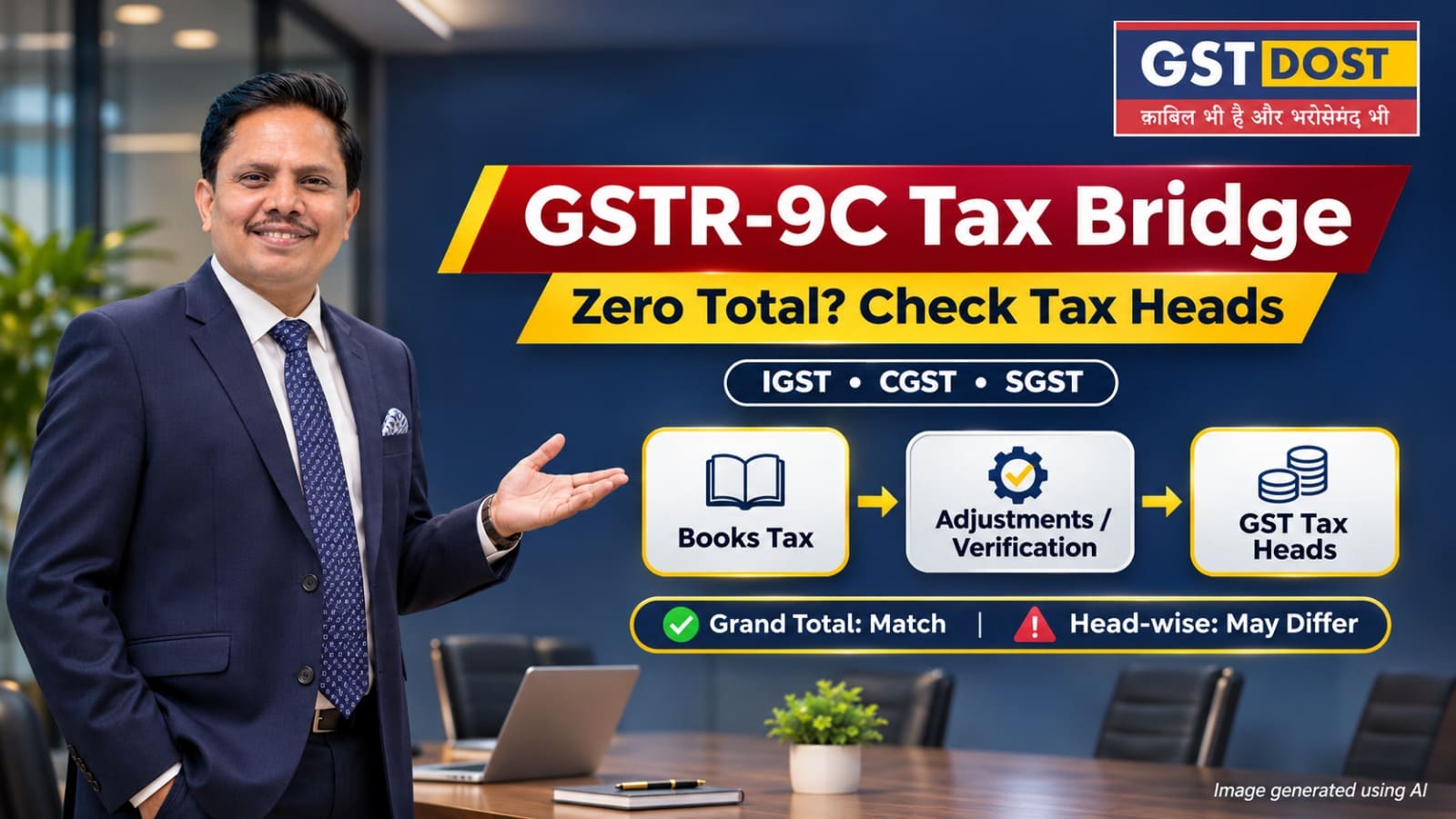
GST is paid under separate heads: IGST on supplies between States, and CGST with SGST or UTGST on supplies within a State. A company's total GST for the year can agree with its books to the rupee while the amounts under the individual heads are wrong. That happens when a supply is treated as inter-State when it was intra-State, or the other way round. Tax paid under one head does not settle a liability under another, so the tax reconciliation in GSTR-9C has to be read head by head.
In simple terms
- Check IGST, CGST, SGST or UTGST and cess separately. A matching grand total proves little.
- Where tax was paid under the wrong head, the law provides for payment under the correct head and a refund of the tax paid wrongly. The two heads are not netted off.
- A head-wise difference is a question to investigate. It becomes a correction only after the underlying transactions are verified.
Why this matters
The usual causes are ordinary: a wrong decision on the place of supply, a customer's State recorded incorrectly, a tax code mapped to the wrong head in the accounting software, or an invoice classified wrongly. Each of them moves tax from one head to another without changing the total.
A review that compares only total tax as per books with total tax as per returns will pass such a file. The error stays until someone asks for the figures head by head.
Where GSTR-9C tests this
Part III of GSTR-9C reconciles the tax paid. Its main table is laid out rate by rate, with separate columns for central tax, State or UT tax, integrated tax and cess.
| GSTR-9C table | What it contains |
|---|---|
| Table 9 | Reconciliation of rate-wise liability and the amount payable on it, for each tax head |
| 9P | Total amount to be paid as per the rows above |
| 9Q | Total amount paid as declared in the annual return (GSTR-9) |
| 9R | Unreconciled payment of amount |
| Table 10 | Reasons for the unreconciled payment |
| Table 11 | Additional amount payable but not paid, for the reasons given in the reconciliation tables |
Because Table 9 has a column for each head, a difference of the kind described here shows up in 9R as a positive figure under one head and a negative figure under another. It disappears only when the columns are added together.
FY 2025-26 form: GST rates changed during the year. Notification No. 05/2026-Central Tax dated 26 October 2026 amended only the instructions to GSTR-9C and did not change the rows of Table 9 or Table 11. Check on the current form which row each rate goes into before filling the table.
Build a three-way bridge
For each tax head, keep three independent figures side by side:
- Liability recomputed from verified invoices, by rate, type of transaction and place of supply.
- Liability declared in GSTR-9 and in the GSTR-1 and GSTR-3B returns behind it.
- Tax actually paid, verified from the returns filed and the ledgers on the portal.
Rate, place of supply, reverse charge, amendments and credit notes can each affect the correct allocation. Equality at the level of the total is not evidence that every head is right.
Practical example
After checking the source invoices, a review recomputes the tax for the year from those invoices and compares it with the figures reported in the annual return.
| Tax head | From invoices | In annual return | Difference |
|---|---|---|---|
| IGST | ₹7,20,000 | ₹7,00,000 | ₹20,000 short |
| CGST | ₹2,80,000 | ₹2,90,000 | ₹10,000 excess |
| SGST | ₹2,80,000 | ₹2,90,000 | ₹10,000 excess |
| Total | ₹12,80,000 | ₹12,80,000 | Nil |
Illustrative figures only.
The net difference is nil. Yet IGST is short by ₹20,000, and CGST and SGST are each higher by ₹10,000. No adjustment should be assumed until the underlying transactions are verified. The difference may turn out to be a mapping error in the working, a timing difference, or a real wrong-head payment.
If it is a real wrong-head payment
Section 77 of the CGST Act and section 19 of the IGST Act deal with tax paid under the wrong head because a supply was treated as intra-State or inter-State incorrectly. Section 77(1) provides for refund of the CGST and SGST paid on a supply that is later held to be inter-State. Section 77(2) says that a person who paid IGST on a supply later held to be intra-State is not required to pay interest on the CGST and SGST payable. Section 19 of the IGST Act has the corresponding provisions.
CBIC Circular No. 162/18/2021-GST dated 25 September 2021 explains how this works:
- The refund is available whether the taxpayer finds the error or a tax officer holds so in a proceeding. In either case the tax has to be paid under the correct head.
- Under rule 89(1A), the refund is claimed in FORM GST RFD-01 within two years from the date of payment of tax under the correct head.
- No refund is available where the tax has already been adjusted by issuing a credit note under section 34 for the same transaction.
In the example, if verification shows that an inter-State supply was treated as intra-State, the route is to pay ₹20,000 of IGST and to seek refund of the ₹10,000 each of CGST and SGST. The framework does not allow the heads to be set off against each other informally.
Forms are changing: Notification No. 05/2026-Central Tax substitutes FORM GST RFD-01 with effect from 1 December 2026 and makes a small change in rule 89(1A) from 1 November 2026. Use the form and procedure in force on the date the refund is applied for.
Action points
If you own or manage the business
- Ask for the tax reconciliation head by head. A single line saying that total GST agrees with the books is not enough.
- Ask how the place of supply is decided. Find out who decides whether a sale is inter-State or intra-State, and how customer State details are kept up to date.
- Do not approve netting. If a wrong-head payment is confirmed, the correction is payment under the correct head and a refund claim, with advice on interest and time limits.
- Read Tables 9 to 11 before signing. GSTR-9C is certified by the taxpayer. Look at the reasons given for any unreconciled amount.
If you prepare or review GSTR-9C
- Recompute taxable supplies and tax by rate, type of transaction, place of supply and tax head.
- Reconcile that computation with GSTR-1 and GSTR-1A, GSTR-3B and the relevant GSTR-9 disclosures.
- Verify the tax actually paid from the returns filed and the electronic ledgers, separately from what the returns declare.
- Investigate every significant head-wise variance, even where the total tax matches.
- Record the reason for each: timing, data mapping, place-of-supply error, wrong rate or unreported liability.
- Take real errors forward for advice on correction, payment, interest and possible refund under the proper provision.
Red flag: The totals of all tax heads reconcile, but IGST and CGST or SGST individually differ from independently computed figures.
Records to keep: The invoice-level mapping of rate and place of supply, the tax-head computations, the GSTR-1, GSTR-3B and GSTR-9 filed, extracts of the payment ledgers, the explanation for each exception and a note of who reviewed it.
A note on audit standards: The Institute of Chartered Accountants of India (ICAI) released a revised Implementation Guide to SA 230, Audit Documentation, in August 2026. Its idea of an evidence trail, covering source, calculation, review and conclusion, is a useful model for this file. It is a method of working. It is not a GST audit requirement, and GSTR-9C remains a statement certified by the taxpayer.
What you should have at the end: A clear answer on each head-wise difference: a presentation issue, a real wrong-head payment that needs corrective payment and a refund claim, or a documented timing difference.
Practical takeaway
Reconcile IGST, CGST, SGST or UTGST and cess separately. A correct grand total is not sufficient evidence that GST was paid correctly.
Terms used in this article
- Tax heads: IGST, CGST, SGST and UTGST
- IGST (integrated tax) is charged on inter-State supplies. CGST (central tax) and SGST (State tax) or UTGST (Union territory tax) are charged together on supplies within a State or Union territory.
- Inter-State and intra-State supply
- A supply is inter-State when the location of the supplier and the place of supply are in different States, and intra-State when they are in the same State.
- Place of supply
- The place where a supply is treated as made under the GST law. It decides which State the tax goes to and which tax head applies.
- GSTR-9 and GSTR-9C
- GSTR-9 is the annual return. GSTR-9C is the reconciliation statement that compares it with the audited financial statements, certified by the taxpayer.
- FORM GST RFD-01
- The application form for claiming a refund under GST.
Sources and references
- FORM GSTR-9C, Part III (Tables 9 to 11), Central Goods and Services Tax Rules, 2017.
- Central Goods and Services Tax Act, 2017 (India Code) - section 77. See also section 19 of the Integrated Goods and Services Tax Act, 2017.
- CBIC Circular No. 162/18/2021-GST dated 25 September 2021 - refund of tax under section 77(1) of the CGST Act and section 19(1) of the IGST Act.
- Notification No. 05/2026-Central Tax dated 26 October 2026, G.S.R. 919(E) - paragraphs 19, 57 and 58 (Gazette copy).
- GSTN user manual - Create and Submit GSTR-3B.
- ICAI - Revised Implementation Guide to SA 230, Audit Documentation (August 2026).
Disclaimer: This article is for general information only and reflects the position as understood on the review date mentioned above. It is not legal advice and does not create a professional relationship. Whether a supply is inter-State or intra-State, and how an error is to be corrected, depends on the facts and documents of each case. Figures in the example are illustrative. Forms and portal behaviour can change, so confirm against the notified form and the live GST portal before filing. Please obtain professional advice before acting on this article.
GST DOST | GST Annual Return, Reconciliation and Professional Advisory

Related posts
Rule 37A Before 30 November 2026: A Supplier Can Report Your Invoice and Still Put Your ITC at Risk...
GSTR-9C Tax Reconciliation: A Zero Total Difference Can Hide a Wrong Tax Head...
180-Day Vendor Payment Test: Use Excel to Find ITC Reversals Hidden in Old Creditors...
Goods Sent to Another Factory for Processing: Who Is Responsible for GST Job Work Records and ITC-04?...
