


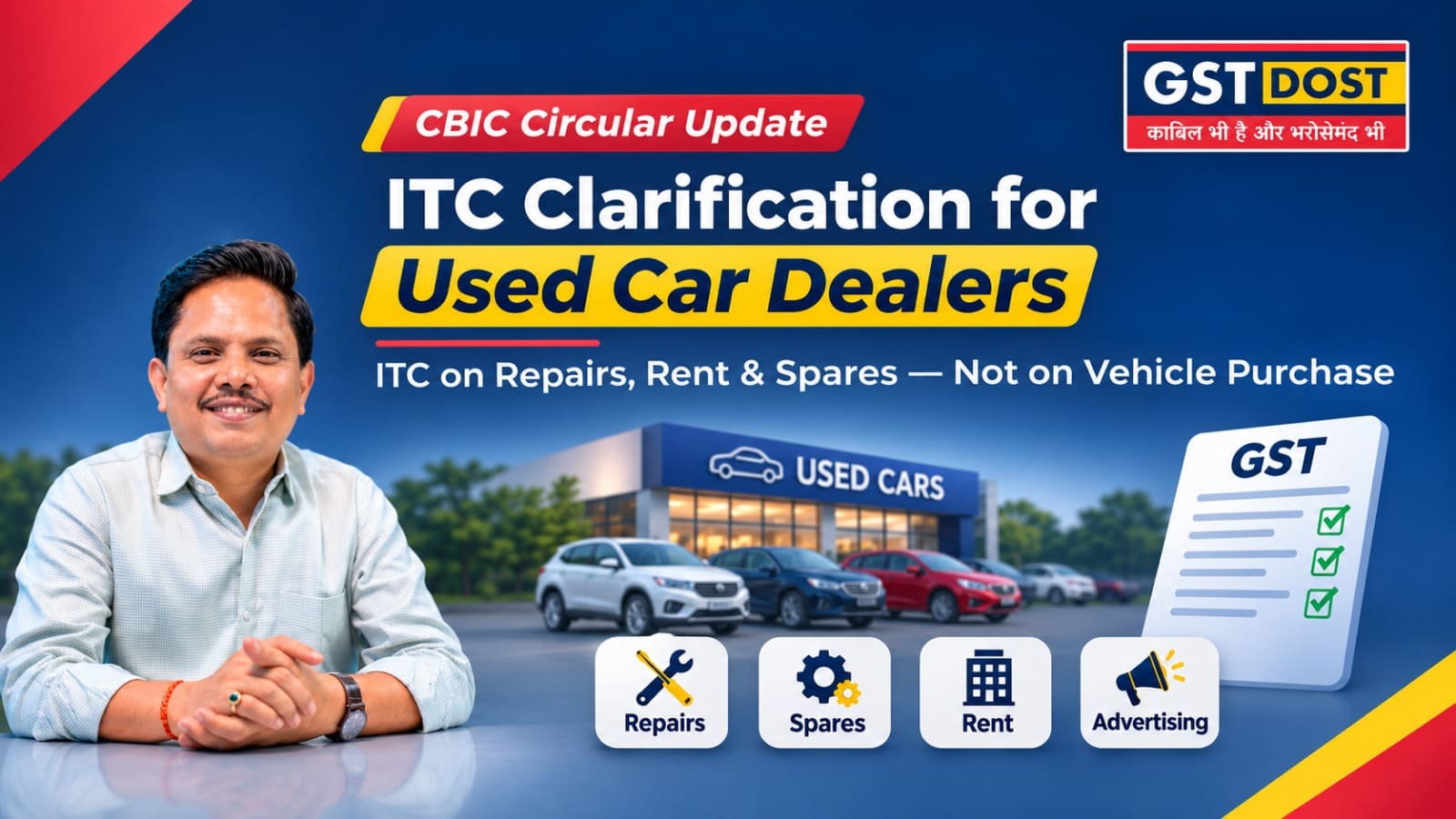
A used-car dealer following the GST margin scheme should not assume that all business-related Input Tax Credit is prohibited.
CBIC has clarified an important issue concerning the GST treatment of businesses selling old and used motor vehicles.
The clarification is contained in Circular No. 265/11/2026-GST, dated 28 October 2026.
It explains the scope of the ITC restriction attached to the special GST margin scheme for old and used motor vehicles.
The distinction is important:
ITC on tax paid when procuring the second-hand vehicles themselves remains restricted under the relevant margin scheme.
ITC on other eligible business inputs and input services is not automatically restricted merely because the dealer follows that scheme.
Normal ITC eligibility conditions under the CGST Act continue to apply.
1. What Was the Earlier Confusion?
The special GST framework for old and used motor vehicles is connected with the following notifications dated 25 January 2018:
Notification No. 08/2018–Central Tax (Rate)
Notification No. 09/2018–Integrated Tax (Rate)
Notification No. 01/2018–Compensation Cess (Rate)
These notifications contained an ITC-related condition.
A question arose:
Does this condition prevent the dealer from claiming ITC on every business expense?
Or does it restrict ITC only on the purchase of the old and used vehicles being sold under the margin scheme?
For example, a used-car dealership may incur GST on showroom rent, vehicle repairs, spare parts and advertising.
Would all such ITC be disallowed simply because the dealer uses the margin scheme?
CBIC has now clarified that the restriction is not so broad.
2. What Exactly Has CBIC Clarified?
Paragraph 3.2 of Circular No. 265/11/2026-GST provides the answer.
The restriction applies to tax paid on the second-hand vehicles procured under the relevant scheme.
It does not automatically extend to other inputs or input services used in carrying on the business.
CBIC specifically mentions the following categories:
| Business expense | Position under the clarification |
|---|---|
| Purchase of the second-hand vehicle itself | Special margin-scheme ITC restriction continues |
| Spare parts used in the business | ITC may be available, subject to CGST Act |
| Repair and maintenance services | ITC may be available, subject to conditions |
| Showroom or office rent | ITC may be available, subject to conditions |
| Technology services | ITC may be available, subject to conditions |
| Marketing and advertising services | ITC may be available, subject to conditions |
Important: The Circular removes a particular interpretational difficulty. It does not override Sections 16 and 17 or other applicable GST restrictions.
3. A Simple Business Example
Imagine a registered used-car dealership operating in Kolkata.
The dealer buys old cars and sells them under the applicable GST margin scheme.
The business also pays for several services:
A workshop repairs and prepares selected vehicles for resale.
A GST-registered landlord charges rent for the showroom.
A digital advertising agency promotes the dealership's available cars.
The dealership receives the relevant tax invoices for these expenses.
The owner asks:
“We are using the GST margin scheme. Does that mean we cannot claim any ITC?”
The answer is not automatically.
Under CBIC's clarification, the special margin-scheme restriction does not extend to all these other inputs and input services.
However, the dealer must still verify the actual invoices, business use, eligibility conditions and applicable restrictions.
This example is hypothetical. It does not establish the ITC entitlement of any particular dealer.
4. Can the Dealer Claim ITC on the GST Charged When Purchasing a Used Car?
The dealer must examine the specific margin-scheme conditions.
The Circular makes clear that the relevant restriction continues to apply to the tax paid on the procured second-hand motor vehicles themselves.
Therefore, a dealer should not treat the clarification as permission to claim ITC on the very vehicles being sold under that margin scheme.
The purchase of the vehicle and the purchase of other business goods or services must be examined separately.
This distinction is the central practical lesson of the Circular.
5. Does Every Repair or Advertising Invoice Automatically Qualify for ITC?
No.
Normal ITC requirements remain relevant.
These include the applicable conditions under Section 16 and restrictions under Section 17 of the CGST Act.
Depending on the transaction, the business should examine:
-
Whether the expense is genuinely connected with the business.
-
Whether the appropriate tax invoice and prescribed records are available.
-
Whether the goods or services have actually been received.
-
Whether the relevant ITC reporting and statutory conditions are satisfied.
-
Whether any blocked-credit or apportionment provision applies.
-
Whether the statutory time limit for claiming the credit has been satisfied.
A dealership should not claim ITC merely because an expense has been described as “advertising”, “repair” or “rent”.
The substance and supporting records matter.
Likewise, a dealer should not automatically disallow eligible business ITC simply because it follows the margin scheme.
6. What About Expenses and ITC From Earlier Financial Years?
This requires particular care.
The Circular clarifies the interpretation of the existing margin-scheme condition.
However, it does not create an unrestricted fresh period for claiming old ITC.
For historical transactions, the dealer must examine the law applicable to the relevant period, including the prescribed ITC time limits and any other applicable conditions.
Do not automatically reclaim all previously unclaimed or reversed ITC merely because this Circular has been issued.
Where a prior departmental dispute or notice involves this specific issue, the Circular may be relevant to the legal examination.
The correct approach depends on the actual records and procedural position.
7. Who Should Review This?
This advisory may be relevant to businesses engaged in buying and selling old or used motor vehicles under the notified margin scheme.
Particularly relevant businesses may include independent second-hand car dealers, multi-brand used-car dealerships and other eligible motor-vehicle traders.
However, not every business selling a used vehicle necessarily falls under the same margin-scheme arrangement.
The seller's actual GST treatment and transaction structure must be verified first.
8. Check This Today — 5 Minute Self-Check
Ask your Accounts or GST Manager to answer YES / NO / NOT SURE.
| Question | Response |
|---|---|
| Have we confirmed whether the relevant vehicle sales fall under the notified margin scheme? | |
| Have vehicle-purchase invoices been separated from other business expenses? | |
| Is ITC on the procured used vehicles treated according to the applicable restriction? | |
| Have we identified GST charged on spare parts and repair services? | |
| Have showroom rent and advertising expenses been reviewed separately? | |
| Have relevant GSTR-2B and invoice records been reconciled? | |
| Have the normal Section 16/17 eligibility requirements been examined? | |
| Have older unclaimed or reversed credits been identified without automatically reclaiming them? | |
| Is one responsible person coordinating the review? |
A NO or NOT SURE answer does not automatically mean that the dealer has made an incorrect GST claim.
It identifies a matter requiring verification.
9. What Documents Should You Keep Ready?
Used-Vehicle Purchase and Sale Records
Evidence supporting the margin-scheme treatment
Maintain the relevant vehicle-purchase documents, sale invoices, transaction values and the basis for applying the scheme.
Expense Tax Invoices
Evidence supporting ITC eligibility
Keep invoices for repairs, maintenance, spare parts, rent, advertising, technology and other relevant business expenses.
Purchase and Expense Ledgers
Accounting records
Separate the purchase cost of vehicles from the other goods and services used in the business.
GSTR-2B and ITC Records
Evidence supporting compliance
Compare the relevant invoices with available GST data and actual ITC claims.
GSTR-3B Records
Required return records
Maintain the relevant ITC reporting and reversal information.
Prior-period ITC Working
Evidence supporting legal review
Where relevant, identify historical ITC treatment, any reversal already made and the applicable statutory time limits.
Management Review Note
Good practice
Record which credits are eligible, ineligible or require further examination.
10. If You Find a Problem
Situation 1: All Business ITC Was Disallowed Merely Because the Dealer Uses the Margin Scheme
Immediate Action: Identify the actual expense categories and review the specific reasons for disallowance.
Responsible Person: GST Professional.
Evidence: Expense invoices, original ITC working and applicable statutory provisions.
Do not automatically book a new ITC claim before reviewing eligibility and time limits.
Situation 2: ITC Was Claimed on the Purchase of Used Vehicles
Immediate Action: Verify the relevant vehicle transactions and the special margin-scheme conditions.
Responsible Person: Accounts Manager and GST Professional.
Evidence: Vehicle-purchase invoices and scheme-related working.
Situation 3: Repair and Advertising ITC Is Unclear
Immediate Action: Review selected expense invoices and determine the applicable Section 16/17 position.
Responsible Person: GST Compliance Professional.
Evidence: Tax invoices, business-use records, GSTR-2B and ledger entries.
Situation 4: Historical Credits Were Not Claimed
Immediate Action: Verify the relevant financial year, statutory time limit and the original reason for non-availment.
Responsible Person: Senior GST Professional.
Do not assume that the Circular reopens every expired ITC claim.
Situation 5: A Departmental Notice Involves This Specific ITC Restriction
Immediate Action: Compare the actual allegation with paragraph 3.2 of the Circular and the relevant notification conditions.
Responsible Person: Senior GST Legal Professional.
Detailed legal submissions and reply drafting should be based on the individual case records.
11. Legal References — Verified Primary Sources
CBIC Circular No. 265/11/2026-GST
Date: 28 October 2026
Issued by: Government of India, Ministry of Finance, Department of Revenue.
Relevant provisions: Paragraphs 3.1 and 3.2.
Clarification: The special ITC restriction under the relevant used-motor-vehicle margin-scheme notifications applies to tax paid on the procured second-hand vehicles, not automatically to other eligible business inputs and input services.
Notification No. 08/2018–Central Tax (Rate)
Date: 25 January 2018.
Provides the relevant special GST framework for old and used motor vehicles, including the associated ITC condition.
The corresponding IGST and Compensation Cess notifications are identified in paragraph 3.1 of the verified Circular.
CGST Act, 2017 — Sections 16 and 17
Existing statutory requirements
Section 16 governs the general eligibility and conditions for ITC.
Section 17 contains relevant restrictions, apportionment and blocked-credit provisions.
One Small Improvement for Today
Ask your Accounts Manager to select one repair invoice, one showroom-rent invoice and one vehicle-purchase invoice, and verify whether their respective ITC treatments correctly reflect the CBIC clarification and the applicable CGST Act provisions.
Need Professional Support?
A used-motor-vehicle business following the GST margin scheme may benefit from a focused GST Margin Scheme & ITC Health Check.
The review can examine selected vehicle transactions, other business expenses, ITC claims and relevant statutory conditions.
The objective is to identify genuine compliance issues and legally supportable credit positions—not promise automatic tax savings.
GST DOST | GST Advisory, ITC Reconciliation & Professional Support

Related posts
Important CBIC Clarification: Used-Car Dealers May Claim ITC on Repairs, Rent, Spares and Other Eligible Business Expenses...
Yes, Police Can Attach Bank Accounts in GST Cases. But Only If They Follow the Law...
Nairson Multiventures Case: Why GST Cancellation Without Due Process Failed...
GST Summons Is Not a Punishment — Don’t Panic Before the Law Does...
