


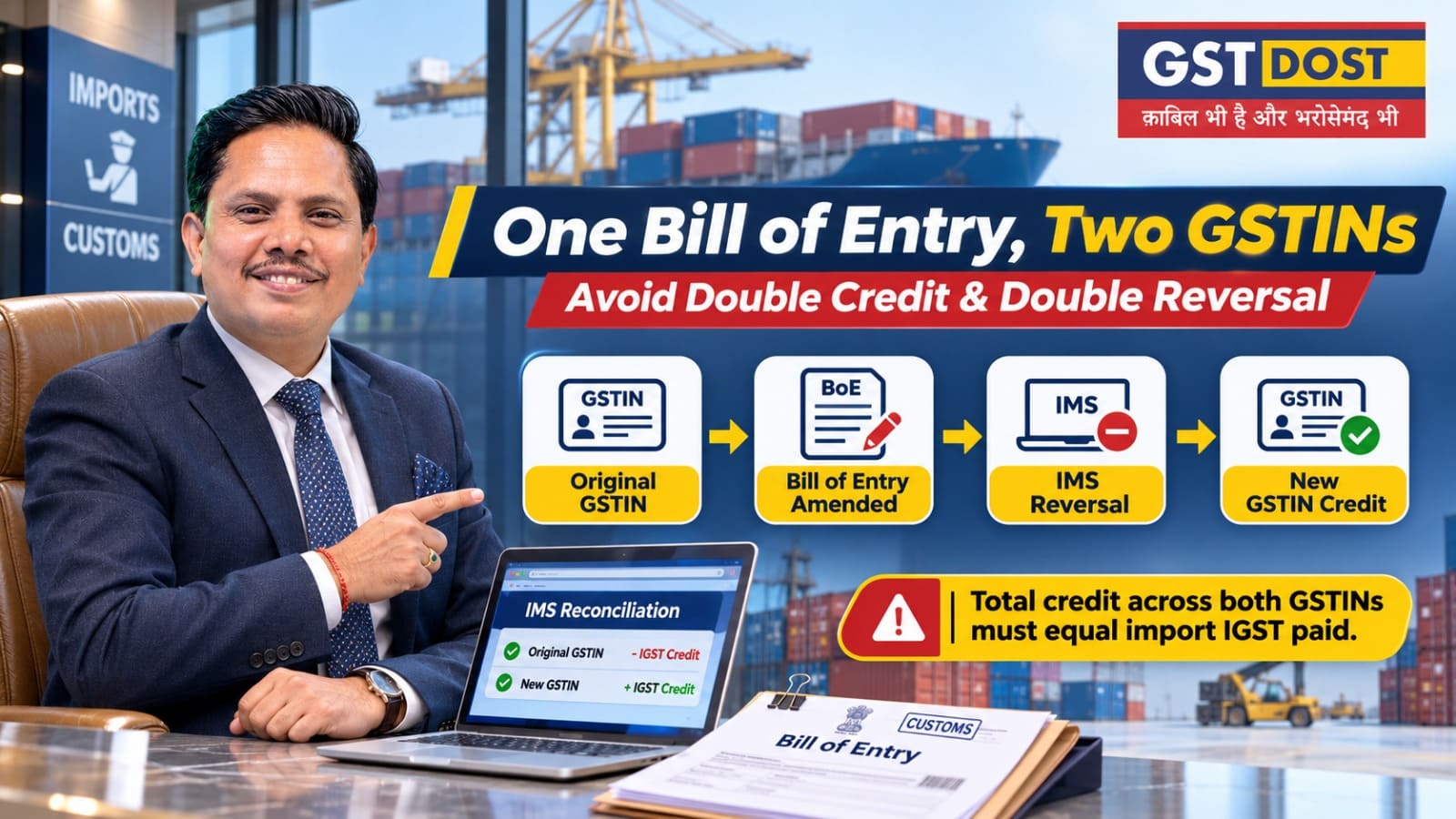
A company with registrations in several States imports goods. The Bill of Entry is filed with the GSTIN of one State, and that registration takes credit of the integrated tax paid at Customs. Later the Bill of Entry is amended to carry the GSTIN of another State. The GST portal now moves the credit from the first registration to the second. If each registration is reconciled on its own, two mistakes are easy to make. The same credit stays in both registrations, or the first registration reverses it twice.
In simple terms
- Credit of IGST paid on imports is taken on the Bill of Entry. The GSTIN on the Bill of Entry decides which registration sees it on the portal.
- From the October 2025 tax period, Bills of Entry appear in the Invoice Management System (IMS). When the GSTIN is amended, the portal shows a reversal entry to the earlier GSTIN and gives the credit to the new one.
- The earlier GSTIN can tell the portal how much it has already reversed. If it says nothing, the full amount is reduced.
Why this matters
Each registration files its own monthly returns and its own annual return. The two are often handled by different people in different offices. The portal now does part of the correction on its own, so a correction that someone made by hand earlier can be repeated by the system. A review of the annual return for FY 2025-26 should therefore look at such a Bill of Entry across both registrations together.
What the law says
- The document: Rule 36(1)(d) of the CGST Rules allows credit on the basis of a bill of entry, or a similar document prescribed under the Customs law for assessing integrated tax on imports.
- The conditions: The other conditions for credit still apply. The goods must be received and used for the business, and the credit must not be blocked under section 17(5).
- The tax: Only the integrated tax on the Bill of Entry, and compensation cess where it was charged, is input tax. Basic customs duty and social welfare surcharge are customs duties and are not available as GST credit.
What the portal does
GSTN's advisory dated 30 October 2025 brought Bills of Entry into IMS. Its main points are below.
The advisory explains how the portal works. It does not deal with interest. It also reminds taxpayers that GST is self-assessed, so each registration still has to satisfy itself that the credit is eligible.
How it goes wrong
Practical example
A company imported goods and paid IGST of ₹1,20,000. Its West Bengal GSTIN was on the Bill of Entry and claimed the whole amount. The Bill of Entry was later amended to the Maharashtra GSTIN. Before the amendment reached IMS, West Bengal had already reversed ₹30,000 of this credit in an earlier GSTR-3B.
Illustrative figures only.
What West Bengal declares in IMS decides the outcome.
The test is simple. For each Bill of Entry, add up the credit held by every registration of the company. The total cannot be more than the IGST paid on that Bill of Entry.
Maharashtra has its own check to make. A new entry on the portal gives it a figure. Whether it received the goods, uses them for its business and is not hit by a blocked-credit rule is for Maharashtra to confirm. If the goods are in fact used by another registration, their movement between the two registrations is a separate supply with its own tax invoice.
What to check in each GSTIN's annual return
GSTN has not published an FAQ on how a GSTIN amendment should appear in the annual return of each registration. The points below follow from the form's instructions and from GSTN's FAQs on imports. Treat them as points to check and document.
On interest: Where the earlier GSTIN had used the credit before reversing it, examine section 50(3), which charges interest on credit wrongly availed and utilised. Take advice on the facts before paying or ignoring it.
On the time limit: Section 16(4) sets its time limit by reference to an invoice or a debit note. Whether it applies to a Bill of Entry is debated. Where an amendment reaches the new GSTIN long after the import, take advice before the credit is claimed.
Looking ahead: At its 57th meeting on 8 October 2026, the GST Council recommended a new sub-rule in rule 60 on accepting, rejecting or keeping documents pending on the portal. It is part of a wider change that may apply from the return for April 2027. It is not in force, and the present process continues.
Action points
If you own or manage the business
- Get the GSTIN right at the start. Tell the customs broker, consignment by consignment, which registration is importing.
- Ask for one list of amended Bills of Entry for the whole company. A State-wise list hides the other half of each amendment.
- Make one person responsible for both sides. The reduction in one registration and the credit in the other should be signed off together.
- See that the IMS question is answered. If the earlier GSTIN had already reversed the credit, the lower figure has to be declared before its GSTR-3B is filed.
- Do not treat a portal entry as proof of eligibility. It shows what the system offers. Eligibility is still the taxpayer's call.
If you prepare or review the returns
- List the Bills of Entry of the year for every GSTIN of the company, from GSTR-2B and from the customs records. Mark those with the amendment type GSTIN.
- For each of them, write one line that covers both GSTINs: IGST paid, credit claimed, credit reversed by hand, reduction through IMS and credit received, with the month of each.
- Check that the credit held by all registrations together is not more than the IGST paid.
- Match every step to the filed GSTR-3B. An entry in IMS or GSTR-2B does not prove what was filed.
- If a Bill of Entry or its amendment is missing on the portal, use the Search BoE facility, which needs the port code, the number and date of the Bill of Entry and a reference date.
- Carry each step into the right table of each GSTIN's GSTR-9, and note the reasoning.
- Raise questions on eligibility, timing and interest before any correction is made.
Red flag: Both GSTINs hold credit for the same Bill of Entry, or the returns of the earlier GSTIN show the same credit reversed twice.
Records to keep: One history for each amended Bill of Entry: port code, number and date, the original and amended GSTIN, the date of amendment, IGST paid and the payment challan, the months of claim and reversal in each GSTIN, the IMS and GSTR-2B downloads, and the goods receipt.
What you should have at the end: A two-GSTIN statement for every amended Bill of Entry, showing that the credit is held once, by the right registration, and where each step sits in the two annual returns.
Practical takeaway
Follow the Bill of Entry across both registrations. Reconciling only the latest entry on the portal, one GSTIN at a time, is how credit ends up counted twice or given up twice.
Terms used in this article
- Bill of Entry (BoE)
- The Customs document filed for clearing imported goods. It shows the duties and the IGST paid, and the GSTIN of the importer.
- IGST on imports
- The integrated tax collected by Customs on imported goods. It is available as input tax credit, subject to the usual conditions.
- GSTIN
- The GST registration number. A company has a separate GSTIN in each State where it is registered.
- Invoice Management System (IMS)
- The facility on the GST portal where a recipient acts on documents before they flow into GSTR-2B.
- GSTR-2B
- The monthly statement on the portal that shows the credit available to a registration.
- ICEGATE
- The Customs portal from which Bill of Entry data reaches the GST portal.
- IMPG and IMPGA
- The sections of IMS and GSTR-2B for Bills of Entry and for amendments to them.
Sources and references
- GSTN advisory on Bill of Entry in IMS dated 30 October 2025 - actions allowed, GSTIN amendment, reversal entry for the earlier GSTIN.
- GSTN FAQs on GSTR-2B - import data from ICEGATE, flow to Table 4(A)(1) of GSTR-3B, Search BoE.
- CBIC - Rule 36, CGST Rules, 2017 - documents on which credit can be taken.
- GSTN consolidated FAQs on GSTR-9 and GSTR-9C dated 17 December 2025 - Table 8H1 for import credit taken in the next year.
- Central Goods and Services Tax Act, 2017 (India Code) - sections 16, 17(5) and 50(3).
- GST Council press release, 57th meeting, 8 October 2026 - recommended changes to the return mechanism from April 2027.
- Notification No. 13/2025-Central Tax dated 17 September 2025 - instructions to FORM GSTR-9 for Tables 8H1 and 12.
Disclaimer: This article is for general information only and reflects the position as understood on the review date mentioned above. It is not legal advice and does not create a professional relationship. Portal screens and processes can change, and the latest GSTN advisory should be checked before acting. Which registration is entitled to the credit, and how a correction is to be reported, depends on the documents and returns of each case. Figures in the example are illustrative. Please obtain professional advice before acting on this article.
GST DOST | GST Annual Return, Reconciliation and Technology-led Review

Related posts
Gold Coins for Dealers: Orient Cement Keeps Its ITC but Owes GST on 110% of Cost, Rules Telangana Appellate Authority...
Temple Hair Auctions and the 18% Clause: Telangana AAR Says Unworked Hair Is Exempt Goods, but the Ruling Binds the Bidder, Not the Temple...
A Three-Wheeler to the Railway Station Without Part-B: GSTAT Lucknow Refuses to Restore a Rs 4.86 Lakh E-Way Bill Penalty...
Filed Under the CrPC, Cognised Under the BNSS: Why the Jharkhand High Court Sent a GST Prosecution Back for a Hearing...
