


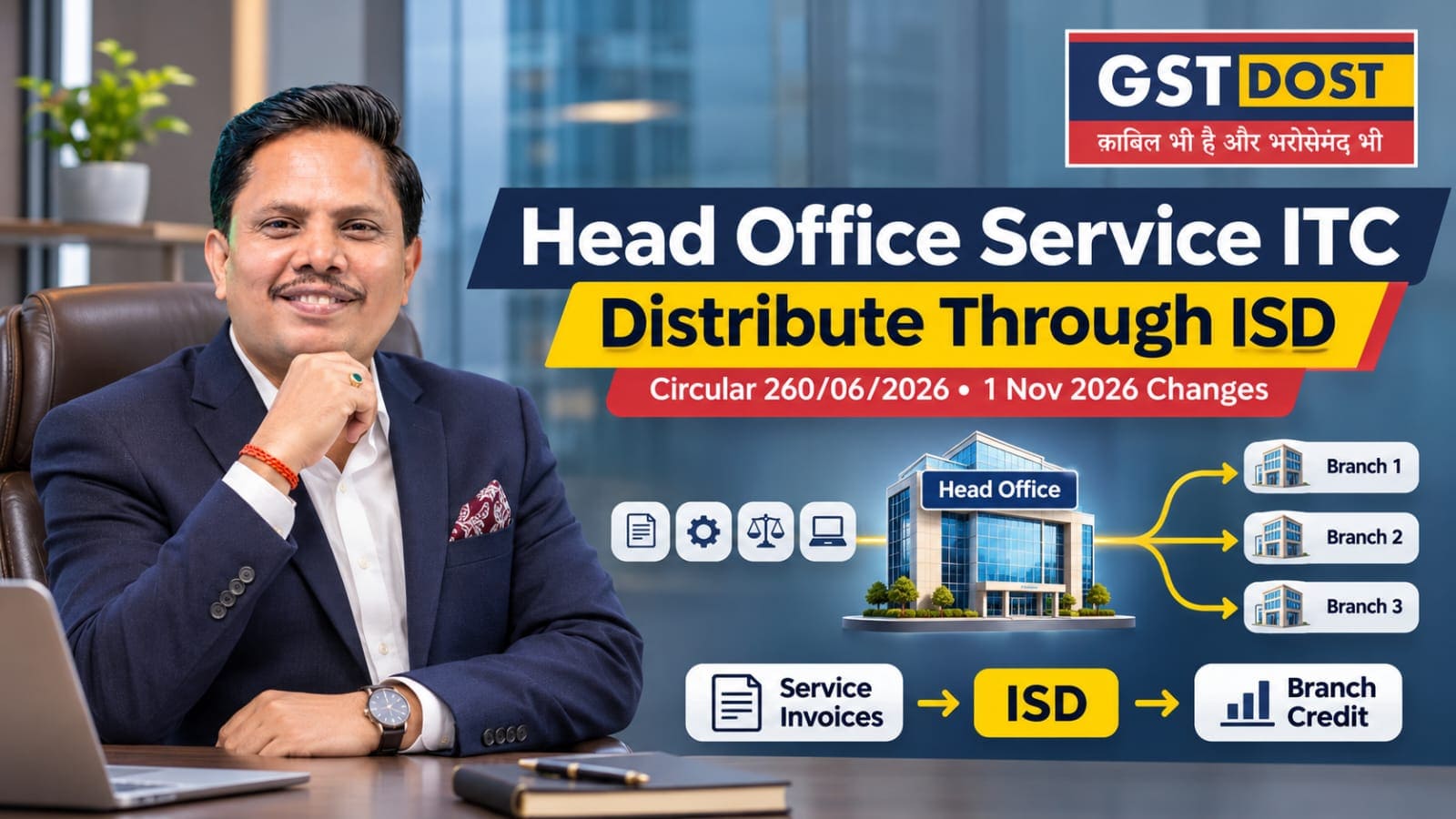
Many companies receive invoices for audit, legal, software, advertising or recruitment services at the head office, even though the services are used by branches registered in other States. Since 1 April 2025, such input service credit must be passed on through an Input Service Distributor (ISD) registration. CBIC Circular No. 260/06/2026-GST and amendments to the CGST Rules effective 1 November 2026 have now settled several practical questions on how this works.
Key takeaways
- From 1 April 2025, an office that receives input service invoices for other GST registrations of the same PAN (distinct persons) must register as an ISD and distribute the credit under section 20.
- The ISD distributes credit only to the registration to which the service is attributable. Common credit is distributed in proportion to turnover under rule 39, not equally.
- Circular 260/06/2026-GST (26 October 2026): more than one ISD per State is allowed; the ISD distributes the full credit; eligibility and reversals are the recipients' responsibility.
- Credit is available for distribution in the month in which the ISD finds it prima facie eligible, and must be distributed in that month.
- From 1 November 2026, rule 54(1A) allows transfer of reverse charge credit on services attributable to distinct persons, not only "common" services. Such transfers are not turnover or Net ITC for refund purposes.
- Wrong distribution is recovered from the recipients with interest, and the ISD can be penalised under section 122.
1. What is an Input Service Distributor?
Section 2(61) of the CGST Act, as substituted with effect from 1 April 2025 (Finance Act, 2024 read with Notification No. 16/2024-Central Tax), defines an ISD as an office of a supplier that receives tax invoices for input services, including services on which tax is paid under reverse charge, for or on behalf of distinct persons, and is liable to distribute that credit under section 20.
Different GST registrations of the same PAN are distinct persons. A Kolkata head office and a Delhi branch of the same company are therefore distinct persons for GST.
ISD is only for input services. It is not a route to distribute credit on goods or capital goods.
2. Before and after 1 April 2025
A genuine supply of services by one registration to another, for example staff of the head office actually rendering services to a branch, is a separate question of distinct-person supply and valuation. It is not the same as distributing third-party input service credit.
3. What Circular 260/06/2026-GST clarifies
Points 5 and 6 matter most to exporters and inverted duty refund claimants that also run an ISD in the same State: transfer amounts should be kept out of the refund formula.
4. What changed in the CGST Rules from 1 November 2026
Notification No. 05/2026-Central Tax dated 26 October 2026 (Central Goods and Services Tax (Amendment) Rules, 2026) made the following ISD-related changes from 1 November 2026:
ERP and return templates built on the earlier GSTR-6 layout should be checked against the current form on the portal.
5. A simple illustration
A company has three regular registrations: Kolkata (head office), Delhi and Bengaluru, and an ISD registration in West Bengal. An annual audit fee of Rs. 1,00,000 plus CGST Rs. 9,000 and SGST Rs. 9,000 is billed to the ISD and relates to all three units. Turnover of the relevant period, as defined in rule 39, is assumed as Kolkata Rs. 50 crore, Delhi Rs. 30 crore and Bengaluru Rs. 20 crore.
If the service were used only by Delhi, the entire Rs. 18,000 would go to Delhi. Equal splitting is not the rule. Each recipient then checks its own eligibility and reversals. This is a hypothetical illustration; actual distribution depends on attribution and the turnover data of the relevant period.
6. Reverse charge services and rule 54(1A)
An ISD cannot pay tax under reverse charge. Where, for example, legal services from an individual advocate are used by several units, a regular registration with the same PAN and State as the ISD pays the RCM tax, and then issues an invoice under rule 54(1A) to the ISD to transfer the credit. The ISD distributes it under rule 39.
From 1 November 2026, this applies to services attributable to one or more distinct persons, not only "common" services. The transferor must pass on the entire credit; it does not reduce the amount on account of its own reversal calculations.
7. GSTR-6 and reconciliation
An ISD files FORM GSTR-6 every month, ordinarily by the 13th of the following month, including a nil return where there is nothing to distribute. GSTR-6 is prepared from the auto-drafted GSTR-6A. Keep the purchase register, GSTR-6A, GSTR-6 and the recipients' GSTR-2B and GSTR-3B in agreement.
8. What is and is not an ISD transaction
9. Action points for businesses
- Check ISD registration.Now
If any office receives input service invoices for other registrations of the same PAN and has no ISD registration, take it now. Separate ISDs for verticals are permitted. - Ask vendors to bill the ISD GSTIN.This month
Common service invoices should carry the ISD GSTIN, not the head office's regular GSTIN. - Build an attribution working.Every month
For each invoice, record which registrations use the service and the turnover basis for common services. - Distribute in the month of eligibility check.Every month
Record when the ISD found the credit prima facie eligible, and distribute in that month, separating ineligible credit. - Route RCM credit through rule 54(1A).Every month
Pay RCM in the regular registration, transfer the full credit to the ISD, and keep it out of turnover and refund calculations. - Make each recipient own its eligibility.Ongoing
Branches should apply section 16 and 17 checks and rule 42/43 reversals on credit they receive. - Update ERP and GSTR-6 templates.This month
Align with the form as amended from 1 November 2026.
10. Action points for GST professionals
- Map clients with multiple GSTINs.
Identify those still keeping common service credit in the head office GSTIN after 1 April 2025. - Review refund claims.
For exporters and inverted duty claimants, exclude rule 54(1A) transfers from turnover and Net ITC as clarified. - Check distribution basis.
Test attribution and turnover ratios; equal splits and transfers to non-users invite recovery under section 21. - Separate ISD credit from cross-charge.
Do not let third-party service credit and genuine internal services get mixed in one invoice. - Use Circular 260 in pending notices.
Where notices question distribution timing, reversals at ISD level or multiple ISDs, compare the allegation with the clarification. - Treat pre-April 2025 periods separately.
For earlier periods, examine the law and judicial decisions then applicable before accepting an ISD-based objection.
11. Five-minute self-check
Ask your corporate finance or GST manager to answer YES, NO or NOT SURE:
A NO or NOT SURE is a signal to review, not an established GST default.
12. Documents to keep ready
- Registration master of all GSTINs and ISD registrations under the PAN.
- Input service register at the ISD with vendor, service, amount and tax.
- Attribution and turnover working for each month's distribution.
- ISD invoices issued to recipients, with eligible and ineligible credit shown separately.
- Rule 54(1A) invoices and RCM payment records.
- GSTR-6A and GSTR-6 for each month.
- Recipients' ITC and reversal workings.
- Refund workings showing exclusion of rule 54(1A) amounts, where applicable.
13. What if you find a problem?
14. Official sources
- CGST Act, 2017: sections 2(61), 20, 21, 25 and 122(1)(ix).
- Notification No. 16/2024-Central Tax dated 6 August 2024: amended sections 2(61) and 20 in force from 1 April 2025.
- CGST Rules, 2017: rules 36, 39, 54(1A), 60, 65 and 89.
- Notification No. 05/2026-Central Tax dated 26 October 2026: CGST (Amendment) Rules, 2026, ISD changes from 1 November 2026.
- Circular No. 260/06/2026-GST dated 26 October 2026: clarifications on ISD.
- GST portal user manual: FORM GSTR-6.
The Act, Rules, notifications and circular are available on taxinformation.cbic.gov.in and cbic-gst.gov.in; the GSTR-6 manual on tutorial.gst.gov.in.
Scope of this article: the article explains the general framework as on the review date. Individual ISD ledgers, refund claims and past-period positions have not been examined.
One small step for today: take three service invoices received at your head office this month and check which GSTIN they are billed to, which units use the service, and how the credit reached those units.
Need help with ISD compliance?
GST DOST offers a focused ISD Registration, Credit Distribution and GSTR-6 Health Check. The review covers:
- ISD registration and vendor billing
- Attribution and turnover-based distribution under rule 39
- RCM transfers under rule 54(1A) and refund computations
- GSTR-6A, GSTR-6 and recipient-level reconciliation
The objective is a supportable distribution process. It is not a promise of additional credit.
Disclaimer: This article is for general information only and reflects the position as understood on the review date mentioned above. It is not legal advice and does not create a professional relationship. The treatment depends on the facts of each case. Please obtain professional advice before acting on this article.
GST DOST | GST ISD, ITC Reconciliation and Professional Advisory

Related posts
One Head Office Pays for Services Used by Several Branches. Who Can Claim the GST Input Tax Credit?...
Rule 42 Annual True-Up: The September Date Has Passed, but the GSTR-9 Review Has Not...
Stock Transfers Between Two GSTINs: Match Dispatch and Receipt Before GSTR-9...
GSTR-9 Table 8C Is Not a Reclaim Register: Getting Tables 8A, 8C and 13 Right...
