


GSTR-9/9C Practical Guide
In most transactions the supplier collects GST and pays it to the Government. Under the reverse charge mechanism (RCM), the buyer pays the GST directly. That tax has to be paid in cash, and any credit for it is a separate entitlement with its own conditions. An accounting entry that books the RCM tax and an equal input tax credit (ITC) shows a net effect of zero. It does not show that the tax was paid, or that the credit was due. This article sets out a simple test to run before the annual return (GSTR-9) is filed.
In simple terms
- RCM tax is paid from the electronic cash ledger. A balance of ITC cannot be used to pay it.
- After paying it, the business can take credit of that tax only if it is otherwise eligible.
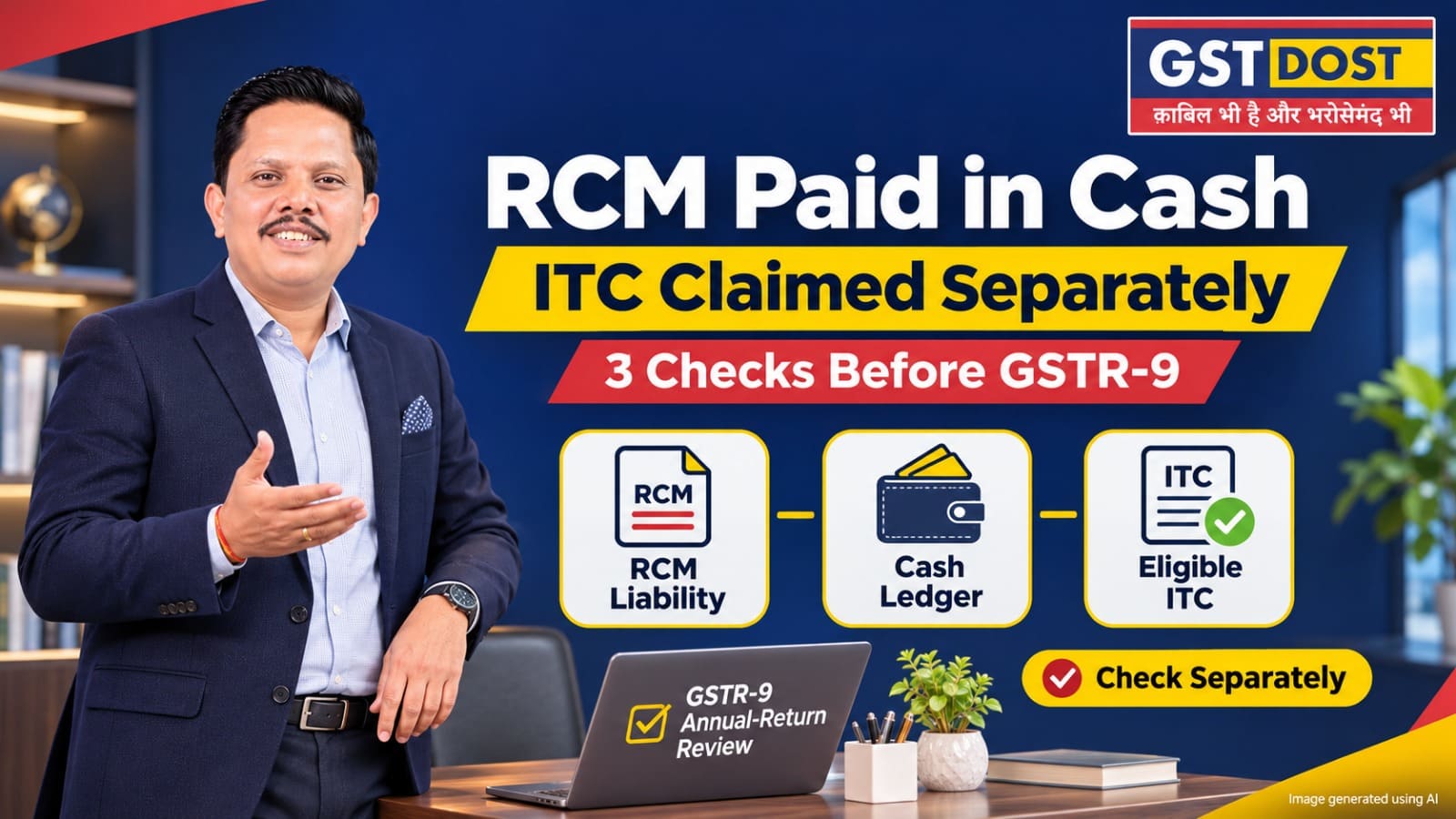
- Liability declared, cash paid and credit taken are three separate facts. Check each one on its own.
Why this matters
Reverse charge can produce a figure that looks perfect and proves nothing. The accounts show RCM tax as payable and the same amount as ITC, so the expense is unaffected and the entry appears harmless.
But the two legs travel through different places in the GST returns. The liability must be declared and paid in cash. The credit is claimed in a different table and only if the law allows it. A net-zero entry in the books cannot confirm either leg.
Paid in cash, credited separately
The explanatory note on reverse charge published by the Central Board of Indirect Taxes and Customs (CBIC) states the position plainly. Tax payable under reverse charge cannot be discharged by using input tax credit and has to be paid by debiting the electronic cash ledger. Once it is paid, the recipient can take credit of that tax, provided the recipient is otherwise eligible for it.
So a business can have a large ITC balance and still have unpaid RCM tax. And a business can pay RCM tax correctly and still not be entitled to the whole of it as credit.
Where each figure sits
| Return and table | What it shows |
|---|---|
| GSTR-3B, Table 3.1(d) | Inward supplies liable to reverse charge, and the tax on them |
| GSTR-3B, Table 6.1 | How the tax was paid, including the amount paid in cash |
| GSTR-3B, Table 4A(2) | ITC on import of services |
| GSTR-3B, Table 4A(3) | ITC on other inward supplies liable to reverse charge |
| GSTR-9, Table 4G | Inward supplies on which tax is to be paid on reverse charge basis, for the year |
| GSTR-9, Tables 6C, 6D, 6F | ITC availed on reverse charge supplies from unregistered persons (6C), from registered persons (6D) and on import of services (6F) |
The instructions to GSTR-9 allow Tables 6C and 6D to be reported together in Table 6D. Paragraph 56 of Notification No. 05/2026-Central Tax dated 26 October 2026 extends the year-wise instructions for Tables 6B, 6C and 6D to FY 2025-26 onwards. Read the instructions on the form before using the option.
Do not assume that every RCM payment produces an equal and immediately eligible credit. The annual ITC figure has to be classified on its own merits.
The portal's own check: RCM Liability/ITC Statement
The GST portal has a statement that does part of this test automatically. GSTN, the Goods and Services Tax Network that runs the portal, introduced the RCM Liability/ITC Statement through its advisory dated 23 August 2024. It captures the RCM liability shown in Table 3.1(d) of GSTR-3B and the corresponding ITC claimed in Tables 4A(2) and 4A(3), period by period. It applies from the tax period August 2024 for monthly filers and from the July to September 2024 quarter for quarterly filers, and is found under Services, then Ledger, on the portal.
A later GSTN advisory with FAQs, dated 29 December 2025, announced that the portal would stop allowing GSTR-3B to be filed where the RCM ITC claimed is more than the balance in this statement plus the RCM liability reported for the period. Check the balance in your statement before filing.
What the statement cannot tell you: It compares what was declared with what was claimed. It does not know whether every expense liable to reverse charge was declared in the first place, and it does not test whether the credit is eligible. Those two questions can be answered only from the books and the documents.
What a tax officer would compare
CBIC's Instruction No. 02/2022-GST dated 22 March 2022 set out a standard procedure for scrutiny of returns for FY 2017-18 and FY 2018-19. Its list of checks includes two on reverse charge:
- RCM liability in Table 3.1(d) is compared with ITC availed in Tables 4A(2) and 4A(3). Credit higher than the liability discharged may point to short payment of tax or to excess credit.
- RCM liability in Table 3.1(d) is compared with the tax paid in cash as per Table 6.1. Cash payment lower than the liability may point to short payment of tax.
That instruction was written for earlier years. Its logic is still a useful self-check. It is not a substitute for the current law or the current instructions on the portal.
Practical example
A company receives services that attract reverse charge. From its books, the RCM tax for FY 2025-26 works out to ₹1,80,000, and the same amount has been recorded as ITC. The GSTR-3B returns filed for the year show something different.
| Particulars | Amount |
|---|---|
| RCM tax computed from the books for the year | ₹1,80,000 |
| RCM liability declared in GSTR-3B and paid in cash | ₹1,50,000 |
| ITC claimed on reverse charge supplies | ₹1,80,000 |
| Difference to be explained | ₹30,000 |
Illustrative figures only.
The ₹30,000 difference calls for a month-wise review. Was a liability left out? Was credit taken early or in excess? Is it only a timing difference? Is the credit eligible at all? A balance in the electronic credit ledger does not cure the gap, because RCM tax is payable in cash.
The reverse situation is not automatically wrong. ITC that is lower than the RCM tax paid may be correct where the credit is blocked, restricted, deferred or otherwise ineligible.
Running the test in Excel
Prepare one sheet with these columns: GSTIN, period, type of reverse charge supply, tax computed from the books, tax declared in GSTR-3B, tax paid in cash, ITC claimed and explanation. Use a PivotTable to total the figures by period and by tax head. Flag every period in which:
- tax computed from the books differs from tax declared,
- tax declared is more than the cash payment, or
- ITC claimed is more than the eligible amount that can be explained.
A flag is a question, not a conclusion. Timing, adjustments and legal eligibility have to be examined before any difference is treated as a shortfall.
Data confidentiality: If an AI assistant is used to design the sheet, use dummy or authorised anonymised data. Do not upload confidential business or client records to a public AI service without permission and safeguards.
Action points
If you own or manage the business
- Ask for three figures, not one. For the year, ask for the RCM tax computed from the books, the RCM tax declared and paid in cash, and the ITC taken on it.
- Ask what is on your reverse charge list. Find out which of your expenses attract reverse charge, for example goods transport agency services, notified services from unregistered suppliers and import of services.
- Do not accept "it is net zero" as an answer. A net-zero entry in the accounts says nothing about cash payment or eligibility.
- Get a decision on each difference. Each one should end as a liability to be paid, a credit to be reversed, or a documented explanation.
If you prepare or review the GST returns
- Build a register of purchases and expenses liable to reverse charge from the expense ledgers and the relevant contracts.
- Note the legal basis of each item: goods transport agency services, notified services from unregistered suppliers, import of services and other applicable categories.
- Reconcile the RCM tax computed month-wise with Table 3.1(d) of GSTR-3B.
- Confirm the actual cash set-off from the returns filed and the payment records. A challan deposit alone does not show that the RCM liability was discharged.
- Compare eligible ITC with Tables 4A(2) and 4A(3) of GSTR-3B, with reversals, and with the Table 6 reporting in GSTR-9.
- Investigate every difference between liability and credit, and record a conclusion for each.
Red flag: The register shows supplies liable to reverse charge, but the GSTR-3B returns show nil RCM liability. Or credit appears without evidence that the liability was paid and that the credit is eligible.
Records to keep: The reverse charge register, a note on how each type of supply was classified, self-invoices where required, the RCM computation, records of cash set-off, the test of ITC eligibility, the list of exceptions and the name of the person who approved the conclusions.
What you should have at the end: A list that separates possible short-paid RCM liabilities, unsupported credits and legitimate differences, with a decision on each, in place of a misleading net-zero figure.
Practical takeaway
Test RCM tax liability, cash payment and eligible ITC as three separate facts.
Terms used in this article
- Reverse charge mechanism (RCM)
- Cases where the recipient of goods or services, and not the supplier, pays the GST to the Government.
- ITC (input tax credit)
- Credit for GST paid on purchases of goods or services used for business, subject to the conditions in the law.
- Electronic cash ledger
- The account on the GST portal that holds amounts deposited by the taxpayer. RCM tax is paid from it.
- Electronic credit ledger
- The account on the GST portal that holds the taxpayer's ITC.
- GSTR-3B and GSTR-9
- GSTR-3B is the monthly or quarterly summary return in which a taxpayer declares liability, pays tax and takes ITC. GSTR-9 is the annual return, which summarises the returns filed for a financial year.
- Import of services
- Services received from a supplier located outside India, on which the recipient in India pays tax under reverse charge.
- Self-invoice
- An invoice that the recipient issues when it receives supplies liable to reverse charge from an unregistered supplier.
- Blocked credit
- ITC that the law does not allow even though tax was paid, for example under section 17(5) of the CGST Act.
Sources and references
- CBIC explanatory note - GST: Reverse Charge Mechanism - payment through the electronic cash ledger and credit to the recipient.
- CBIC Instruction No. 02/2022-GST dated 22 March 2022 - SOP for scrutiny of returns for FY 2017-18 and 2018-19, Annexure B, serial number 2.
- GSTN advisory dated 23 August 2024 - Introduction of RCM Liability/ITC Statement.
- GSTN advisory and FAQs dated 29 December 2025 on the Electronic Credit Reversal and Re-claimed Statement and the RCM Liability/ITC Statement, under News and Updates on the GST portal.
- Notification No. 05/2026-Central Tax dated 26 October 2026, G.S.R. 919(E) - paragraph 56, instructions to FORM GSTR-9 (Gazette copy).
- GSTN user manual - Create and Submit GSTR-3B.
- Central Goods and Services Tax Act, 2017 (India Code) - sections 9(3), 9(4), 16, 17(5) and 31(3)(f).
Disclaimer: This article is for general information only and reflects the position as understood on the review date mentioned above. It is not legal advice and does not create a professional relationship. Whether a supply attracts reverse charge, and whether credit is eligible, depends on the facts and documents of each case. Figures in the example are illustrative. Portal behaviour and form instructions can change, so confirm against the live GST portal and the notified form before filing. Please obtain professional advice before acting on this article.
GST DOST | GST Annual Return, Reconciliation and Professional Advisory

Related posts
Rule 37A Before 30 November 2026: A Supplier Can Report Your Invoice and Still Put Your ITC at Risk...
GSTR-9C Tax Reconciliation: A Zero Total Difference Can Hide a Wrong Tax Head...
180-Day Vendor Payment Test: Use Excel to Find ITC Reversals Hidden in Old Creditors...
Goods Sent to Another Factory for Processing: Who Is Responsible for GST Job Work Records and ITC-04?...
