


GSTR-9/9C Practical Guide
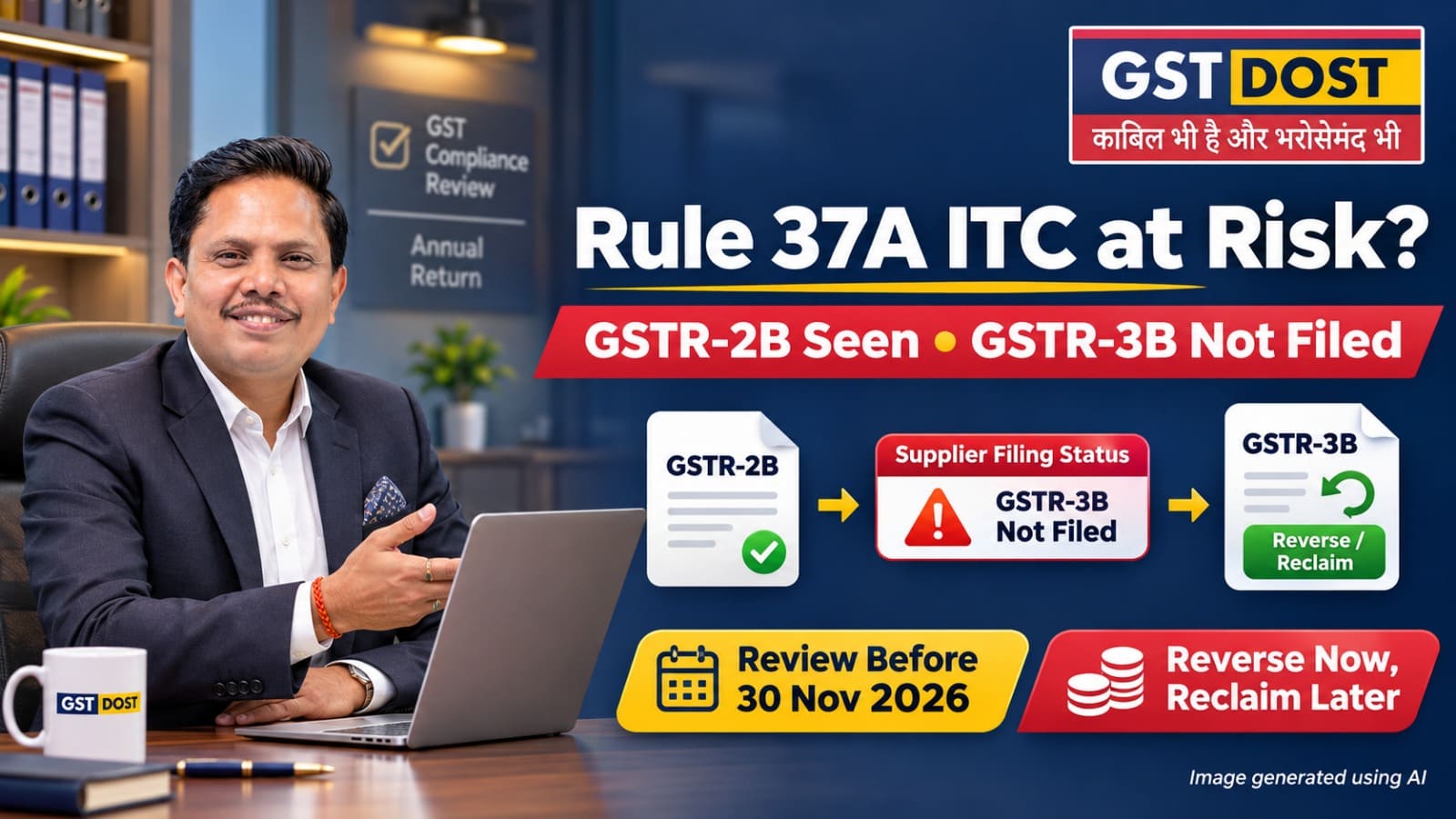
An invoice that appears in GSTR-2B shows that the supplier reported the sale. It does not show that the supplier filed the return in which the tax is paid. Rule 37A of the CGST Rules deals with that gap. Where the supplier has reported the invoice but has not filed its GSTR-3B for that period by 30 September after the year in which the buyer took the credit, the buyer has to reverse that input tax credit (ITC) by 30 November. For credit taken in FY 2025-26, those dates are 30 September 2026 and 30 November 2026.
In simple terms
- Seeing an invoice in GSTR-2B and the supplier having filed GSTR-3B are two different checks.
- For ITC taken in FY 2025-26, the supplier's filing is tested as on 30 September 2026, and the reversal has to go into a GSTR-3B filed on or before 30 November 2026.
- The credit is not lost for ever. It can be taken again after the supplier files that GSTR-3B.
Why this matters
Most ITC checks stop at GSTR-2B. If the invoice is there, the credit is treated as safe. Rule 37A adds a second question that is asked only once a year, and it is easy to miss because nothing in the buyer's own books changes. The supplier's missing return is the only trigger.
The annual-return review is the natural time to run this check, and for FY 2025-26 the window to act through a return is nearly over.
What Rule 37A says
Rule 37A was inserted in the CGST Rules by Notification No. 26/2022-Central Tax dated 26 December 2022. It applies when all of the following are true:
- The buyer has taken ITC in GSTR-3B on an invoice or debit note.
- The supplier has reported that document in GSTR-1 or through the invoice furnishing facility (IFF).
- The supplier has not furnished GSTR-3B for the tax period of that GSTR-1 till 30 September following the end of the financial year in which the buyer took the credit.
In that case the buyer has to reverse the credit while furnishing a GSTR-3B on or before 30 November following the end of that financial year. The rule has two provisos:
- If the credit is not reversed in a GSTR-3B by 30 November, the amount becomes payable along with interest under section 50.
- If the supplier later furnishes the GSTR-3B for that period, the buyer may take the credit again in a GSTR-3B for a later period.
Key dates for credit taken in FY 2025-26
| Date | What it means |
|---|---|
| 30 September 2026 | The checkpoint. Had the supplier filed the GSTR-3B for the period in which it reported your invoice? |
| 20 November 2026 | Due date of the GSTR-3B for October 2026 for monthly filers. For most of them, this is the last return that can be filed on or before 30 November 2026. |
| 30 November 2026 | Last date under the rule for reversing the credit through GSTR-3B. |
Which return? The rule asks for the reversal in a GSTR-3B furnished on or before 30 November. The November 2026 return can be filed only in December, so for a monthly filer the October 2026 return is normally the last one available. A business that files quarterly under the QRMP scheme should check its position at once, because its return for the October to December quarter is filed only in January 2027. If the last available return has already been filed without the reversal, the amount becomes payable with interest under the first proviso. Take advice immediately on how to pay it.
Three points that are easy to miss
- The year of the credit decides, not the year of the invoice. The test is tied to the financial year in which the buyer took the ITC. An invoice of an earlier year on which credit was taken in FY 2025-26 falls in this year's review.
- The status on 30 September decides, not the status today. A supplier who filed the return in October 2026 still missed the checkpoint. The second proviso then allows the credit to be taken again. Where the supplier filed late but before the buyer's reversal, the order of reversal and re-availment should be examined for that transaction.
- It is not a finding of a fake purchase. The rule deals with a supplier's non-filing. It says nothing about whether the purchase is real.
This reversal is also separate from the time limit in section 16(4) for taking credit that was missed. For FY 2025-26 that limit ends on 30 November 2026 as well, but it is a different rule with a different effect.
How to check a supplier's filing
- Search Taxpayer on the GST portal. Enter the supplier's GSTIN and use the Show Filing Table button. GSTN's manual shows that this works without logging in and displays the returns filed by that GSTIN for the chosen financial year.
- GSTR-2A. The notified form has a column for the supplier's GSTR-3B filing status (Yes or No) against the supplier's documents.
Both show the position on the day you look. What matters under the rule is whether the supplier's GSTR-3B had been furnished by 30 September 2026, so note the date of filing and keep a dated copy of what you saw.
Practical example
A company took ITC of ₹54,000 in its GSTR-3B for March 2026 on a supplier's invoice of February 2026.
| When | What happened |
|---|---|
| February 2026 | The supplier issues the invoice and reports it in GSTR-1. |
| March 2026 | The buyer takes ITC of ₹54,000 in GSTR-3B. The credit belongs to FY 2025-26. |
| 30 September 2026 | The supplier has still not filed its GSTR-3B for February 2026. |
| By 30 November 2026 | The buyer reverses ₹54,000 in a GSTR-3B filed on or before this date. |
| Later | The supplier files the February 2026 GSTR-3B. The buyer may take the ₹54,000 again in a GSTR-3B for a later period. |
Illustrative figures and dates only.
The company should flag the ₹54,000 for a Rule 37A review and decide on the reversal from verified records of the supplier's filing. If the supplier files later, the evidence of that filing should be kept with the re-availment.
Where it goes in the returns
- GSTR-3B. A Rule 37A reversal is a reversal that can be reclaimed later. CBIC Circular No. 170/02/2022-GST places such reversals in Table 4(B)(2), and the credit taken again in Table 4(A)(5) with disclosure in Table 4(D)(1). The circular was issued before Rule 37A existed and gives Rule 37 as its example, so confirm the reporting for your case.
- The portal statement. The Electronic Credit Reversal and Re-claimed Statement on the GST portal tracks reversals reported in Table 4(B)(2) and credit reclaimed in Table 4(D)(1). GSTN's advisory dated 29 December 2025 announced that the portal would stop allowing GSTR-3B to be filed where the credit reclaimed is more than the balance in this statement plus the reversal of the current period. A reclaim therefore needs a correctly reported reversal behind it.
- GSTR-9. GSTN's FAQs for FY 2024-25 place a Rule 37A reversal in Table 7A1 and the credit taken again in Table 6H, and treat the reclaimed credit as ITC of the year in which it is reclaimed. Check the FY 2025-26 form before filing.
Running the check in Excel
Prepare a register with one row for each invoice or debit note on which credit was taken in FY 2025-26. Useful columns are supplier GSTIN, document number, tax amount, period of claim, the supplier's GSTR-1 period, whether credit was taken in the year (Yes or No), whether the supplier's GSTR-3B for that period was filed by 30 September 2026 (Yes or No) and the date on which this was verified.
If the two Yes or No answers are in columns C and D, a simple screening formula is =IF(AND(C2="YES",D2="NO"),"RULE 37A REVIEW","CHECK"). The formula only sets the order of review. A person still has to check the law, the period of claim, the actual filing record and any re-availment.
Data confidentiality: Do not put invoice data of a business or its clients into a public AI tool without authorisation and adequate safeguards.
Action points
If you own or manage the business
- Ask for the supplier-wise list today. Ask whoever handles your GST returns which suppliers had not filed GSTR-3B by 30 September 2026 for periods on which you took credit in FY 2025-26, and the amount involved.
- Decide before the last return. Confirm which GSTR-3B is still open for your business and take the decision on reversal before it is filed.
- Speak to the supplier. Once the supplier files the pending GSTR-3B, the rule allows the credit to be taken again. Ask for the date of filing and keep the proof.
- Do not treat it as an accusation. A Rule 37A flag is about a missing return. It is not, by itself, a finding against the purchase or the supplier.
If you prepare or review the GST returns
- Extract the ITC actually taken in FY 2025-26, with invoice or debit note number, supplier GSTIN and period of claim.
- Identify the supplier's GSTR-1 or IFF period for each of those documents.
- Verify whether the supplier's GSTR-3B for that period had been furnished by 30 September 2026, and keep dated evidence.
- Separate the documents that fall outside the conditions of Rule 37A from those that need a reversal review.
- Reconcile earlier reversals and later re-availments, so that no item is reversed twice or taken again twice.
- Put the evidence-backed list before the owner or management for a decision, in time for the GSTR-3B.
Red flag: The supplier's invoice appears in GSTR-2B and the credit was taken, but the supplier's GSTR-3B for that period had not been filed by 30 September 2026.
Records to keep: Invoice-level details of the claim, the supplier's return period, dated evidence of the filing status, the working of the reversal, the GSTR-3B in which it was reported, evidence of the supplier's later filing and the name of the person who reviewed the conclusion.
What you should have at the end: A supplier-wise list with amounts, sorted into credits to be reversed, credits to be watched for re-availment and credits needing no action, in place of a general warning about non-compliant suppliers.
Practical takeaway
GSTR-2B visibility and the supplier's GSTR-3B filing are different checks. Complete the Rule 37A review before the last GSTR-3B that can be filed by 30 November 2026.
Terms used in this article
- ITC (input tax credit)
- Credit for GST paid on purchases of goods or services used for business, subject to the conditions in the law.
- GSTR-1 and IFF
- GSTR-1 is the supplier's statement of outward supplies (sales). IFF, the invoice furnishing facility, lets a quarterly filer report invoices to registered buyers in the first two months of a quarter.
- GSTR-3B
- The monthly or quarterly summary return in which a taxpayer declares liability, pays tax and takes ITC.
- GSTR-2A and GSTR-2B
- Statements on the GST portal built from what suppliers have reported. GSTR-2B is the fixed monthly statement used for taking ITC. GSTR-2A keeps updating as suppliers file.
- Reversal and re-availment
- Reversal means giving back credit already taken, through GSTR-3B. Re-availment means taking the same credit again once the condition for it is met.
- QRMP scheme
- Quarterly Return Monthly Payment scheme, under which eligible smaller taxpayers file their returns quarterly and pay tax monthly.
Sources and references
- Notification No. 26/2022-Central Tax dated 26 December 2022 - insertion of rule 37A in the CGST Rules, 2017.
- CBIC Circular No. 170/02/2022-GST dated 6 July 2022 - reporting of ITC reversal and reclaim in GSTR-3B, paragraph 4.3.
- GSTN user manual - Search Taxpayers using GSTIN/UIN - Show Filing Table.
- GSTN advisory - Electronic Credit Reversal and Re-claimed Statement.
- GSTN advisory and FAQs dated 29 December 2025 on the Electronic Credit Reversal and Re-claimed Statement and the RCM Liability/ITC Statement, under News and Updates on the GST portal.
- GSTN Consolidated FAQs on GSTR-9/9C for FY 2024-25 - Tables 7A1 and 6H.
- FORM GSTR-2A, Central Goods and Services Tax Rules, 2017 - column for GSTR-3B filing status.
Disclaimer: This article is for general information only and reflects the position as understood on the review date mentioned above. It is not legal advice and does not create a professional relationship. Whether Rule 37A applies to a credit depends on the facts and the filing records of each case. Figures and dates in the example are illustrative. Portal behaviour and form instructions can change, so confirm against the live GST portal and the notified form before filing. Please obtain professional advice before acting on this article.
GST DOST | GST Annual Return, Reconciliation and Professional Advisory

Related posts
Rule 37A Before 30 November 2026: A Supplier Can Report Your Invoice and Still Put Your ITC at Risk...
GSTR-9C Tax Reconciliation: A Zero Total Difference Can Hide a Wrong Tax Head...
180-Day Vendor Payment Test: Use Excel to Find ITC Reversals Hidden in Old Creditors...
Goods Sent to Another Factory for Processing: Who Is Responsible for GST Job Work Records and ITC-04?...
