


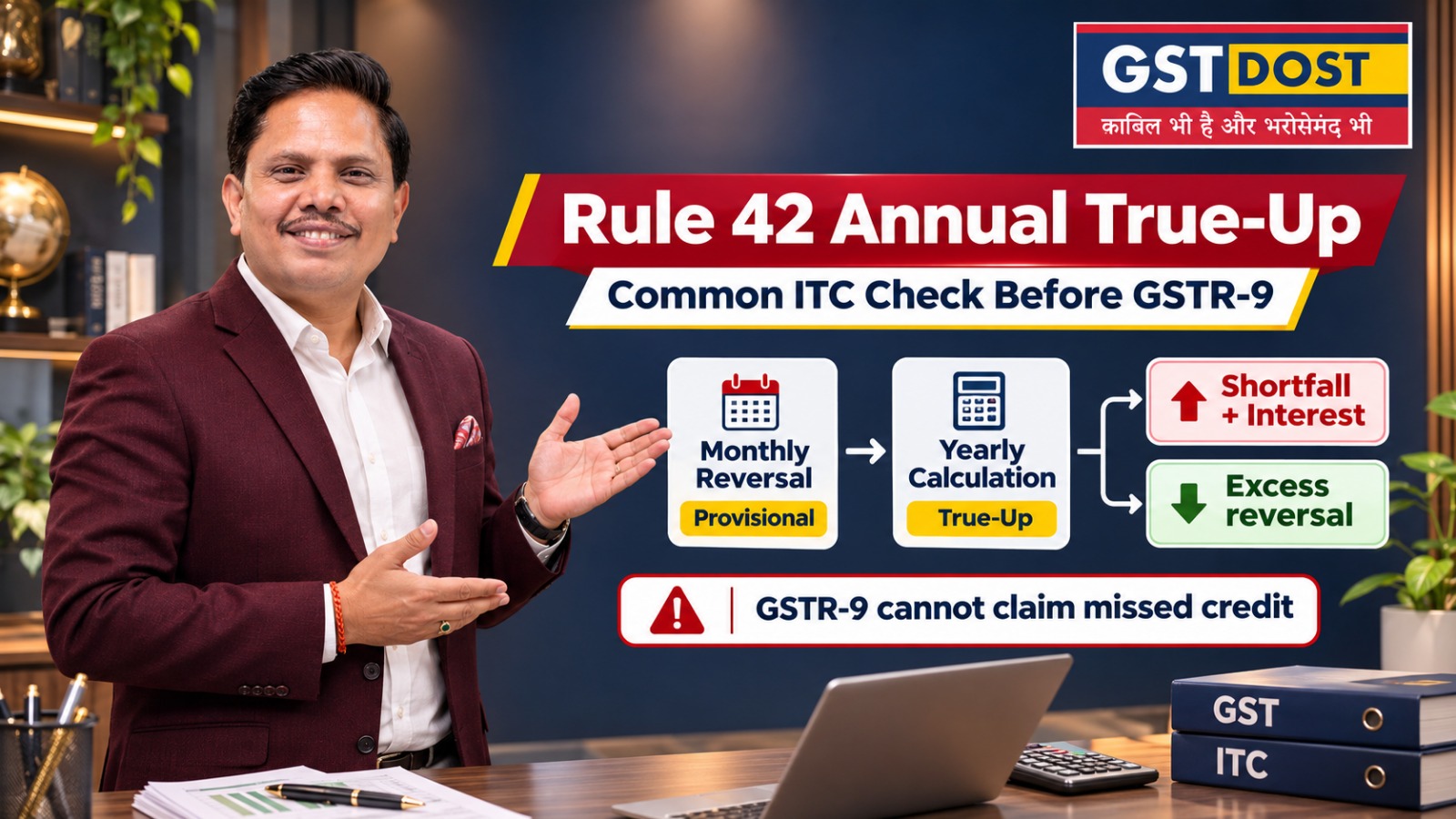
A business that makes both taxable and exempt supplies cannot keep all its input tax credit (ITC). Credit on purchases used for both kinds of supply has to be shared out, and the share that belongs to exempt supplies has to be reversed. This is done every month, on that month's figures. The law then asks for one more calculation, on the figures of the whole year. For FY 2025-26, the time for that calculation ended with the due date of the September 2026 return. Many businesses never made it. The annual return is the last routine occasion to find out.
In simple terms
- Rule 42 works in two stages: a reversal every month on monthly figures, and a final calculation for the year.
- If the yearly figure is higher than the total of the monthly reversals, the difference is payable with interest from 1 April 2026 until the date of payment.
- If the monthly reversals were too high, the excess could be taken back only in a return up to September 2026. GSTR-9 cannot be used to take credit.
Why this matters
The monthly reversal is only provisional. The share of exempt supplies changes from month to month, and so does the amount of common credit. Twelve monthly answers added together rarely equal the answer worked out on the year's totals. A business that reversed correctly every month can still have a shortfall for the year.
Interest on that shortfall does not wait for anyone to notice it. Under the rule it runs from 1 April following the year, and it keeps running until the amount is paid.
Who is affected
Section 17(2) of the CGST Act limits credit to the part used for taxable supplies, including zero-rated supplies, where goods or services are used partly for taxable and partly for exempt supplies. Rule 42 gives the method for inputs and input services. Capital goods follow rule 43.
For this purpose, exempt supply is wider than most people expect:
- The ordinary meaning. Supplies taxed at nil rate, supplies wholly exempt by notification, and non-taxable supplies.
- Added by section 17(3). Supplies on which the recipient pays the tax under reverse charge, transactions in securities, sale of land and, subject to a condition, sale of building.
- Left out. Explanation 1 after rule 43 leaves out interest on deposits, loans and advances, except for banks and financial institutions, and the supply of Duty Credit Scrips. The Explanation to section 17(3) leaves out most activities in Schedule III.
A manufacturer with rental income from a residential flat, a trader who also sells exempt goods, and a company that sold a plot of land during the year can all be within rule 42.
The monthly calculation
D1 and D2 are reversed in GSTR-3B or through FORM GST DRC-03. The calculation is made separately for central tax, State tax, Union territory tax and integrated tax. CBIC Circular No. 170/02/2022-GST places rule 42 reversals in Table 4(B)(1) of GSTR-3B.
Three points are often missed:
- The ratio is applied to the common credit only. It is not applied to the whole of the ITC, and not to the GSTR-2B total.
- Both E and F leave out the duties and taxes named in the Explanation to the rule, such as central excise and State taxes on petroleum products and alcohol.
- If there is no turnover in a period, the rule uses the figures of the last period for which they are available.
The yearly calculation
Rule 42(2) requires the credit to be calculated finally for the financial year, in the same manner, before the due date of the return for September following the year.
- If the yearly D1 and D2 are more than the monthly total, the excess is to be reversed in GSTR-3B or through DRC-03 in a month not later than that September. Interest is payable at the rate under section 50(1), from 1 April of the next financial year until the date of payment.
- If the monthly total is more than the yearly D1 and D2, the excess is to be claimed as credit in a return for a month not later than that September.
Practical example
A business has common credit, exempt supplies and taxable supplies throughout FY 2025-26. Its common inputs are not used for any non-business purpose, so D2 is nil.
Illustrative figures only, shown for all tax heads together. The actual calculation is made for each tax head. Interest is rounded and assumes payment on 30 November 2026.
The shortfall of ₹60,000 is not a penalty and not a new demand. It is the difference between twelve provisional answers and one final answer. Every further day of delay adds to the interest.
If a shortfall is found now
- The date has passed, the liability has not. Rule 42(2) gave time until the September 2026 return. An amount still unpaid remains payable, and interest continues until it is paid.
- Pay it through the return or through DRC-03. The rule names both routes. Confirm the route and the reporting before using it.
- Report it in the right row of GSTR-9. Table 7C is the row for reversals under rule 42. GSTN's FAQs place credit of a financial year that is reversed in a return of the next year in Table 12.
- Do not treat GSTR-9 as the payment. GSTN's FAQs say that an additional liability declared in the annual return is paid through FORM GST DRC-03.
If too much was reversed
Rule 42(2) allowed the excess to be claimed as credit in a return for a month not later than September 2026. It gives no later window. GSTN's FAQs say that ITC cannot be claimed through GSTR-9. A business in this position should take advice before making any claim, and should not adjust the figure in the annual return.
A simple working sheet
Keep one sheet for each tax head, with one row for each month from April 2025 to March 2026 in rows 2 to 13. Use column C for the common credit, D for exempt supplies, E for total turnover in the State and G for the reversal actually made in GSTR-3B. The shortfall for the year is:
A positive answer is a shortfall. A negative answer means more was reversed than the year required. If the shortfall is in cell H15 and the date of payment in H16, the interest is:
The sheet only does the arithmetic. Someone still has to confirm that each purchase was placed in the right group and that E and F follow the definitions in the rule.
Cases that follow different rules
- Construction of apartments. Rule 42(2) does not apply to these services. Sub-rules (3) to (6) provide a project-wise calculation based on carpet area.
- Banks and financial institutions. Section 17(4) gives them the option of taking 50% of the eligible credit every month in place of this method.
- Capital goods. Rule 43 applies, with its own formula.
Action points
If you own or manage the business
- Ask whether the yearly calculation was made. Ask for the date on which it was done for FY 2025-26, and for the working.
- Ask for the result for each tax head. It will be a shortfall, an excess or nil.
- Pay a shortfall early. Interest has been running since 1 April 2026.
- Fix the cause. Have every purchase marked at the time of booking as used for taxable supplies, for exempt supplies or for both.
- Put the September date in next year's calendar. For FY 2026-27, the yearly calculation is due before the September 2027 return.
If you prepare or review the returns
- Collect the monthly classification of ITC and the rule 42 working for all twelve periods.
- Trace E and F to the returns and the ledgers, and check them against the definitions and exclusions in the rule.
- Confirm that credits used only for taxable supplies, only for exempt supplies and blocked credits were removed before the common credit was worked out.
- Recalculate D1 and D2 for the year, separately for each tax head.
- Compare the yearly figure with the reversals actually made in GSTR-3B and with any DRC-03 payments.
- Record the shortfall or excess, the interest and the decision taken, before finalising Table 7C of GSTR-9.
Red flag: One percentage has been applied to the whole GSTR-2B total, and the working says that the reversal for the year is complete.
Records to keep: The month-wise schedule of common credit, the working of exempt and total turnover, the yearly recalculation, the returns or DRC-03 showing each reversal, and the interest calculation.
What you should have at the end: For each tax head, the yearly figure, the amount already reversed, the difference and what was done about it.
Practical takeaway
The annual return is a second check. It cannot reopen a time limit that has already passed.
Terms used in this article
- Input tax credit (ITC)
- The credit a registered business takes for GST paid on its purchases, which it sets off against the GST payable on its sales.
- Exempt supply
- A supply on which no GST is charged because the rate is nil, the supply is exempt or it is outside GST. For rule 42 it also includes the items added by section 17(3).
- Common credit
- Credit on purchases used for both taxable and exempt supplies, such as rent, audit fees or electricity for a shared office.
- Total turnover in the State
- The value of all supplies made by the business from the State, taxable and exempt, including exports and inter-State supplies, without the GST itself. Purchases on which the business itself pays tax under reverse charge are not part of it.
- Reversal
- Giving back credit already taken, by adding it to the amount payable in the return or by paying it through FORM GST DRC-03.
- True-up
- A final calculation on the year's figures that corrects the provisional monthly amounts.
- Tax head
- Central tax, State tax, Union territory tax or integrated tax. Each has its own credit and its own calculation.
Sources and references
- Rule 42, Central Goods and Services Tax Rules, 2017 (CBIC) - the monthly method, the yearly calculation, interest and the time limits.
- Rule 43, Central Goods and Services Tax Rules, 2017 (CBIC) - capital goods, and the Explanations on the value of exempt supplies.
- Central Goods and Services Tax Act, 2017 (India Code) - sections 2(47), 2(112), 17(1) to 17(4) and 50(1).
- Notification No. 13/2017-Central Tax dated 28 June 2017 - rate of interest under section 50(1).
- CBIC Circular No. 170/02/2022-GST dated 6 July 2022 - reversals under rule 42 in Table 4(B)(1) of GSTR-3B.
- GSTN FAQs on FORM GSTR-9 - no credit through the annual return; additional liability paid through DRC-03.
- GSTN FAQs on GSTR-9 and GSTR-9C - Tables 7 and 12 of GSTR-9.
Disclaimer: This article is for general information only and reflects the position as understood on the review date mentioned above. It is not legal advice and does not create a professional relationship. Which supplies count as exempt, which credits are common and how a shortfall or an excess should be dealt with depend on the facts and documents of each case. Figures in the example are illustrative. Please obtain professional advice before acting on this article.
GST DOST | GST Annual Return, Reconciliation and Technology-led Review

Related posts
Rule 42 Annual True-Up: The September Date Has Passed, but the GSTR-9 Review Has Not...
Stock Transfers Between Two GSTINs: Match Dispatch and Receipt Before GSTR-9...
GSTR-9 Table 8C Is Not a Reclaim Register: Getting Tables 8A, 8C and 13 Right...
Could a GST Officer Turn ‘Can’ Into ‘Must’? The ₹53.36 Crore Solar Case...
