



Namaste DOST!
Today we unpack a short but significant Delhi High Court order that every taxpayer should know. If your phones, laptops, or hard drives are seized during a GST search, what are your rights—especially to get copies of your own data? This case gives crisp answers.
Summary
In M/s Balaji Enterprises v. Principal Commissioner, DGGI (Meerut Zonal Unit), decided on 6 October 2025, the Delhi High Court addressed a narrow yet crucial issue: after a GST search and seizure of multiple electronic devices and documents, can the taxpayer obtain copies of seized data and on what terms? The Court reproduced Section 67(3)–(5) of the CGST Act and emphasized that copies of seized documents/data must be allowed in the presence of an authorised officer, unless the department records in writing that supplying copies would prejudicially affect the investigation. Given that the panchnama recorded successful cloning of devices, the Court directed the proprietor to appear and receive copies of the entire set of documents and data in the presence of an authorised officer, while also directing cooperation with the investigation. The writ petition was disposed of with these directions.
Facts of the Case
The petitioner, M/s Balaji Enterprises through its proprietor Mr. Sandeep Singhal, filed a writ petition under Article 226 seeking return of electronic devices, documents, and records seized on 1 July 2025. The seizure was recorded in a panchnama drawn at the proprietor’s office premises in Pitampura, Delhi. Items seized included multiple mobile phones, pen drives, a Samsung Galaxy Z-Fold, a WD Elements hard disk, a HP Pavilion laptop, a CPU, 113 stamps/seals, notebooks, and loose papers.
Counsel for the petitioner argued that since the department had already copied the records, the devices should be returned; alternatively, copies of the data and documents should at least be supplied. The department responded that the petitioner was not cooperating and needed to appear for recording of statement, as the department wished to confront him with the seized documents.
Legal Issue
Whether, after seizure under Section 67 of the CGST Act, the taxpayer is entitled to obtain copies of seized documents and electronic data—and under what safeguards? The related questions included how Section 67(3) (return of documents not relied upon), Section 67(4) (power to seal/break open), and Section 67(5) (entitlement to make copies) apply to the facts.
Arguments (as recorded)
Petitioner’s stance:
Devices should be returned, as the department already has copies; at minimum, copies of data and documents must be provided so business is not detrimentally affected.
Department’s stance:
The petitioner is not cooperating; he must appear for recording of statement so he can be confronted with seized material.
(The order is concise and does not set out extensive submissions beyond this.)
⚖️ High Court’s Ruling
Statutory framework set out by the Court: The Court reproduced Section 67(3), (4), and (5) of the CGST Act. In particular:
-
Section 67(3): Documents/books/things not relied upon for issuance of notice shall be returned within thirty days of the issue of such notice.
-
Section 67(5): The person from whose custody documents are seized is entitled to make copies or take extracts in the presence of an authorised officer, except where the proper officer records that doing so would prejudicially affect the investigation.
Court’s key clarification:
The Court stated that copies of the seized data cannot be denied to the petitioner. However, such copies must be made in the presence of an authorised officer, unless it is recorded in writing that providing copies would be prejudicial to the investigation.
Cloning recorded in the panchnama:
The panchnama specifically records that devices were opened in the presence of the petitioner’s advocate and a forensic expert; data contained in the devices was retrieved and downloaded into hard drives: Master Copy (S.No. WX42AC4RTNPK) and Working Copy (S.No. WX42AC4RTER9), and a cloning & data extraction report was printed and signed.
Operative direction:
To resolve the issue, the Court directed that Mr. Sandeep Singhal shall appear before the GST Department and, in the presence of an authorised officer, copies of the entire set of documents and data shall be provided to him. The petitioner is duty bound to cooperate in the investigation. The writ petition was disposed of accordingly.
Reasoning (in simple terms)
The Court anchored its decision in the text of Section 67(5). The default rule is access to copies; the exception is when the officer records in writing that giving copies would prejudice the probe. By explicitly requiring a written recording of prejudice, the statute builds a safeguard against blanket refusals. The Court applied this framework and ordered a practical modality: the petitioner will receive copies under supervision (presence of an authorised officer). The Court also noted the panchnama’s record that cloning/extraction had already been done, which made it feasible to supply copies without impeding the investigation.
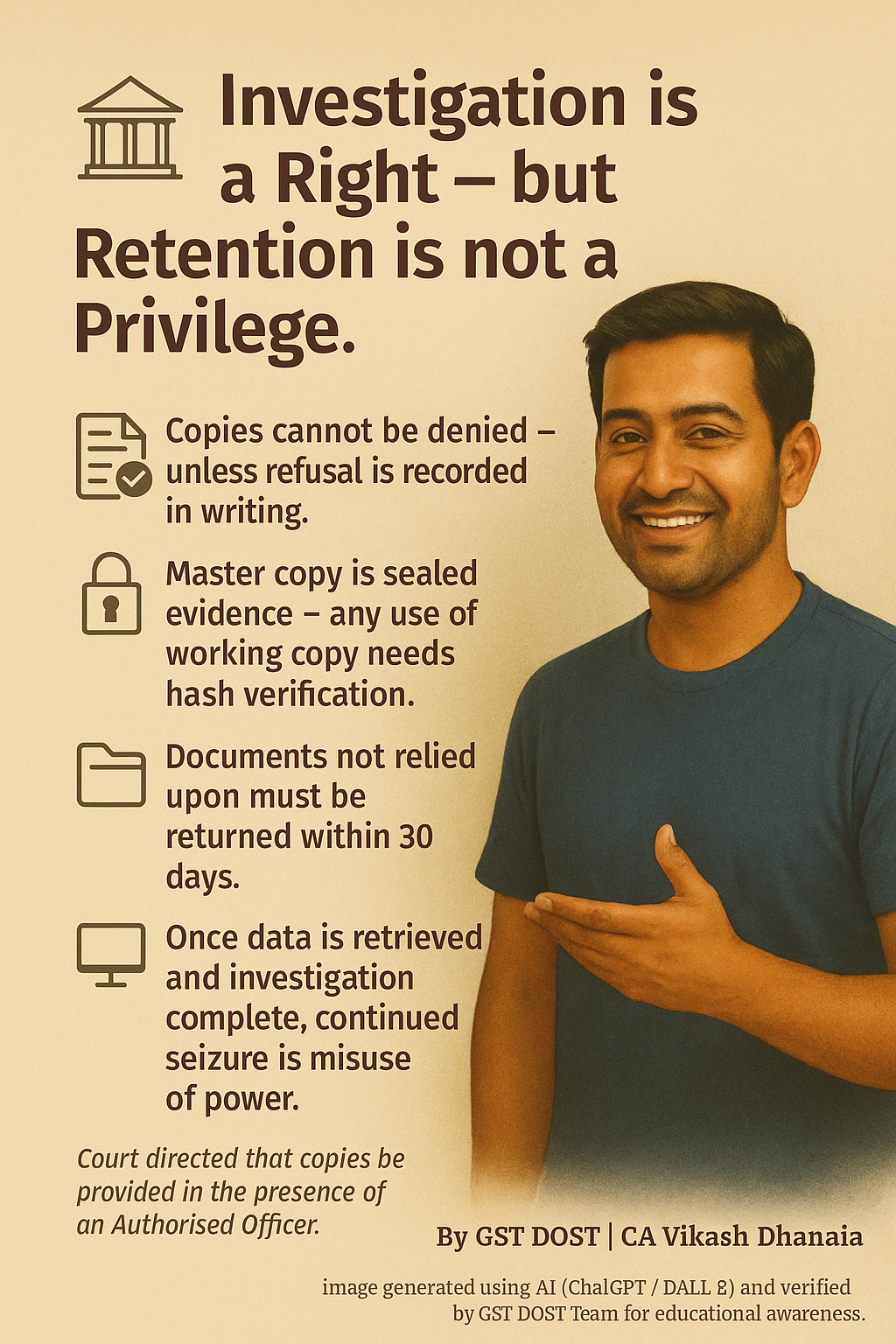
Important Message for Every Business Owner
1. Know Your Right to Copies (Section 67(5)):
You are entitled to copies of seized documents/data in the presence of an authorised officer, unless the officer records in writing that it would prejudice the investigation. Ask for a copy politely and in writing using this language.
2. Watch the Paper Trail:
If the department refuses copies, request the written reasons that the law requires. The absence of such a record is significant under Section 67(5).
3. Section 67(3) Timeline Matters:
Documents not relied upon for a notice must be returned within 30 days of the notice. Track dates and ask appropriately.
4. Use the Panchnama:
If the panchnama shows data cloning/extraction done, it supports a practical request for copies without delay. Keep a copy and read it carefully.
5. Cooperate, But Assert Rights:
The Court also emphasized cooperation with investigation. Appear when called, but assert your statutory rights calmly and clearly.
Why This Matters
This order reinforces that search and seizure powers are balanced by procedural safeguards. Taxpayers can invoke Section 67(5) to access their own data for business continuity and legal defence, while investigations continue under court-endorsed supervision.
Conclusion
A GST search can feel overwhelming—especially when your phones, laptops, and hard drives go out of your hands. The Delhi High Court’s direction in Balaji Enterprises is a timely reminder: the law gives you a pathway to copies of your seized data, and it requires the department to justify in writing any lawful refusal. Stay calm, cooperate, and use the statute’s exact words—that is often the strongest defence.
📞 Need help with a similar case? Contact GST DOST for personalized support.
Frequently Asked Questions
Q: What was the dispute in this case?
A: After a GST search, multiple electronic devices and documents were seized. The petitioner sought return of devices or at least copies of the seized data/documents.
Q: How did the Delhi High Court rule?
A: The Court directed the petitioner to appear before the department and held that copies of the entire set of documents and data be provided under Section 67(5).
Q: What does Section 67(5) CGST Act guarantee?
A: It entitles the person from whose custody documents are seized to make copies/take extracts in the presence of an authorised officer, except when it may prejudice the investigation.
Q: What about documents not relied upon for a notice?
A: Under Section 67(3), such documents must be returned within 30 days of issue of notice — a key safeguard for taxpayers.
Q: When the panchnama records that data cloning has been completed, how can a taxpayer use the right to obtain copies?
A: Show the panchnama wording and request copies under Section 67(5) before an authorised officer. If refused, seek the written reasons that the law mandates.
References
-
Case: M/s Balaji Enterprises v. The Principal Commissioner, DGGI, Meerut Zonal Unit & Ors., Delhi High Court, Judgment dated 6 October 2025, W.P.(C) 15237/2025.
-
Statute (reproduced in the order): Section 67(3), (4), (5), Central Goods and Services Tax Act, 2017 (entitlement to copies; return within 30 days of notice; seizure powers).
Keywords: Section 67 GST search and seizure; copy of seized data; panchnama forensic cloning.

Related posts
Yes, Police Can Attach Bank Accounts in GST Cases. But Only If They Follow the Law...
Nairson Multiventures Case: Why GST Cancellation Without Due Process Failed...
GST Summons Is Not a Punishment — Don’t Panic Before the Law Does...
Sale of Business as a Going Concern Is GST-Exempt — And ITC Transfer Is Allowed...
