


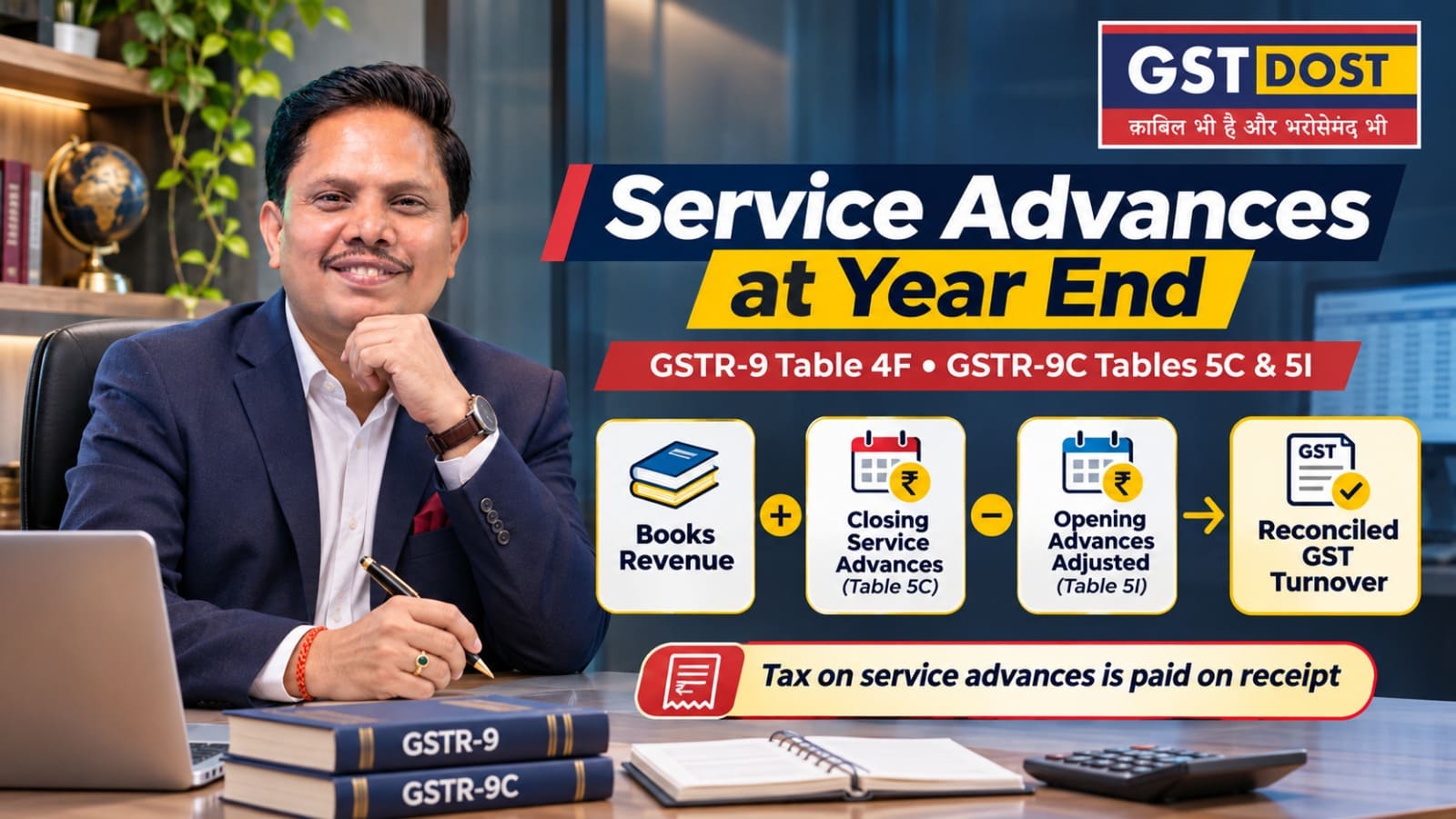
A service provider receives an advance in March and does the work in May. In the accounts, the money sits in the balance sheet as a liability to the customer until the work is done. Under GST, tax on a service advance is payable in the month the money comes in. So at 31 March the books and the GST returns show different figures for the same customer, and both are right. In the annual return this difference has a place of its own. If it is not put there, it looks like turnover that is missing from one side or the other.
In simple terms
- For services, GST is payable when an advance is received. In the accounts, the advance becomes revenue only when the service is provided.
- GSTR-9 shows such advances in Table 4F. GSTR-9C adds the closing advances in Table 5C and takes out the opening advances in Table 5I.
- Only taxable service advances belong in these rows. Advances for goods, security deposits and advances for exempt services do not.
Why this matters
The amounts can be large for consultants, software and maintenance companies, event managers, coaching institutes and anyone who bills in advance for a period. A preparer who reconciles only the sales ledger with the returns will find that the returns show more turnover than the books in a year when advances rise, and less in a year when they fall. Without a schedule of advances, neither difference can be explained.
There is also a real tax risk on each side. An advance that was never reported means tax paid late. An invoice issued later without adjusting the advance means tax paid twice on the same money.
The rule in brief
- Services. Under section 13(2) of the CGST Act, the time of supply of a service is the date of the invoice or the date of receipt of payment, whichever is earlier, where the invoice is issued in time. An advance therefore brings forward the tax on the amount received.
- Goods. Notification No. 66/2017-Central Tax relieves suppliers of goods, other than those under the composition scheme, from paying tax when an advance is received. Their tax follows the invoice.
- In GSTR-1. Table 11A is for advances received in a period for which the invoice was not issued in that period. Table 11B is for advances taxed in an earlier period that are adjusted against invoices issued in the current period.
Where advances appear in the annual return
The wording of Table 5I confuses many readers. It makes sense once the year is kept in mind. The revenue is recognised this year, and no GST is paid on it this year, because the GST was paid in an earlier year when the advance came in.
How Table 4F is filled: Table 4 of GSTR-9 is filled in by the portal from GSTR-1 and GSTR-3B and can be edited. For 4F the portal works from Table 11 of GSTR-1, taking the advances received less the advances adjusted. The figure it shows is therefore usually a net figure for the year, and it can be negative in a year when more advances were adjusted than received. Check it against your own schedule before accepting it.
An option in GSTR-9C: The instructions allow Tables 5B to 5N to be left blank, with the adjustments reported together in Table 5O. Notification No. 05/2026-Central Tax has extended this option to FY 2025-26 onwards. The working behind the figure is needed either way.
Practical example
A consultancy has revenue of ₹1,00,00,000 in its accounts for FY 2025-26.
- This includes ₹2,00,000 for work invoiced during the year against an advance received in FY 2024-25. GST on that advance was paid in FY 2024-25.
- At 31 March 2026 it holds ₹3,00,000 of advances for taxable services, received during FY 2025-26. GST on them was paid in the month of receipt. The work has not been done and no revenue has been recognised.
Illustrative figures only. The example assumes that all revenue in the accounts was invoiced during the year and that there are no other adjustments.
Both routes reach ₹1,01,00,000. The deduction of ₹2,00,000 is safe only if the tax paid on that advance in FY 2024-25 can be shown. Without that trail, the deduction looks like turnover left out.
What does not belong in these rows
- Advances for goods received by a regular supplier. No tax arises on receipt, so there is nothing to report as a taxed advance.
- Security deposits. A deposit is not payment for a supply until it is applied as consideration.
- Advances for exempt services.
- Advances invoiced in the same tax period. These are reported as invoices and never enter Table 11A.
- Advances returned to the customer. A refund without any supply has its own documents and treatment.
Where it goes wrong
Time limit: An error in the advances reported in GSTR-1 for FY 2025-26 can be rectified only in a return filed by 30 November 2026, or before the annual return for the year is filed, whichever is earlier.
Action points
If you own or manage the business
- Ask for the advance schedule at 31 March 2026. It should list each customer advance, what it is for and whether GST was paid on it.
- Ask how last year's advances were closed. Each opening advance should be traced to an invoice, a refund or the closing balance.
- Ask whether any tax was paid twice. This happens when an invoice is issued for the full value and the advance already taxed is not adjusted.
- Keep advances, deposits and goods advances in separate ledgers. The year-end work becomes far simpler.
If you prepare or review the return
- Obtain the opening and closing customer advance ledgers, bank receipts and service contracts.
- Tag each advance as taxable service, goods, exempt service, deposit or other receipt.
- Match each taxable service advance to Table 11A of GSTR-1, to the tax paid in GSTR-3B and to the later adjustment in Table 11B.
- Reconcile the unadjusted advances at the year end with Table 4F of GSTR-9, and with Table 5C of GSTR-9C.
- Trace the opening advances to the earlier year's tax payment before deducting them in Table 5I.
- List the advances that do not match, with the explanation for each.
Red flag: The balance sheet shows a large customer advance balance, and there is no register linking each advance to an invoice or any record of how GST was treated.
Records to keep: An advance-wise movement sheet showing the date of receipt, the purpose, the GST rate, the period in which tax was paid, the invoice date, the period of adjustment and the opening and closing balance.
What you should have at the end: One schedule that explains the opening balance, the receipts, the adjustments and the closing balance of advances, and that agrees with Table 4F of GSTR-9 and with the bridge in GSTR-9C.
Practical takeaway
Reconcile advances receipt by receipt and period by period. The closing balance alone explains nothing.
Terms used in this article
- Advance
- Money received from a customer before the goods are supplied or the service is provided.
- Time of supply
- The point at which the liability to pay GST on a supply arises.
- Unadjusted advance
- An advance on which GST has been paid but against which no invoice has yet been issued.
- Revenue recognition
- The accounting rule that income is recorded when it is earned, which for a service is generally when the service is provided.
- GSTR-1
- The monthly or quarterly statement of outward supplies. Its Table 11 deals with advances.
- GSTR-9 and GSTR-9C
- GSTR-9 is the annual return. GSTR-9C is the self-certified statement that reconciles the annual return with the audited accounts.
- Security deposit
- Money held as security and returnable under the agreement. It is not an advance unless it is applied as payment.
Sources and references
- Section 13, Central Goods and Services Tax Act, 2017 (CBIC) - time of supply of services.
- CBIC GST flyer - GST on advances received for future supplies - services and goods, and Notification No. 66/2017-Central Tax dated 15 November 2017.
- GSTN user manual - GSTR-1 - Tables 11A and 11B.
- GSTN advisory on GSTR-9 (copy hosted by the Uttar Pradesh Commercial Tax Department) - Table 4F, its instruction and its link with Table 11 of GSTR-1.
- GSTN FAQs on FORM GSTR-9 - Table 4 is filled in from GSTR-1 and GSTR-3B and can be edited.
- FORM GSTR-9C, instructions for Tables 5C, 5I and 5O.
- Notification No. 05/2026-Central Tax dated 26 October 2026 (Gazette copy) - option for Tables 5B to 5N of GSTR-9C extended to FY 2025-26 onwards.
- Section 37(3), Central Goods and Services Tax Act, 2017 - time limit for rectifying errors in GSTR-1.
Disclaimer: This article is for general information only and reflects the position as understood on the review date mentioned above. It is not legal advice and does not create a professional relationship. Whether a receipt is a taxable advance, and how it is to be shown in the annual return, depends on the contract, the documents and the facts of each case. Check the FY 2025-26 forms and the portal before filing. Figures in the example are illustrative. Please obtain professional advice before acting on this article.
GST DOST | GST Annual Return, Reconciliation and Technology-led Review

Related posts
Service Advances at Year End: The Hidden Difference Between the Books, GSTR-9 and GSTR-9C...
GSTR-9 Table 9 Shows a Difference in Red: Find the Reason Before You Change the Number...
One Head Office Pays for Services Used by Several Branches. Who Can Claim the GST Input Tax Credit?...
Rule 42 Annual True-Up: The September Date Has Passed, but the GSTR-9 Review Has Not...
