


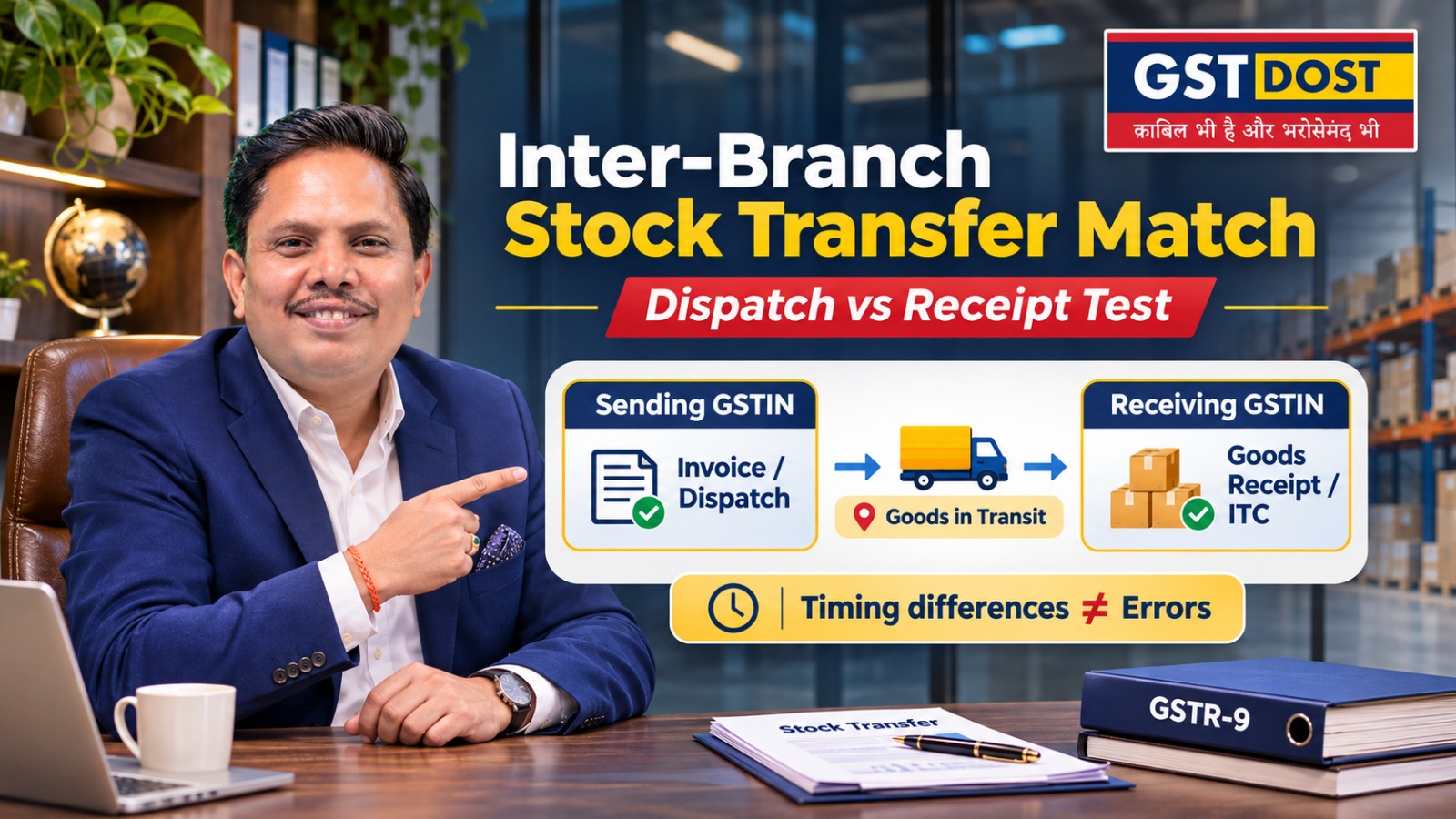
A company with registrations in two States moves its own goods from one to the other. No customer is involved and no money changes hands. GST still treats the movement as a supply by one registration to the other. The sending registration reports an outward supply and pays tax. The receiving registration records an inward supply and takes credit. At the year end the two sets of records rarely agree to the last carton, because goods sent in the last days of March arrive in April. A two-sided match in Excel shows which differences are goods in transit and which are errors.
In simple terms
- Each GST registration of the same business is a distinct person. Goods moved between two registrations in the course of business are a supply, even without consideration.
- Every transfer should be traceable on both sides: the invoice of the sending GSTIN and the goods receipt of the receiving GSTIN.
- Goods in transit on 31 March are a supply of FY 2025-26 for the sender. The receiver can take the credit only after the goods arrive.
Why this matters
In the company's accounts, a transfer between its own branches is not a sale. It is removed when the accounts are drawn up for the company as a whole. The GST returns work differently. Each GSTIN files its own returns and its own GSTR-9, and the transfer is an outward supply in one and an inward supply in the other.
A reviewer who sees a difference between the two sides can make two opposite mistakes. One is to treat genuine goods in transit as missing turnover. The other is to wave through a real error because it looks like a timing difference. Only a document-wise match separates the two.
What the law says
- Distinct persons. Under section 25(4) of the CGST Act, a person with more than one registration is treated as a distinct person for each registration. Section 25(5) says the same for establishments in different States. A business can also hold separate registrations for different places of business within one State, and those too are distinct persons.
- Supply without consideration. Paragraph 2 of Schedule I treats a supply of goods or services between distinct persons, made in the course or furtherance of business, as a supply even if no consideration is paid.
- Invoice and timing. Under section 31(1), a tax invoice is to be issued before or at the time the goods are removed. Under section 12(2), the time of supply of goods turns on the date of the invoice, or the last date on which it should have been issued.
- Value. Rule 28 of the CGST Rules values a supply between distinct persons at open market value. Where the goods are meant for further supply as such, the supplier may opt for 90% of the price the recipient charges its unrelated customers. Where the recipient is eligible for full input tax credit, the value declared in the invoice is deemed to be the open market value.
- Credit for the receiver. Section 16(2)(b) allows credit only when the goods have been received. Where goods against one invoice arrive in lots, the credit is available on receipt of the last lot.
- Payment within 180 days. Rule 37 treats the value of a Schedule I supply made without consideration as paid, so this condition does not stand in the way.
A different case: A movement between two premises covered by the same GSTIN is not a supply between distinct persons. Do not mix such movements into this reconciliation.
On value: The invoice value is safe under rule 28 only where the receiving registration can take full credit. If the receiving registration also makes exempt supplies, or cannot take the credit for any other reason, the value needs a closer look. Book cost is not automatically the right figure.
Practical example
On 29 March 2026, a company's Maharashtra registration sends 400 cartons to its Karnataka registration under two invoices. IGST is taken at 18% for illustration.
Illustrative figures only.
The difference is explained by Invoice B. It is not a reason to remove that invoice from the sender's turnover, and it is not a reason for the receiver to take the credit in March.
What it means for each annual return
- Each GSTIN is reconciled on its own. The sender's transfers are part of its outward supplies in GSTR-9. They do not net off against the receiver's figures.
- GSTR-9C of the sender. Turnover in the audited accounts does not include transfers between branches. Table 5D of GSTR-9C is the row for deemed supplies under Schedule I, where such transfers are added back.
- GSTR-9 of the receiver. The March invoice for goods received in April is a cross-year credit. If the credit was first taken in the April 2026 return, GSTN's FAQs place it in Tables 8C and 13. If it was taken and reversed in March and taken again in April, they place the claim in 6B, the reversal in 7H and the reclaim in Table 13 only. The FAQs were written for FY 2024-25, so check the FY 2025-26 form before filing.
The two-sided match in Excel
- Prepare a dispatch table from the sending GSTIN: sending GSTIN, receiving GSTIN, document type, invoice number, invoice date, financial year, quantity, taxable value and tax. Check it against that GSTIN's GSTR-1.
- Prepare a receipt table from the receiving GSTIN's goods receipt register, with the same fields and, in addition, the date of receipt, the quantity received and the month in which credit was taken.
- Build the same key in both tables. Join the sending GSTIN, the receiving GSTIN, the document type, the financial year and the original invoice number, in that order.
- Check that the key is unique in each table. Use Group By with a row count. A key that repeats will multiply rows when the tables are merged.
- Merge the two queries with a Full Outer join on the key. Microsoft's documentation describes this join as keeping all rows from both tables, matched or not.
- Add a status column with the formula below, and filter out the rows marked Matched.
A custom column for the status, where the two keys and the quantity and value from each side have been kept after the merge:
The column names are examples. Use the names in your own tables.
A third leg: The receiving GSTIN's GSTR-2B should show the same invoices, because the sending GSTIN is its supplier. An invoice in the dispatch table that is not in the receiver's GSTR-2B points to a gap in the sender's GSTR-1.
Using AI to draft the query
An AI assistant can draft the steps. Practise with made-up data. A prompt you can reuse:
Data confidentiality: Test the logic on made-up data before using it on real records. Never upload confidential invoices or GSTIN-linked files of a business or its clients to a public AI system without permission and adequate safeguards.
Action points
If you own or manage the business
- Ask for a list of all your GSTINs and the transfers between them. Include registrations in the same State.
- Ask for the unmatched transfer schedule. It should show each open item, the person responsible and the explanation.
- Ask for the stock in transit at 31 March 2026. It should agree with the dispatches that have no receipt in March.
- Check when the receiving branch takes credit. It should follow the date of receipt, not the date of the invoice.
- Make the match a monthly routine. A difference is easier to explain in the month it arises.
If you do the reconciliation
- List the sending and receiving GSTINs and identify the transfers that are supplies between distinct persons.
- Export the stock transfer invoices, dispatch registers, goods receipt notes and GSTR-1 data for both sides.
- Keep the original invoice numbers. Match on the pair of GSTINs, the financial year, the number and the tax amount.
- Run the Full Outer merge and list the dispatch-only, receipt-only and difference rows.
- Support each in-transit item with transport evidence and the date of receipt.
- Check the month of credit for every item received after the invoice month.
- Carry the result into each GSTIN's GSTR-9 separately, and into Table 5D of GSTR-9C where it applies.
Red flag: The transfer was removed from the company's accounts on consolidation, and for that reason alone it was also removed from the sending GSTIN's taxable supplies.
Records to keep: The stock transfer invoices, dispatch and goods receipt registers, transport documents and e-way bills, the returns of both GSTINs for the relevant months and the stock-in-transit reconciliation at the year end.
What you should have at the end: A list of transfers matched on both sides, a short list of open items with reasons, and turnover and credit figures for each GSTIN that stand on their own.
Practical takeaway
Reconcile both ends of a stock transfer before deciding whether a difference in GSTR-9 is an error.
Terms used in this article
- GSTIN
- The GST registration number. A business has a separate GSTIN for each State, and can have more than one in a State.
- Distinct person
- The way GST law treats each registration of the same business: as a separate person for the purpose of tax.
- Stock transfer
- A movement of the business's own goods from one of its locations to another, without a sale to a customer.
- Schedule I
- The part of the CGST Act that lists activities treated as supplies even when nothing is paid for them.
- Open market value
- The full price that would be paid for the same supply at the same time between unrelated parties.
- Goods in transit
- Goods that have left the sender but have not yet reached the receiver on a given date.
- Full Outer join
- A way of combining two tables that keeps every row from both, whether or not it finds a match in the other.
- Key
- The column or combination of columns used to decide whether two rows refer to the same document.
Sources and references
- Central Goods and Services Tax Act, 2017 (India Code) - sections 12(2), 16(2), 25(2), 25(4), 25(5) and 31(1), and paragraph 2 of Schedule I.
- Rule 28, Central Goods and Services Tax Rules, 2017 (CBIC) - value of supply between distinct persons.
- Rule 37, Central Goods and Services Tax Rules, 2017 (CBIC) - Schedule I supplies without consideration deemed to be paid.
- GSTN consolidated FAQs on GSTR-9 and GSTR-9C dated 17 December 2025 - Tables 6B, 7H, 8C and 13 for credit taken in the next year.
- FORM GSTR-9C, Table 5D - deemed supply under Schedule I.
- Microsoft Learn - Full outer join (Power Query).
Disclaimer: This article is for general information only and reflects the position as understood on the review date mentioned above. It is not legal advice and does not create a professional relationship. Whether a movement is a supply, how it is to be valued and when credit can be taken depend on the facts and documents of each case. The rate and figures in the example are illustrative. Software features can differ between versions, and any query should be tested on sample data before use. Please obtain professional advice before acting on this article.
GST DOST | GST Annual Return, Reconciliation and Technology-led Review

Related posts
Rule 42 Annual True-Up: The September Date Has Passed, but the GSTR-9 Review Has Not...
Stock Transfers Between Two GSTINs: Match Dispatch and Receipt Before GSTR-9...
GSTR-9 Table 8C Is Not a Reclaim Register: Getting Tables 8A, 8C and 13 Right...
Could a GST Officer Turn ‘Can’ Into ‘Must’? The ₹53.36 Crore Solar Case...
