


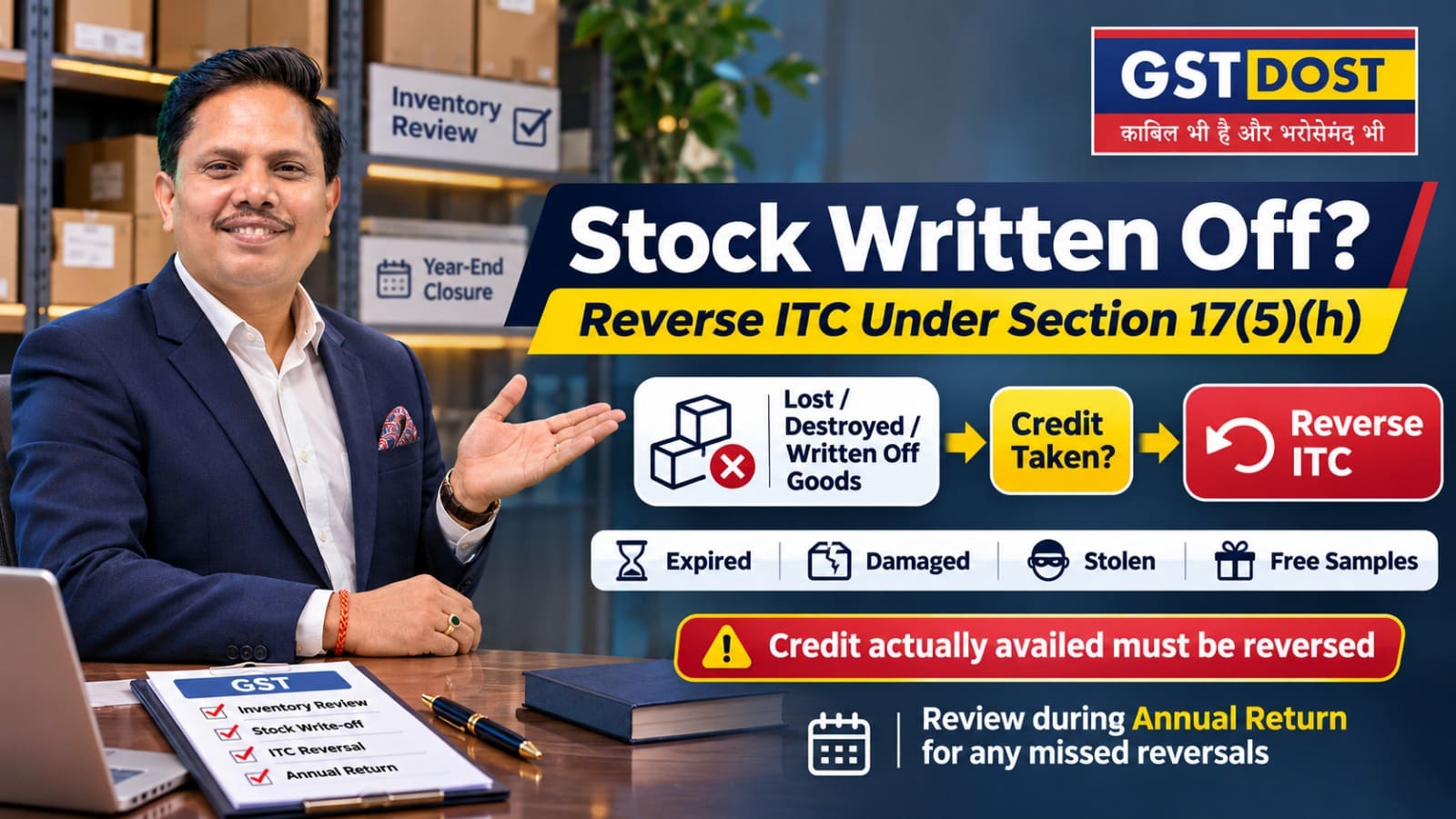
Goods expire, break, get stolen or are found short at the year-end count. The accounts department passes an entry and the loss goes to the profit and loss account. The GST credit taken when those goods were bought often stays exactly where it was. The law does not allow that credit. The annual return is a good time to find out how much of it is still sitting in the books.
In simple terms
- Section 17(5)(h) of the CGST Act blocks input tax credit on goods that are lost, stolen, destroyed or written off, and on goods given away as gifts or free samples.
- If credit was taken on such goods, it has to be reversed. The amount is the credit actually taken on those goods. It is not a percentage of their book value.
- The GST Council has recommended relaxing this rule for free samples and for expired goods. That change is not yet law.
Why this matters
The warehouse knows what was destroyed. The accounts department knows what was written off. The person who files GSTR-3B usually works from the purchase register, where neither fact appears. So the credit is reversed late, or not at all, and the gap comes up later in a departmental audit, with interest. FY 2025-26 is the year now being closed, and GSTR-9 for it is due by 31 December 2026.
What the law says
Section 17(5) lists cases where credit is not available even though the purchase was made for the business. Clause (h) covers goods that are lost, stolen, destroyed or written off, and goods disposed of as gifts or free samples. The clause speaks of goods in general, so it reaches raw material, packing material, trading stock and finished goods alike. Capital goods that are written off raise further questions and are outside this article.
The Act and the Rules give no formula for this reversal and fix no separate due date for it. The usual practice is to reverse the credit in the GSTR-3B of the month in which the goods are destroyed or written off.
Not every stock adjustment is the same
A change has been recommended. It is not yet law.
At its 57th meeting on 8 October 2026, the GST Council recommended an amendment to section 17(5). Among other things, the amendment would remove the restriction on credit for free samples, and for goods destroyed or written off on expiry of their shelf life as required by law.
What this means today: The press release gives no date for this change. It also states that the recommendations take effect only through notifications, circulars or amendments to the law. As on the review date of this article, section 17(5) has not been amended. Until it is, the present rule applies to every return, including those for FY 2025-26. The recommendation, as worded, does not mention gifts, or goods that are lost, stolen or damaged.
How much to reverse
- Start from the goods. Identify what was lost or destroyed: item, quantity and batch.
- Trace them to the purchase. Use the purchase invoice where it can be identified. Where it cannot, use a method the stock records support, such as batch cost or first-in-first-out, and apply it the same way every time.
- Take the credit actually availed. If no credit was taken on those goods, there is nothing to reverse.
- For manufactured goods, look at what went into them. Circular 72/46/2018-GST speaks of the credit attributable to the manufacture of the destroyed goods. A bill of materials is the usual basis for working this out.
Practical example
A distributor bought 100 units of a product and took full credit. During FY 2025-26, 20 of those units expired and were destroyed. The purchase can be traced, and no reversal has been made so far.
Illustrative figures only.
Two shortcuts give the wrong answer. Applying 18% to the reduced book value of the stock at the year end understates the reversal, because that value has nothing to do with the credit taken. Reversing the whole ₹18,000 overstates it, because 80 units were not affected.
Where the reversal goes in the returns
Stock bought in an earlier year: GSTN's FAQs, written for FY 2024-25, say that Table 7 is meant for reversal of that same year's credit. Stock destroyed in FY 2025-26 may have been bought, and the credit taken, in an earlier year. The FAQs do not deal with that case. Note the year of purchase and how the reversal was reported.
On interest: Section 50(3) charges interest where credit has been wrongly availed and utilised, and rule 88B sets out how it is worked out. Whether credit that was correctly taken, and became blocked only when the goods were later destroyed, falls within those words is debated. Check whether the balance in the credit ledger stayed above the amount in question, and take advice. Do not ignore interest, and do not compute it mechanically.
Action points
If you own or manage the business
- Make the warehouse report to accounts every month. The report should cover goods destroyed, shortages, thefts, samples issued and scrap sold.
- Approve write-offs with the GST effect shown. The approval note should state the credit to be reversed along with the value written off.
- Keep proof of what happened to the goods. Destruction certificates, photographs, regulatory records, insurance papers and police reports all help.
- Count the credit as part of the loss. The real cost of damaged stock is its cost plus the credit given up.
- Do not act on the Council's recommendation yet. Continue to reverse until the law is amended and its wording and date are known.
If you prepare or review the returns
- Collect the stock adjustment, damage, expiry, sample and scrap registers for the year, and the differences found at the physical count.
- Agree their total with the write-off and stock loss accounts in the trial balance.
- Classify each item using the table above. Keep destruction, write-off, samples, promotional offers and scrap sales apart.
- Trace the quantities to purchase invoices or batches, and work out the credit taken on them.
- Read Table 4(B)(1) of each GSTR-3B to see what has already been reversed, so that nothing is reversed twice.
- Decide the return and the table for the balance, and review the interest position.
- Record a conclusion for every item: reverse, already reversed, or not required, with the reason.
Red flag: The stock ledger shows goods destroyed or written off, but the GST working has neither a reversal nor a written reason for not making one.
Records to keep: Stock adjustment vouchers, approvals, evidence of destruction, batch details, the purchase invoices, the credit computation and the GSTR-3B in which the reversal was made.
What you should have at the end: An item-wise register of the year's stock losses showing quantity, cause, credit involved and the return in which it was reversed, with a total that agrees with the accounts.
Practical takeaway
A stock write-off is more than an accounting entry. Each one should start a GST check.
Terms used in this article
- Input tax credit (ITC)
- The credit for GST paid on purchases, which can be used to pay GST on sales.
- Blocked credit
- Credit that section 17(5) does not allow, even though the purchase was for the business.
- Write-off
- Removing goods from the stock records because they no longer exist or have no value.
- Carrying value
- The value at which stock is shown in the accounts. It can be reduced while the goods are still held.
- Schedule I
- The list in the CGST Act of dealings that are treated as supplies even when nothing is charged, such as supplies between related persons.
- Bill of materials
- The list of inputs, with quantities, that go into one unit of a manufactured product.
- Table 4(B)(1) of GSTR-3B
- The row of the monthly return for credit reversals that cannot be claimed back.
- Tables 7 and 12 of GSTR-9
- The parts of the annual return for credit reversed during the year, and for credit of the year reversed in the next year.
Sources and references
- Central Goods and Services Tax Act, 2017 (India Code) - section 17(5)(h) and section 50(3).
- CBIC Circular No. 92/11/2019-GST dated 7 March 2019 - free samples, gifts and "buy one, get one free" offers.
- CBIC Circular No. 72/46/2018-GST dated 26 October 2018 - return and destruction of time-expired medicines.
- CBIC Circular No. 170/02/2022-GST dated 6 July 2022 - reporting of reversals in Table 4(B) of GSTR-3B.
- GST Council press release, 57th meeting, 8 October 2026 - recommendation to amend section 17(5).
- GSTN consolidated FAQs on GSTR-9 and GSTR-9C dated 17 December 2025 - Table 7 and Table 12.
- CBIC - Rule 88B, CGST Rules, 2017 - manner of calculating interest.
- Notification No. 13/2025-Central Tax dated 17 September 2025 - instructions to FORM GSTR-9 for Tables 7 and 12.
- ARS Steels & Alloy International Pvt. Ltd. v. State Tax Officer, Madras High Court, order dated 24 June 2021 - loss inherent in the manufacturing process.
Disclaimer: This article is for general information only and reflects the position as understood on the review date mentioned above. It is not legal advice and does not create a professional relationship. Whether credit has to be reversed, for how much, in which return and with what interest depends on the facts and records of each case. The GST Council's recommendation described above may be enacted with different wording or conditions. Figures in the example are illustrative. Please obtain professional advice before acting on this article.
GST DOST | GST Annual Return, Reconciliation and Technology-led Review

Related posts
Gold Coins for Dealers: Orient Cement Keeps Its ITC but Owes GST on 110% of Cost, Rules Telangana Appellate Authority...
Temple Hair Auctions and the 18% Clause: Telangana AAR Says Unworked Hair Is Exempt Goods, but the Ruling Binds the Bidder, Not the Temple...
A Three-Wheeler to the Railway Station Without Part-B: GSTAT Lucknow Refuses to Restore a Rs 4.86 Lakh E-Way Bill Penalty...
Filed Under the CrPC, Cognised Under the BNSS: Why the Jharkhand High Court Sent a GST Prosecution Back for a Hearing...
