


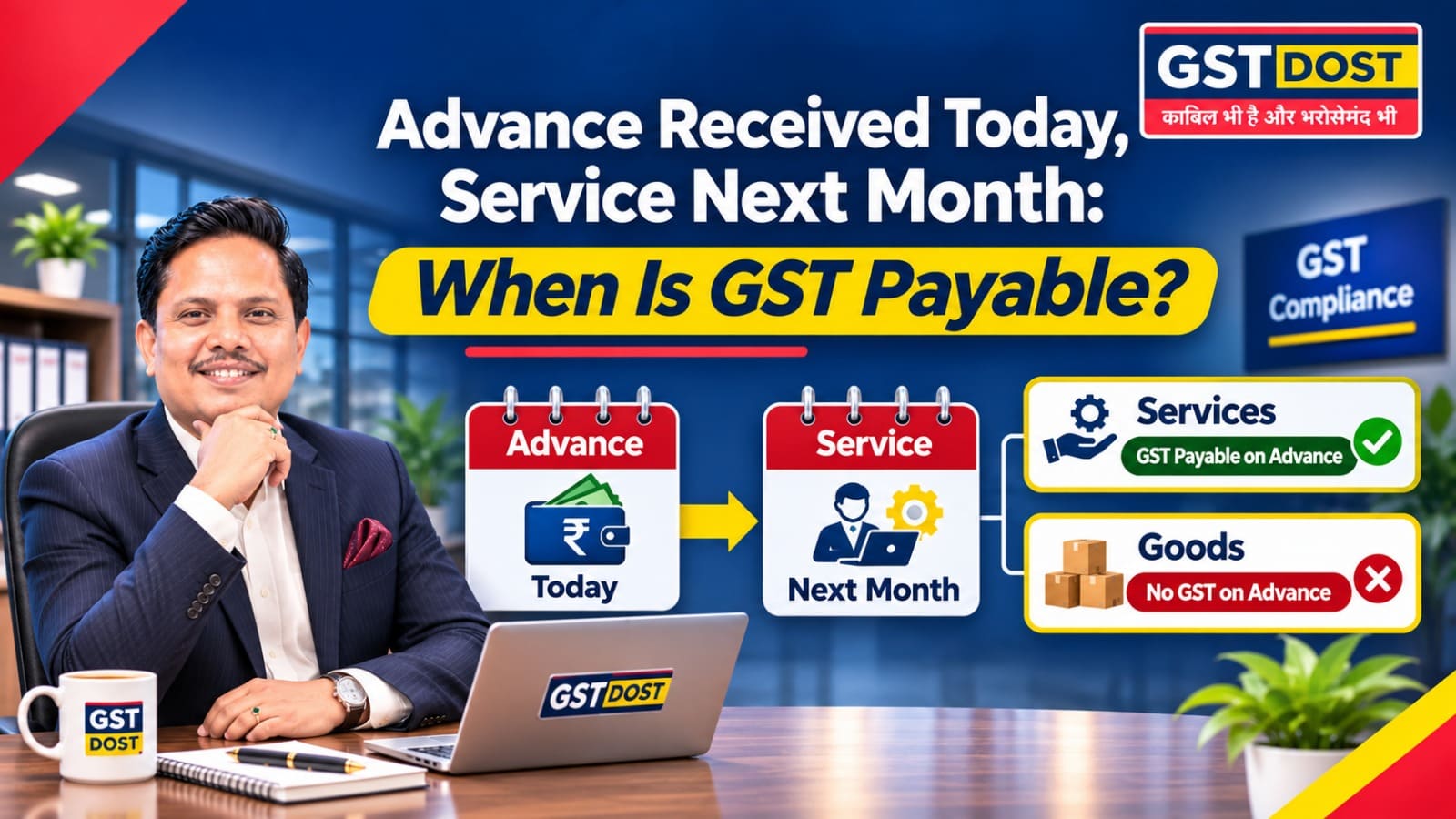
Event planners, interior designers, consultants and contractors often collect an advance before they start work. For a taxable service, GST on that advance is generally payable in the month the money is received, not when the service is delivered. For goods, regular suppliers do not pay GST on advances. Mixing up the two, or missing the receipt voucher and return reporting, is a common source of notices.
Key takeaways
- Services: under section 13(2), the time of supply is generally the earlier of the invoice date (if issued on time) and the date of receipt of payment. An advance received therefore triggers GST to the extent of the advance.
- Goods: registered persons not in the composition scheme pay GST on goods at the time of supply under section 12(2)(a), that is, on invoicing, not on receipt of advance (Notification No. 66/2017-Central Tax).
- A receipt voucher under section 31(3)(d) and rule 50 must be issued for an advance.
- Advances are reported in GSTR-1 Table 11A and adjusted against the later invoice in Table 11B.
- A genuine deposit is not payment for the supply until it is applied as consideration (section 2(31)).
- If the service is cancelled, the route depends on whether a tax invoice or only a receipt voucher was issued (Circular No. 137/07/2020-GST).
1. Services: when is GST payable on an advance?
Section 13(2) of the CGST Act sets the time of supply of services under forward charge:
| Situation | Time of supply |
|---|---|
| Invoice issued within the time prescribed under section 31(2) | Date of invoice or date of receipt of payment, whichever is earlier |
| Invoice not issued within the prescribed time | Date of provision of service or date of receipt of payment, whichever is earlier |
| Neither of the above applies | Date on which the recipient shows receipt of the service in its books |
In each case, receipt of an advance before the service or the invoice fixes the time of supply for the amount received. The invoice for a taxable service is generally to be issued within 30 days of supply of the service (rule 47).
Two smaller points:
- Where the supplier receives up to Rs. 1,000 more than the invoice amount, it may, at its option, treat the invoice date as the time of supply for that excess (proviso to section 13(2)).
- Advances for exempt services, and services under reverse charge, follow their own provisions and should not be treated in the same way.
2. A simple illustration
A registered event management company is booked in November for a corporate event on 20 December 2026. The customer pays an advance on 17 November 2026.
| Particulars | Amount / date |
|---|---|
| Total value of service (excluding GST) | Rs. 2,00,000 |
| Advance received on 17 November 2026 | Rs. 50,000 plus GST |
| GST on advance, assuming 18% for illustration | Rs. 9,000 |
| Event date | 20 December 2026 |
The company cannot wait until December. GST on the Rs. 50,000 advance falls in the November 2026 tax period: it issues a receipt voucher, reports the advance in Table 11A of the November GSTR-1 and pays the tax through the November GSTR-3B. When the final invoice of Rs. 2,00,000 is issued in December, the advance already taxed is adjusted in Table 11B, so that tax is not paid twice. The rate is assumed for illustration; the actual rate depends on the service.
3. Goods: the position is different
Notification No. 66/2017-Central Tax dated 15 November 2017, issued under section 148, provides that registered persons who have not opted for the composition levy shall pay tax on outward supplies of goods at the time of supply specified in section 12(2)(a), which is linked to the date of issue of the invoice or the last date for issuing it. As a result, a regular supplier of goods does not pay GST merely on receiving an advance.
| Point | Advance for services | Advance for goods (regular supplier) |
|---|---|---|
| GST on receipt of advance | Payable | Not payable |
| Provision | Section 13(2) | Section 12(2)(a) read with Notification 66/2017-CT |
| Receipt voucher | Required (section 31(3)(d)) | Required (section 31(3)(d)) |
| GSTR-1 Table 11A | Report advance not invoiced in the same period | Not applicable for tax on advance |
| Composition taxpayers | Own provisions | Not covered by Notification 66/2017 |
Where one contract covers both goods and services, first decide whether it is a composite or mixed supply and what the principal supply is, before applying either rule.
4. Receipt voucher: what it must contain
On receiving an advance for any supply, a registered person must issue a receipt voucher (section 31(3)(d)). Rule 50 prescribes its particulars, including the supplier's name, address and GSTIN; a serial number and date; the recipient's details; a description of the goods or services; the amount of advance; the rate and amount of tax; the place of supply for inter-State supplies; whether tax is payable under reverse charge; and the signature or digital signature.
Where, at the time of the advance, the rate of tax cannot be determined, tax is paid at 18%; where the nature of supply cannot be determined, it is treated as an inter-State supply (proviso to rule 50). A bank credit or booking e-mail does not replace the receipt voucher.
5. Reporting in GSTR-1 and GSTR-3B
| GSTR-1 table | What goes there |
|---|---|
| 11A | Advances received in the period on which tax is payable, where the invoice is not issued in the same period |
| 11B | Adjustment of advances taxed in earlier periods against invoices issued in the current period |
Tax on the advance is paid through GSTR-3B for the same period. If it is not paid in time, interest under section 50 applies. Reconcile Tables 11A and 11B with the advances ledger and GSTR-3B every month.
6. Is every deposit an advance?
No. Under the proviso to section 2(31), a deposit given for a supply is not payment for that supply unless the supplier applies it as consideration. A genuine refundable security deposit, held and returned under the agreement, is therefore different from an advance that is part of the price. If the deposit is later adjusted against the service charges, GST arises at that point. The label "refundable deposit" on a receipt is not enough; the agreement and the actual treatment decide.
7. What if the service is cancelled?
CBIC Circular No. 137/07/2020-GST dated 13 April 2020 explains two situations where an advance was received and GST paid, and the service contract was later cancelled:
| Situation | What to do |
|---|---|
| Tax invoice issued before the service, contract cancelled | Issue a credit note under section 34 and declare it in the return for the month it is issued; the tax liability is adjusted. Where there is no output liability to adjust against, refund may be claimed in FORM GST RFD-01 under "Excess payment of tax, if any". |
| Only a receipt voucher issued, no tax invoice, contract cancelled | Issue a refund voucher under section 31(3)(e) read with rule 51, and claim refund of the GST paid on the advance in FORM GST RFD-01 under "Refund of excess payment of tax". |
Refund claims are subject to the time limit in section 54. Where part of the advance is retained as a cancellation charge, the GST treatment of that retained amount needs separate examination.
8. Action points for businesses
- Separate service advances from goods advances.Now
Tag each customer advance by type of supply in the accounts. - Issue a receipt voucher for every advance.On receipt
Use a separate series with the rule 50 particulars. - Pay GST on service advances in the month of receipt.Monthly
Report in GSTR-1 Table 11A and pay through GSTR-3B for that month, unless the invoice is issued in the same month. - Adjust in Table 11B when invoicing.On invoicing
Avoid paying tax twice on the same amount. - Issue the service invoice on time.Ongoing
Generally within 30 days of supply of the service. - Keep deposits separate.Ongoing
Document genuine security deposits in the agreement and in a separate ledger. - Handle cancellations by the right route.When cancelled
Credit note if a tax invoice was issued; refund voucher if only a receipt voucher was issued.
9. Action points for GST professionals
- Reconcile advances with Table 11A and 11B.
Match the advances ledger with GSTR-1 and GSTR-3B month by month; unmatched advances are a common scrutiny point. - Check the supply type before applying Notification 66/2017.
It covers goods supplied by non-composition taxpayers only. - Examine composite and mixed contracts.
Settle classification first, since the advance rule follows the nature of supply. - Test deposits against section 2(31).
Read the agreement and the actual adjustment before treating a deposit as an advance or otherwise. - Use Circular 137 for cancellations.
Advise the correct document and refund category, and track the section 54 time limit. - Check interest on late payment.
Where tax on advances was paid late, quantify interest under section 50.
10. Five-minute self-check
Ask your finance or accounts manager to answer YES, NO or NOT SURE:
| # | Question | Response |
|---|---|---|
| 1 | Are customer advances recorded separately from sales? | |
| 2 | Is each advance linked to a contract or booking? | |
| 3 | Are goods advances and service advances distinguished? | |
| 4 | Is a receipt voucher issued for every advance? | |
| 5 | Is GST on service advances paid in the month of receipt? | |
| 6 | Are GSTR-1 Tables 11A and 11B reconciled? | |
| 7 | Are final invoices adjusted against advances already taxed? | |
| 8 | Are security deposits kept separate from advances? | |
| 9 | Are cancellations handled by credit note or refund voucher, as applicable? | |
| 10 | Is one person responsible for the advances reconciliation? |
A NO or NOT SURE is a signal to verify, not a confirmed GST default.
11. Documents to keep ready
- Booking agreements: scope, value and payment milestones.
- Advance register: date, amount, customer, booking reference and tax treatment.
- Bank statements and ledgers: evidence of receipt and allocation.
- Receipt vouchers, tax invoices and refund vouchers.
- GSTR-1 and GSTR-3B: Tables 11A, 11B and the tax paid.
- Cancellation records: customer requests, credit notes, refund vouchers and RFD-01 filings.
12. What if you find a problem?
| Situation | Suggested next step |
|---|---|
| GST not paid on a service advance | Pay it in the next GSTR-3B with interest, and report the advance in GSTR-1. |
| GST paid on a goods advance by a regular supplier | Examine Notification 66/2017 and the adjustment or refund route. |
| GST paid on advance and again on the full invoice | Check Table 11B adjustment and correct in the next return. |
| Security deposit treated as revenue, or the reverse | Re-examine under section 2(31) and the agreement. |
| Service cancelled after advance | Credit note or refund voucher as per Circular 137, and refund within the section 54 time limit. |
| Bundled goods and services in one booking | Decide composite or mixed supply first, then the advance treatment. |
13. Official sources
- CGST Act, 2017: sections 2(31), 12(2), 13(2), 31(2), 31(3)(d) and (e), 34, 50, 54 and 148.
- CGST Rules, 2017: rules 47, 50 and 51.
- Notification No. 66/2017-Central Tax dated 15 November 2017: time of payment of tax on outward supplies of goods by non-composition registered persons.
- Circular No. 137/07/2020-GST dated 13 April 2020: Serial Nos. 1 and 2, advances for cancelled service contracts.
- GST portal GSTR-1 user manual: Tables 11A and 11B.
The Act, Rules, notification and circular are available on taxinformation.cbic.gov.in and cbic-gst.gov.in; the portal manuals on tutorial.gst.gov.in.
Scope of this article: the article explains the general framework for forward charge supplies as on the review date. Tax rates, special schemes and individual contracts have not been examined.
One small step for today: pick one advance received for a service and one for goods this month, and check for each the receipt voucher, the tax treatment, and how it appears in GSTR-1 and GSTR-3B.
Need help with GST on advances?
GST DOST offers a focused Advance Receipts and Time of Supply Health Check. The review covers:
- Classification of advances as goods, services or deposits
- Receipt vouchers, invoices and refund vouchers
- GSTR-1 Tables 11A and 11B and GSTR-3B reconciliation
- Cancellations, credit notes and refund claims
The objective is the correct GST position and clean reporting. We do not promise refunds.
Disclaimer: This article is for general information only and reflects the position as understood on the review date mentioned above. It is not legal advice and does not create a professional relationship. The treatment depends on the facts and contracts of each case. Please obtain professional advice before acting on this article.
GST DOST | GST Advisory, Advance Reconciliation and Professional Support

Related posts
Build a GST Exception Dashboard in Excel: Let Data Analytics Find the Mistakes First...
GSTR-9C: A Turnover Difference Does Not Always Mean GST Was Underpaid...
Before 30 November 2026: Find the ITC Your Business May Still Be Entitled to Claim...
You Received an Advance Today, but the Service Will Be Delivered Next Month. When Is GST Payable?...
