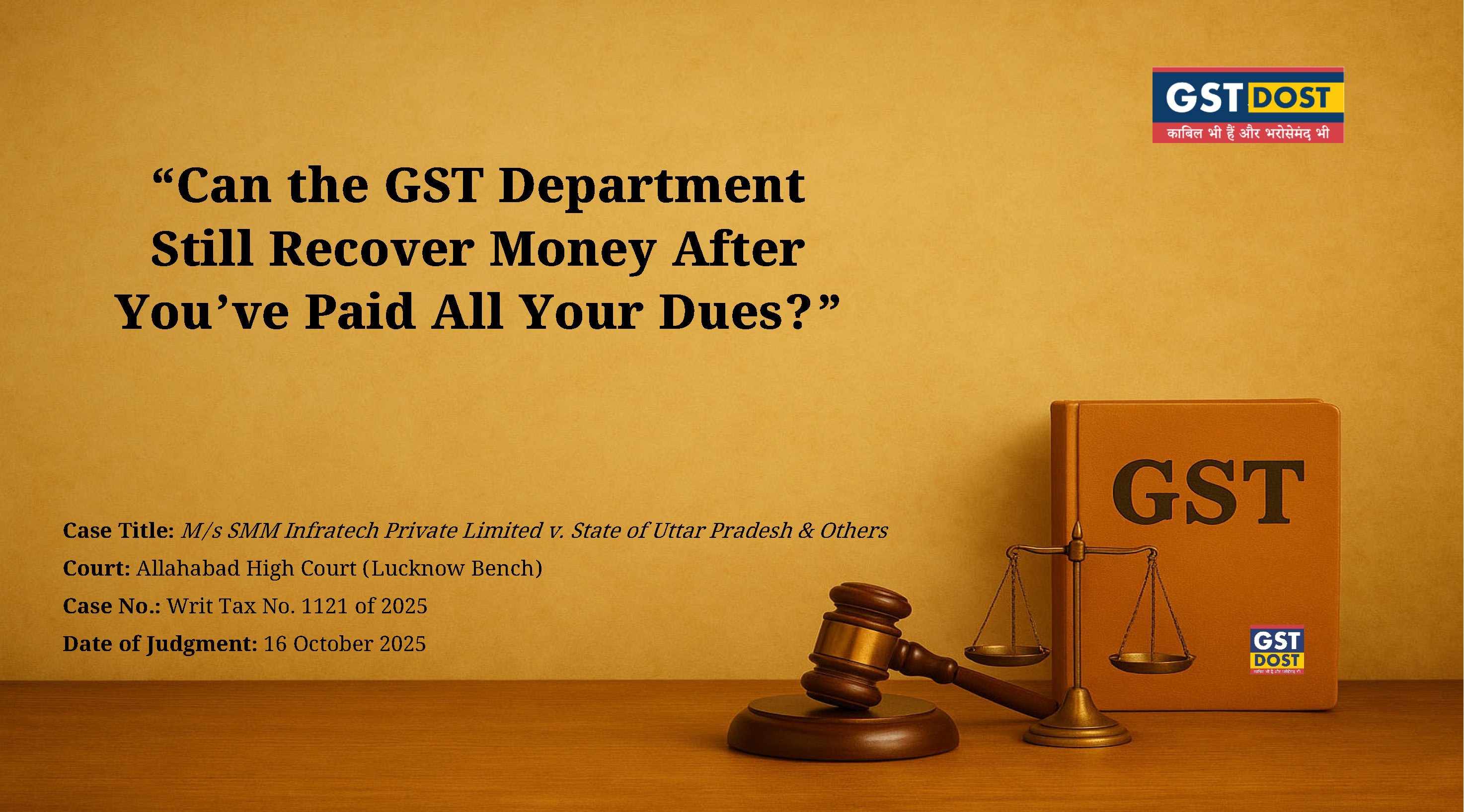
Can the GST Department Still Recover Money After You’ve Paid All Your Dues?
GST DOST's BLOG
| Ownership | Own | ||
Namaste DOST!
Imagine this — your company files all its pending GST returns, pays every rupee of tax, and finally breathes a sigh of relief. But just when you think it’s over… a notice arrives. Your bank account is frozen, and funds are blocked — all in the name of “recovery.”
Sounds unbelievable? That’s exactly what happened to M/s SMM Infratech Pvt. Ltd., and the Allahabad High Court had a lot to say about it.
Summary
In M/s SMM Infratech Pvt. Ltd. vs. State of U.P. (Writ Tax No. 1121 of 2025, decided on 16 October 2025), the Allahabad High Court examined whether the GST Department can recover dues under Section 79 of the UPGST Act after the taxpayer has already filed all returns and paid taxes.
The Court held that once a taxpayer complies within the time limit under Section 62(2) — by filing returns and paying the tax — the earlier best judgment assessment under Section 62(1) is automatically withdrawn. Therefore, no recovery proceedings can continue, and freezing a bank account after full compliance is illegal and excessively harsh.
Facts of the Case
M/s SMM Infratech Pvt. Ltd. had delayed filing of some GST returns and payment of taxes. Because of this, the Department passed best judgment assessment orders under Section 62(1) of the UPGST Act.
But soon after receiving those orders, the company filed all pending returns and cleared all dues within 60 days — exactly as permitted under Section 62(2).
Despite that, over a year later, the Department issued orders on 14 July 2025, 15 September 2025, and 19 September 2025, instructing banks to freeze the company’s accounts and even recovered ₹4.79 lakh while marking a lien of ₹2.36 crore on other accounts.
The company, shocked by these actions, approached the Allahabad High Court, arguing that such coercive steps were unlawful, since the tax dues had already been settled long ago.
Legal Issue
The key legal question before the Court was simple but vital:
Can the GST Department use Section 79 (Recovery Proceedings) once the taxpayer has already paid taxes and filed all pending returns within the prescribed 60 days under Section 62(2)?
This issue required the Court to interpret how the deeming provision in Section 62(2) interacts with the Department’s recovery powers under Section 79.
Arguments by the Parties
Petitioner’s Stand (SMM Infratech Pvt. Ltd.)
-
The petitioner emphasized that all pending returns had been filed and taxes paid within 60 days.
-
As per Section 62(2), the earlier best judgment orders automatically stand withdrawn once compliance is done.
-
Hence, no tax was legally “payable” after that, and invoking Section 79 to recover dues or freeze accounts was beyond the Department’s legal authority (ultra vires).
-
The petitioner further argued that such harsh measures — especially a year after payment — were unjust, disproportionate, and contrary to natural justice.
Department’s Response
-
The Department did not dispute that taxes were eventually paid but contended that there had been an initial delay.
-
It relied on that delay to justify the recovery steps — though it offered no valid reason for why coercive action was taken after compliance was complete.
⚖️ High Court’s Decision
The Allahabad High Court (Bench of Justice Shekhar B. Saraf and Justice Prashant Kumar) ruled decisively in favour of the taxpayer.
The Court observed that:
-
The taxpayer had filed returns and paid taxes within the permitted 60 days.
-
Therefore, under Section 62(2), the best judgment assessments automatically stood withdrawn.
-
The Department’s later actions — freezing bank accounts and creating liens more than a year afterward — were “extremely harsh and cannot be countenanced.”
The Court directed that:
-
The Department must cancel all lien directions immediately.
-
The bank should defreeze the taxpayer’s accounts forthwith.
-
The Department may raise any fresh demand (like interest or penalty) only by issuing a new show-cause notice following proper procedure.
With these directions, the petition was disposed of.
Legal Reasoning & Analysis
This judgment is rooted in a clear understanding of how Sections 62 and 79 of the GST law work together:
-
Section 62(1): Enables the officer to make a “best judgment” assessment if a taxpayer fails to file returns.
-
Section 62(2): Offers a second chance — if the taxpayer files returns and pays dues within 60 days, the earlier assessment is deemed withdrawn.
In legal terms, “deemed” means it automatically happens by operation of law — no separate order is required.
Thus, once the taxpayer complies, there remains no valid assessment or outstanding demand to justify any recovery under Section 79.
By still freezing accounts, the Department violated the principle of proportionality and fairness in administrative action.
The Court’s firm stance shows that tax collection cannot override justice. Even the State must act within the law, and once compliance is done, recovery becomes both illegal and unethical.
📘 Takeaways for Every Taxpayer
1️⃣ Timely Compliance Can Undo Best Judgment Orders:
File your returns and pay dues within 60 days of receiving a best judgment assessment — it cancels that order automatically under Section 62(2).
2️⃣ No Recovery After Full Payment:
Once you’ve paid everything, the Department cannot attach your bank or recover funds unless a fresh proceeding is initiated lawfully.
3️⃣ Keep Documentation Ready:
Maintain proof of all return filings (GSTR-3B) and challans — these are your strongest shield in case of wrongful recovery.
4️⃣ Section 62(2) is Your Legal Safety Net:
It’s designed to encourage compliance, not punishment. Knowing this right can save you from arbitrary actions.
5️⃣ Justice is Accessible:
If you face an unlawful freeze or recovery, don’t panic — courts have consistently upheld taxpayers’ rights in such cases.
Why This Judgment Matters
This ruling has broader implications across India’s GST ecosystem. It sends a message that compliance cannot be penalized.
If a taxpayer fulfills legal obligations, authorities must respect that compliance and refrain from coercive actions.
It also reaffirms that “deeming provisions” like Section 62(2) are self-executing — they don’t need extra paperwork or approval.
For both taxpayers and officers, this decision serves as a reminder that fairness is part of the law itself.
Conclusion
What began as a delayed return filing ended as a lesson in balance and fairness.
The Allahabad High Court made it clear — once you’ve paid your dues, the file should close, not reopen.
At GST DOST, we stand for that very balance — between tax enforcement and taxpayer protection.
Because true compliance thrives only when fairness walks alongside the law.
“ 📞 Need help with a similar recovery or bank attachment issue? Contact GST DOST for professional guidance and representation.
FAQ
Q1. What was the dispute in this case?
A: The GST Department froze the taxpayer’s bank accounts under Section 79 even after all pending returns and dues were cleared under Section 62(2).
Q2. What did the High Court decide?
A: The Allahabad High Court held the recovery actions illegal and directed the Department to defreeze the accounts immediately.
Q3. What does Section 62(2) mean for taxpayers?
A: It means that if you file your returns and pay dues within 60 days of a best judgment order, that order is automatically withdrawn — no recovery can continue.
Q4. What should a taxpayer do if the bank account is frozen despite payment?
A: Present evidence of tax payment, quote Section 62(2), and if needed, approach the High Court for relief.
Q5. Can the GST Department freeze your bank account even after you’ve paid all your dues?
A: No. Once all pending returns and taxes are filed and paid within the prescribed time, the earlier assessment order automatically stands withdrawn under Section 62(2) of the GST Act — meaning no further recovery or bank attachment is legally valid.
References
-
Case Citation: M/s SMM Infratech Pvt. Ltd. vs. State of Uttar Pradesh & Others, Allahabad High Court, Writ Tax No. 1121 of 2025, Judgment dated 16 October 2025; [2025 (10) TMI 961 – Allahabad High Court].
-
Statutory Provisions:
-
Section 62(1) & 62(2), Uttar Pradesh Goods and Services Tax Act, 2017
-
Section 79, UPGST Act, 2017 – Recovery of tax
-
Article 226, Constitution of India – Power of High Courts to issue writs
-

CBIC Notifies New Rule 14A – Quick GST Registration Option for Small Taxpayers [News]
[News]
GST Summons Is Not a Punishment — Don’t Panic Before the Law Does [Blog]
Yes, Police Can Attach Bank Accounts in GST Cases. But Only If They Follow the Law [Blog]
Gujarat HC says:“Phone calls don’t count as hearings!”Know your rights under Sec 75(4) [Video]
Know GST Rate of HSN 3926 | GST DOST [Video]

GST DOST, formerly known as My Service Tax, is a specialist GST firm led by experienced professionals — including CA, CS, MBA, and Advocates.
We are fluent in the ever-evolving GST regime and ensure accurate, timely, and actionable advice. Our strength lies not just in technical depth but in the use of AI tools and behavioural intelligence to ensure our clients feel informed, assured, and genuinely supported at every stage.

Powered by: RNJ Consultancy Services