YOU ARE HERE Home > Blogs > GST Doesn’t Tax Your Pain. It Taxes What You Choose to Tolerate.
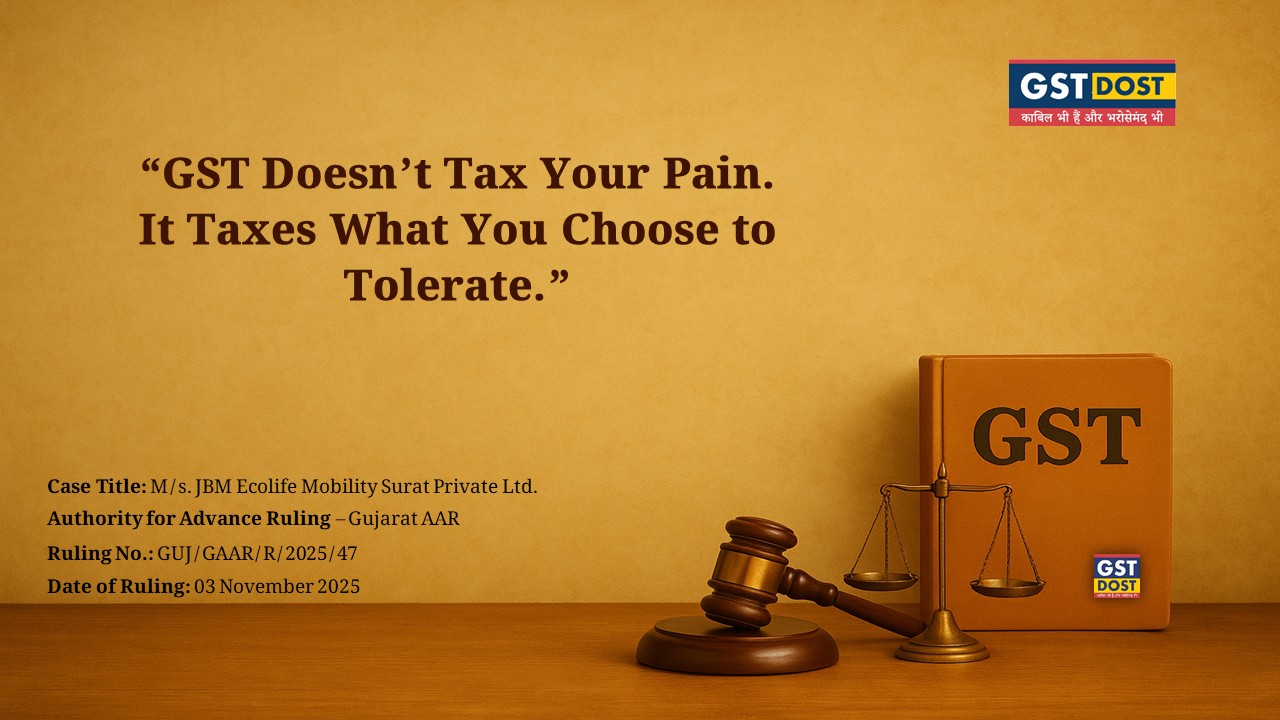
GST Doesn’t Tax Your Pain. It Taxes What You Choose to Tolerate.
GST DOST's BLOG
| Ownership | Own | ||
Namaste DOST!
Today’s story is about a phrase we often hear but rarely understand: Liquidated Damages. And a deeper truth that Circular 178 quietly whispers —
“GST doesn’t tax your loss. It taxes what you willingly tolerate.”
Sounds philosophical? It is.
And this Advance Ruling from Gujarat makes it crystal clear.
Summary (What, Why, Outcome)
This case revolves around JBM Ecolife Mobility Surat Pvt. Ltd., a company entrusted with operating and maintaining electric buses for Surat city. Under its Concession Agreement with Surat Sitilink Ltd. (SSL), the company had to pay various liquidated damages if buses were not maintained, if defects were not rectified in time, or if operational rules were violated.
The core question:
Are these liquidated damages taxable under GST?
The Authority analysed the agreement, the obligations, and Circular 178/10/2022.
Its conclusion was simple yet powerful:
👉 Liquidated damages meant to compensate loss are NOT taxable. GST applies only when you pay someone for “tolerating” something.
This AAR clarifies an issue faced by thousands of businesses — and brings sanity back to the interpretation of LD under GST.
Facts of the Case
JBM Ecolife Mobility Surat Pvt. Ltd. is an SPV created to run 150 electric buses in Surat under the National E-Bus Program. The tender was awarded in July 2023, and a detailed Concession Agreement was signed with SMC. Later, operations shifted to SSL, making SSL the authority overseeing the project.
The Agreement was extensive. It defined everything —
from bus design and maintenance to depot infrastructure and safety standards.
And naturally, it had liquidated damages clauses:
-
Delay in procurement of buses
-
Non-rectification of defects
-
Poor maintenance
-
Operational infractions (e.g., driver misconduct, not following schedule)
-
Failure to meet performance indicators
-
Damage to equipment
-
Non-availability of buses
Every breach carried a price. Penalties ranged from ₹100 to ₹10,000 per incident, and in some cases, damages were pegged at 5% of performance security per bus, per day.
SSL began recovering these damages. JBM then approached AAR with a simple but critical question:
“Is GST payable on these liquidated damages?”
Legal Issue
Whether the liquidated damages paid by JBM to SSL under the Concession Agreement amount to a “supply” under Section 7 of the CGST Act, and therefore attract GST?
If yes — what rate?
If yes — is ITC available on such GST?
Arguments
Applicant (JBM) argued:
-
Liquidated damages are compensation for breach, not a supply.
-
There is no service being provided by SSL.
-
A breach cannot be considered a “supply” of tolerating an act.
-
Circular 178/10/2022 says breach-related LD are not taxable.
-
SSL is not “agreeing” to suffer loss or breach in exchange for money.
Additional point:
SSL itself inserted LD clauses to ensure performance and discipline — not to supply a service.
Authority’s Ruling
The AAR Gujarat delivered a clear and well-reasoned ruling:
1️⃣ Liquidated Damages Not Taxable
The Authority held that LD in this case are pre-estimated losses, not consideration for any supply.
The contract explicitly calls them “genuine pre-estimated loss” and not penalty.
2️⃣ No Agreement to Tolerate a Breach
Nothing in the Agreement suggests SMC/SSL was “agreeing to tolerate an act” in return for money.
This is the heart of the ruling.
3️⃣ Circular 178 Controls the Field
Circular 178 draws a bright line:
-
-
If LD compensates damage → No GST
-
If LD is paid because someone agreed to tolerate something → GST applies
-
Here, LD arose from non-performance, unsatisfactory performance, or delayed performance — all of which cause loss to SSL.
So GST is not attracted.
4️⃣ Other Questions Become Irrelevant
Since GST itself does not apply, the questions regarding rate and ITC become irrelevant.
Legal Reasoning & Analysis
This ruling beautifully reinforces a central idea:
⭐ “Contract is made for performance, not breach.”
A breach is never a supply.
A loss is never a service.
Circular 178 explains the test simply:
A payment becomes “consideration” only when one party does something and the other party pays for THAT something.
If there is no such arrangement,
the payment is “de hors the agreement”,
meaning outside the contract —
and hence not consideration.
Think of it this way:
-
If a bank gives you an early-closure option and charges fees — that’s a supply.
-
If a bus operator fails to maintain buses and pays damages — that’s loss recovery.
Loss recovery is not a service. No supply → No GST.
This AAR aligns perfectly with multiple earlier rulings (Achampet Solar, GSPC, etc.) and strengthens one common principle:
Breach ≠ Supply.
Important Message for Every Business Owner
- Breach is not a business model.
Liquidated damages for delay, non-performance, or operational issues are not taxable.
- GST applies only when someone gets paid for tolerating something.
This is rare — and must be an explicit or implied agreement.
- Draft contracts clearly.
Use phrases like “pre-estimated loss”, not “penalty”, to avoid misinterpretation.
- Use Circular 178 confidently.
It’s the backbone of LD taxability.
-
Don’t let officers force GST on LD blindly.
Share this ruling. Educate them.
Why This Matters
This ruling protects businesses from unnecessary tax burdens on contractual breaches.
It stops the trend of treating every payment as consideration. And it reinforces that GST is a tax on supplies, not on mistakes.
It brings clarity for contractors, operators, manufacturers, infra companies, logistics players — practically everyone dealing with performance clauses.
Conclusion
What started as a routine contractual issue — penalties for delayed buses — ended up becoming a powerful reminder:
GST doesn’t tax your pain. It taxes what you choose to tolerate. And in this case, SSL wasn’t tolerating anything. It was simply recovering its loss.
As long as LD compensate loss — not buy tolerance — GST stays out.
At GST DOST, we stand by this simple truth: When you understand the law, you don’t fear the law.
📞 Need help with a similar GST confusion? Connect with GST DOST — your partner in clarity.
FAQ
Q1: What was the core dispute in this case?
Whether liquidated damages paid by JBM Ecolife to SSL under a Concession Agreement were taxable under GST.
Q2: What did the Authority decide?
The AAR ruled that these LD were compensation for loss, not consideration for any supply, and therefore not taxable.
Q3: When can LD become taxable?
LD becomes taxable only when it is paid for tolerating an act, not for recovering loss.
Q4: Does this ruling align with Circular 178?
Yes. The Circular clearly states that LD paid for breach of contract is not taxable unless it is consideration for tolerance.
Q5: How do I know whether GST applies on my Liquidated Damages?
If the payment is made to compensate a loss → No GST.
If the payment is made for tolerating a breach or wrongdoing → GST applies.
References
-
Advance Ruling: In Re: M/s JBM Ecolife Mobility Surat Pvt. Ltd. (AAR Gujarat, 3 Nov 2025).
-
CBIC Circular No. 178/10/2022-GST dated 03.08.2022.
-
Concession Agreement extracts as reproduced in the AAR.
Related AAR/AAAR decisions: GSPC, Achampet Solar, Rites Ltd., SECL
Written by CA Vikash Dhanania | Reviewed by GST DOST Legal Research Team | Updated on 13/11/2025
© GST DOST | When GST gets complicated, we make it simple—saving your time, money, and effort.

CBIC Notifies New Rule 14A – Quick GST Registration Option for Small Taxpayers [News]
[News]
GST Summons Is Not a Punishment — Don’t Panic Before the Law Does [Blog]
Yes, Police Can Attach Bank Accounts in GST Cases. But Only If They Follow the Law [Blog]
Gujarat HC says:“Phone calls don’t count as hearings!”Know your rights under Sec 75(4) [Video]
Know GST Rate of HSN 3926 | GST DOST [Video]

GST DOST, formerly known as My Service Tax, is a specialist GST firm led by experienced professionals — including CA, CS, MBA, and Advocates.
We are fluent in the ever-evolving GST regime and ensure accurate, timely, and actionable advice. Our strength lies not just in technical depth but in the use of AI tools and behavioural intelligence to ensure our clients feel informed, assured, and genuinely supported at every stage.

Powered by: RNJ Consultancy Services