YOU ARE HERE Home > Blogs > GST Isn’t a Buffet: You Can’t Serve 7 Years on One Plate!
GST Isn’t a Buffet: You Can’t Serve 7 Years on One Plate!
GST DOST's BLOG

| Ownership | Own | ||
Namaste DOST!
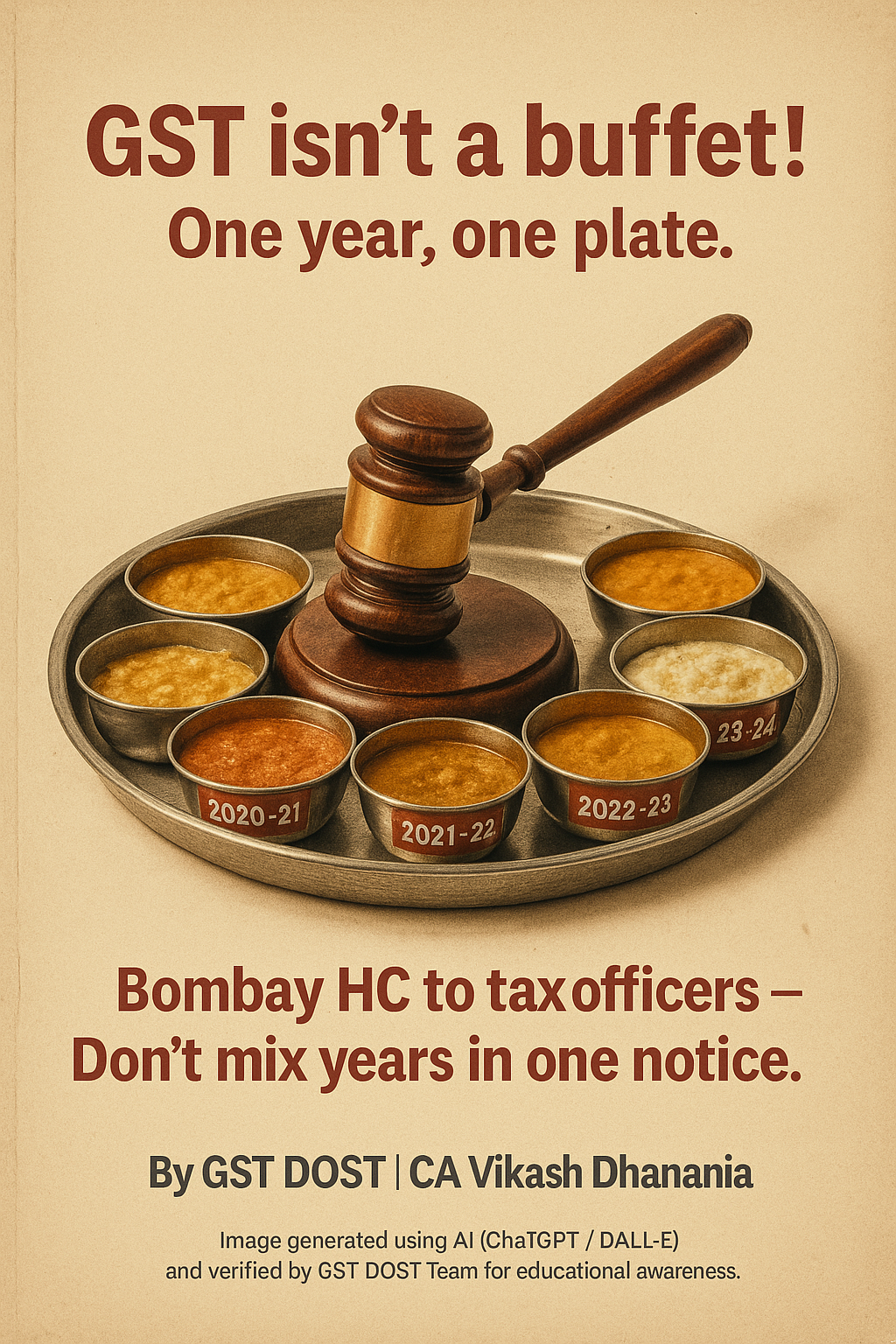
Imagine you’re dining at your favorite buffet. You pick up one plate — and the waiter piles on seven years’ worth of food! Sounds absurd, right? That’s exactly what happened in a GST case where officers issued one show-cause notice covering multiple financial years.
And just like a good maître d’ would stop that chaos, the Bombay High Court stepped in and said — “Hold on! Each year deserves its own plate.”
Summary
In M/s Milroc Good Earth Developers v. Union of India (2025 (10) TMI 867 – Bombay High Court), the department had issued a consolidated show-cause notice (SCN) to a Goa-based real estate developer for seven years — from FY 2017-18 to 2023-24. The notice demanded GST on construction services provided to landowners, reversal of Input Tax Credit (ITC), and tax under reverse charge on Transfer of Development Rights (TDR).
The High Court held that such “bunched” notices are beyond jurisdiction. Each financial year is a distinct tax period under the CGST Act, and combining multiple years in one SCN violates both the law and limitation timelines. The Court quashed the notice, calling it a case of “judicial overreach.”
This ruling reinforces a simple truth — GST may be a uniform law, but every financial year stands on its own.
Facts of the Case
The petitioner, M/s Milroc Good Earth Developers, a partnership firm in Goa, was engaged in construction and redevelopment projects. Two major projects — Colina and Adarsh — were under scrutiny.
Based on departmental intelligence, the authorities alleged that the developer:
-
failed to pay GST on construction services provided to landowners,
-
wrongly availed ITC under Section 17 read with Rule 42, and
-
was liable under reverse charge for TDR services related to unbooked flats.
Accordingly, a single show-cause notice dated 28 March 2025 demanded:
-
₹2.16 crore GST for the Colina Project,
-
₹9.32 crore GST for the Adarsh Project,
-
₹2.30 crore ITC reversal, and
-
₹2.39 crore under RCM on TDR services — all spanning FY 2017-18 to 2023-24.
Another entity, Mariposa Beach Grove, faced a similar multi-year demand. Both petitioners approached the High Court challenging the validity of issuing one SCN for multiple financial years.
Legal Issue
The core question before the Court was simple but crucial:
“Can the GST Department issue a single show-cause notice covering multiple financial years under Sections 73 or 74 of the CGST Act, 2017?
The answer, as the Court made clear — No.
Arguments
Petitioner’s Stand:
-
Each financial year is an independent “tax period.”
-
Sections 73 and 74 of the CGST Act specify that SCNs must relate to a specific period and be issued within defined limitation timelines — 3 years under Section 73 and 5 years under Section 74.
-
A combined notice shortens limitation for later years and prevents the taxpayer from giving year-wise explanations.
-
Reliance was placed on judgments like Titan Company Ltd. (Madras HC), Veremax Technologie Services Ltd. (Karnataka HC), and R.A. & Co. (Madras HC), which held that bunching multiple years in one notice violates the statutory scheme.
Department’s Stand:
-
The notice was valid under Sections 74(3) and 74(4), which use the words “for any period” and “for such periods.”
-
Cited Ambika Traders (Delhi HC) and RioCare India Pvt. Ltd. (Bombay HC), arguing that in certain cases (like fraud or continuous ITC misuse), multi-year notices could be justified.
-
Objected that the petitions were premature, as they were filed against SCNs, not final orders.
⚖️ Court’s Decision
Bench: Justice Bharati Dangre & Justice Ashish S. Chavan
Court: Bombay High Court (Goa Bench)
Date: 9 October 2025
The High Court examined the entire structure of the GST law — from definitions of “assessment,” “return,” and “tax period” to the provisions on limitation under Sections 73(10) and 74(10).
It held that:
-
Each financial year is a self-contained unit of assessment under GST.
-
A show-cause notice must correspond to the specific period of return — monthly, quarterly, or annual — and cannot be merged across years.
-
The Act prescribes clear limitation periods for each year; a composite notice distorts those timelines and prejudices taxpayers’ defense.
-
The statute nowhere allows “consolidated” or “bunched” SCNs covering multiple financial years.
The Court quoted the Supreme Court’s ruling in State of Jammu & Kashmir v. Caltex (India) Ltd. (AIR 1966 SC 1350):
“Where an assessment encompasses different assessment years, each assessment year could be easily split up and dissected and the items can be separated and taxed for different periods.”
It also relied on Titan Company Ltd. and R.A. & Co., which declared such bunching “jurisdictional overreach.”
Finally, the Court quashed the impugned notices, holding:
“The action of issuing consolidated show-cause notices for multiple assessment years is without jurisdiction and constitutes judicial overreach.”
Legal Reasoning & Analysis
The judgment beautifully connects law with logic.
Sections 73 and 74 define both the cause (non-payment, short payment, or wrongful ITC) and the period (financial year) of dispute. The limitation clock runs from the due date of the annual return for that year.
So when officers merge seven years in one notice, they effectively reset or shorten different limitation periods — something the law never intended.
The Court reasoned that every year allows separate reconciliation, audit, and defense. By forcing all into a single notice, the department denies the taxpayer a fair opportunity to reply distinctly for each year — violating the principles of natural justice and statutory design.
The Bench also distinguished Ambika Traders, noting that the Delhi HC case involved fraudulent ITC across years, where clubbing was evidentially necessary. Here, Milroc’s case involved regular construction services — not fraud — so that exception did not apply.
Important Message for Every Business Owner:
-
📆 One Year, One Notice: GST law treats every financial year as a separate chapter. A notice covering multiple years is not legally valid.
-
🧾 Respect the Calendar: Limitation runs separately for each year — keep track of due dates and filings carefully.
-
📚 Maintain Year-Wise Evidence: Organize invoices, returns, and reconciliations year by year — they’re your defense.
-
⚖️ Challenge Clubbed SCNs Early: If you receive a multi-year notice, raise a jurisdictional objection immediately.
-
🤝 Seek Expert Help: GST procedures are time-bound and technical. Early advice can save you years of litigation.
Why This Matters
This ruling restores discipline and clarity in GST enforcement. It reminds officers that administrative convenience can’t override statutory precision. For taxpayers, it’s reassurance that time-bound rights under GST aren’t just formalities — they’re real safeguards.
The judgment now joins landmark precedents like Titan Company Ltd., Veremax Technologies, and R.A. & Co., building a strong shield against multi-year show-cause notices across India.
Conclusion
Every GST year is like a course in a meal — it must be served, tasted, and assessed separately. When the department tried to turn it into a buffet, the Bombay High Court stepped in and said, “Not on our table.”
The Milroc Good Earth Developers ruling isn’t just about one builder’s relief — it’s about reasserting structure, fairness, and logic in tax administration.
At GST DOST, we believe the message is clear: compliance must be systematic, and justice must be specific.
📞 Need help with a similar case? Contact GST DOST for personalized support and expert representation.
FAQ
Q1: What was the dispute in this case?
A: The department issued a single show-cause notice covering seven financial years, demanding GST and ITC reversal. The taxpayer challenged it as illegal.
Q2: How did the Bombay High Court rule?
A: The Court quashed the multi-year notices, holding that each financial year is a distinct tax period and must have a separate notice.
Q3: Is it ever legal to issue a consolidated GST notice?
A: Only in rare fraud-related cases where transactions span across years (Ambika Traders, Delhi HC). Otherwise, it’s impermissible.
Q4: Can the department demand GST for multiple years in a single notice?
A: No. Each financial year requires a separate notice. Combining multiple years into one show-cause notice is against the provisions of law.
Q5: What should businesses do if they receive such a notice?
A: File a written objection citing this judgment, maintain proper documentation, and seek expert advice to protect your rights.
References
-
M/s Milroc Good Earth Developers & Mariposa Beach Grove v. Union of India & Ors., Bombay High Court (Goa Bench), W.P. Nos. 2203 & 2312 of 2025, Judgment dated 9 Oct 2025 (2025 (10) TMI 867 – BHC).
-
State of Jammu & Kashmir v. Caltex (India) Ltd., AIR 1966 SC 1350 (Supreme Court of India).
-
Titan Company Ltd. v. Joint Commissioner of GST & C. Ex. (2024 (1) TMI 619 – Madras HC).
-
R.A. & Co. v. Additional Commissioner of Central Taxes, Madras HC (2025).
-
Sections 73, 74, 74A of the CGST Act, 2017 — Determination of tax not paid, short paid, or ITC wrongly availed
Written by CA Vikash Dhanania | Reviewed by GST DOST Legal Research Team | Updated on 10/11/2025
© At GST DOST, we stop when officers cross their line — protecting your lawful rights and keeping GST action within its limits.

CBIC Notifies New Rule 14A – Quick GST Registration Option for Small Taxpayers [News]
[News]
GST Summons Is Not a Punishment — Don’t Panic Before the Law Does [Blog]
Yes, Police Can Attach Bank Accounts in GST Cases. But Only If They Follow the Law [Blog]
Gujarat HC says:“Phone calls don’t count as hearings!”Know your rights under Sec 75(4) [Video]
Know GST Rate of HSN 3926 | GST DOST [Video]

GST DOST, formerly known as My Service Tax, is a specialist GST firm led by experienced professionals — including CA, CS, MBA, and Advocates.
We are fluent in the ever-evolving GST regime and ensure accurate, timely, and actionable advice. Our strength lies not just in technical depth but in the use of AI tools and behavioural intelligence to ensure our clients feel informed, assured, and genuinely supported at every stage.

Powered by: RNJ Consultancy Services