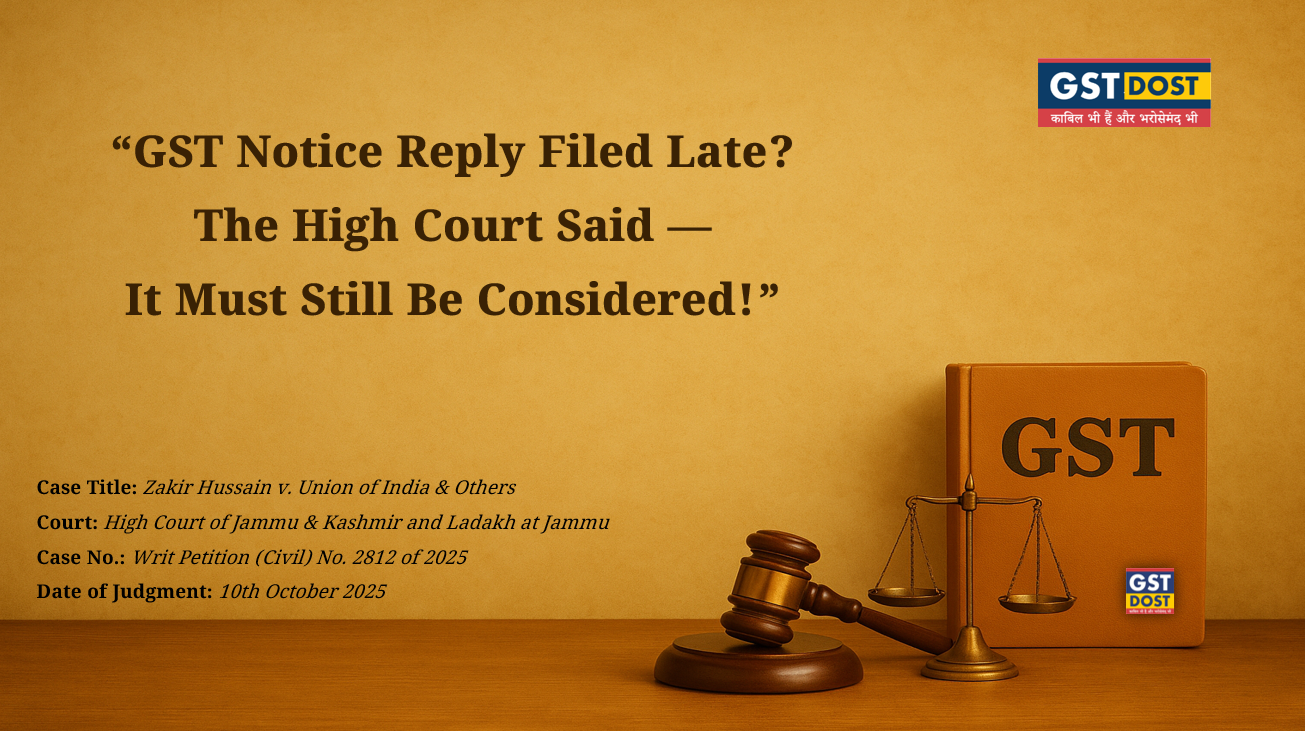
GST Notice Reply Filed Late? The High Court Said — It Must Still Be Considered!
GST DOST's BLOG
| Ownership | Own | ||
Namaste DOST!
Ever missed a deadline to reply to a GST notice—may be because you were compiling records or simply didn’t see it in time? Should that mean your side won’t be heard at all?
The Jammu & Kashmir High Court recently gave an answer that every taxpayer should know — fairness doesn’t expire with a due date.
Summary
In Zakir Hussain v. Union of India & Ors. (Order dated 10 October 2025), the High Court of Jammu & Kashmir and Ladakh set aside a GST demand of ₹ 15.44 lakh because the taxpayer’s reply to a show-cause notice, though filed late, was submitted before the final order. The officer ignored it entirely and passed the order anyway.
The Court held that since Section 73(9) of the GST Act requires the officer to consider “any representation” before determining tax, non-consideration of a reply received before the order violates principles of natural justice. The case reinforces that a taxpayer’s right to be heard cannot be brushed aside on technical delay.
Facts of the Case
Zakir Hussain, a 55-year-old contractor from District Kishtwar, was registered under GST.
The State Taxes Officer, Circle Kishtwar issued a show-cause notice dated 25 November 2024 under Section 73(1) of the J&K GST Act, 2017, alleging short payment of tax of ₹ 15.06 lakh for FY 2020-21 and calling for explanation by 30 December 2024
Zakir filed his reply on 20 January 2025, about 20 days late but before any final order was made. The officer, however, refused to consider it, citing delay, and passed an order on 26 February 2025 under Section 73(9), raising a demand of ₹ 15.44 lakh.
Feeling unheard, Zakir approached the High Court, arguing that the order was passed without considering his reply and hence violated the principles of natural justice.
Legal Issue
Whether a GST officer must consider a taxpayer’s reply filed after the period mentioned in a show-cause notice, but before the final order under Section 73(9) is passed.
A related question: Does ignoring such a reply render the demand order invalid for violation of natural justice?
Arguments & Court’s Consideration
The petitioner contended that since his reply was filed before the final order, the officer was bound in law to consider it. The department maintained that the reply was beyond the deadline given in the notice and thus need not be examined.
The Bench of Justice Sanjeev Kumar and Justice Sanjay Parihar analysed Section 73 of the GST Act and Rule 142 of the J&K GST Rules 2017.
The Court noted that while officers may fix a timeframe in the notice, the statute itself does not prescribe any mandatory time limit for filing a reply under Section 73(1). Therefore, a reply received before the final order cannot be ignored merely because it was late.
⚖️ High Court’s Ruling
The Court held that:
“ If the response to the show-cause notice is received by the proper officer after the period stipulated in the notice but before the final order is passed, it is incumbent upon the officer, in the interest of justice, equity and fair play, to consider such response before passing the order.”
Key observations:
-
Section 73(9) expressly mandates that the proper officer shall determine tax after considering the representation, if any made by the taxpayer.
-
Since no statutory deadline is fixed for replies, an officer cannot treat a slightly delayed submission as non-existent.
-
Fair hearing and principles of natural justice demand that once a reply is on record, it must be evaluated before deciding liability.
Accordingly, the Court set aside the order dated 26 February 2025 and directed the STO to pass a fresh speaking order after considering Zakir’s reply and giving him an opportunity of personal hearing.
Any tax recovered under the quashed order would remain subject to the outcome of the new decision.
Legal Reasoning & Analysis
This ruling underscores that procedural fairness forms the backbone of tax adjudication.
Even though Section 73 empowers officers to determine tax not paid or short paid, sub-section (9) compels them to do so only after considering the taxpayer’s representation.
By refusing to look at a reply simply because it came a few days late, the officer undermined both the intent of the Act and Article 14 of the Constitution, which ensures fairness in administrative action.
The High Court’s interpretation balances the government’s right to collect tax with the citizen’s right to be heard — reaffirming that law is a tool of justice, not punishment for delay.
Important Takeaways for Every Business Owner
-
Fair Hearing Is a Right: Your reply must be considered if submitted before the order, even if late.
-
Section 73(9) Matters: It requires officers to decide tax liability after considering representation — ignoring it violates the Act.
-
File Anyway: Even if you miss a due date in a notice, still file your reply. The law is on your side.
-
Keep Proof: Always maintain acknowledgment or an email trail showing when your reply was sent.
-
Seek Professional Help: When in doubt, consult a GST expert — timely representation can save both tax and peace of mind.
Why This Matters
This verdict sets a nationwide precedent reminding GST officers that administrative efficiency cannot override natural justice.
It reassures taxpayers that courts will step in when fairness is ignored, and encourages transparent, humane tax administration.
Conclusion
What began as a contractor’s late reply ended as a landmark reaffirmation of fairness.
Deadlines may guide the process, but justice listens even when the clock runs out.
At GST DOST, we believe this judgment embodies the spirit of tax law — compliance tempered with compassion and equity.
“📞 Need help with a similar case? Contact GST DOST for personalised support.
FAQ
Q: What was the dispute in this case?
A: The taxpayer’s GST demand order under Section 73(9) was challenged because his reply to the show-cause notice, though filed late, was ignored by the officer.
Q: How did the High Court rule?
A: It set aside the order and directed the officer to consider the reply and grant a personal hearing before passing a fresh order.
Q: Is there any statutory deadline for filing reply to a show-cause notice under Section 73(1)?
A: No. The Act does not fix a specific period; the officer may allow reasonable time, but a reply filed before the order must still be considered.
Q: Will I still be heard if I submit a late reply?
A: Yes, if your reply is given before the final order is passed, the officer must consider it — that’s exactly what the Court said.
Q: What should taxpayers do on receiving a GST notice?
A: Respond in writing as soon as possible, keep proof of submission, and if a delay occurs, still file the reply before order — your right to be heard remains protected.
References
-
Zakir Hussain v. Union of India & Ors. — High Court of Jammu & Kashmir and Ladakh at Jammu, Order dated 10 October 2025, WP (C) No. 2812 of 2025.
-
Section 73, Central Goods and Services Tax Act, 2017 – Determination of tax not paid or short paid.
-
Rule 142, Jammu & Kashmir GST Rules, 2017 – Notice and order for demand of amounts payable under the Act.
-
Principles of Natural Justice – Right to be heard (audi alteram partem).

CBIC Notifies New Rule 14A – Quick GST Registration Option for Small Taxpayers [News]
[News]
GST Summons Is Not a Punishment — Don’t Panic Before the Law Does [Blog]
Yes, Police Can Attach Bank Accounts in GST Cases. But Only If They Follow the Law [Blog]
Gujarat HC says:“Phone calls don’t count as hearings!”Know your rights under Sec 75(4) [Video]
Know GST Rate of HSN 3926 | GST DOST [Video]

GST DOST, formerly known as My Service Tax, is a specialist GST firm led by experienced professionals — including CA, CS, MBA, and Advocates.
We are fluent in the ever-evolving GST regime and ensure accurate, timely, and actionable advice. Our strength lies not just in technical depth but in the use of AI tools and behavioural intelligence to ensure our clients feel informed, assured, and genuinely supported at every stage.

Powered by: RNJ Consultancy Services