Q 5. What if an order is passed before the date of personal hearing?
A: In such cases, you can approach the High Court — because the law clearly says that no order can be validly passed without giving the taxpayer a fair opportunity to be heard.

No Breadcrumbs
| Ownership | Own | ||
Namaste DOST!
Imagine walking into your GST appeal hearing right on time — only to be told the order was passed two days earlier.
Sounds absurd? Yet that’s precisely what happened in this Delhi High Court case.
The Court’s message was crystal clear: “Natural justice delayed is justice denied — and justice denied is no justice at all.”
M/s A.L. Exports, a Delhi-based exporter, claimed a refund of ₹36.61 lakh for unutilised Input Tax Credit (ITC) on zero-rated exports. The Assistant Commissioner rejected it, citing missing shipping bills and Bank Realisation Certificates.
On appeal, the Joint Commissioner (Appeals-II) issued an Order-in-Appeal on 30 June 2025, before any effective hearing — while a “system-generated” hearing notice was uploaded the next day (1 July 2025) for a hearing fixed on 2 July 2025.
The Delhi High Court found this sequence deeply concerning, set aside the order, and directed a fresh hearing, reaffirming that every taxpayer must be given a fair chance to present their case.
M/s A.L. Exports, through proprietor Arshi, sought refund of ₹36,61,166 under the CGST Act for accumulated ITC on exports made without payment of IGST.
The Assistant Commissioner, CGST rejected the claim on 24 January 2025, holding that key documents — E-Way Bills, shipping bills, and BRCs — were not furnished.
The taxpayer appealed before the Joint Commissioner (Appeals-II). Several hearing notices (17 Feb, 5 Mar & 17 Mar 2025) were allegedly sent by speed-post, but the record showed no confirmed appearance. On 1 July 2025, a new notice appeared on the GST portal fixing hearing for 2 July 2025 at 12:30 p.m.
When the petitioner appeared on that date, he discovered that the appeal had already been decided on 30 June 2025. The order was physically handed over along with copies of the earlier notices.
Can an appellate authority pass a GST order before the scheduled date of personal hearing — and would that violate Section 75(4) of the CGST Act and Article 14 of the Constitution?
Petitioner:
The appeal was disposed of even before the hearing fixed for 2 July 2025 (as per the GST portal). Hence, the order was void for breach of natural justice.
Respondents:
The Department argued that multiple hearing notices had already been issued via speed-post, each bearing a Document Identification Number (DIN). Therefore, sufficient opportunity was allegedly provided.
Bench: Justices Prathiba M. Singh & Shail Jain — Delhi High Court
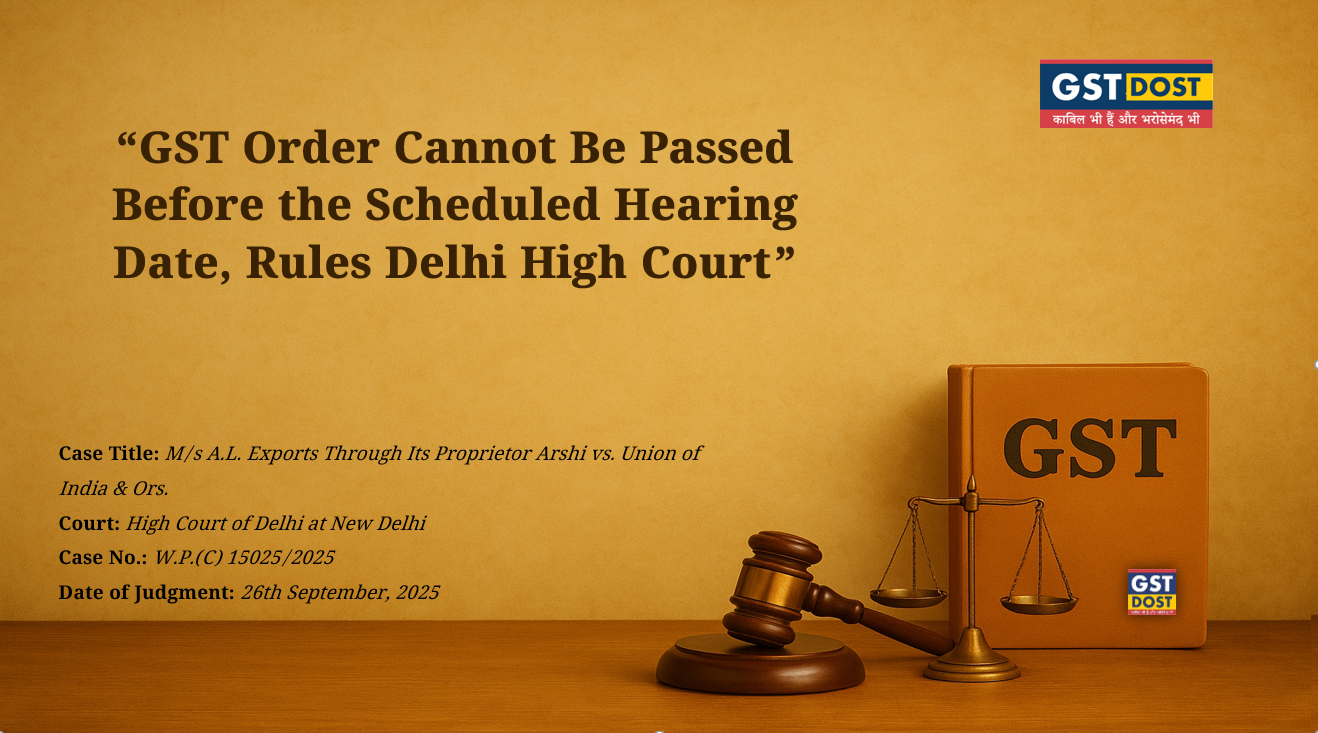
Date of Decision: 26 September 2025 (W.P.(C) 15025/2025)
The Court held that the petitioner had not been effectively heard in appeal. It observed a recurring pattern where hearing notices in GST appeals are often sent only by speed-post and not uploaded on the GST portal — depriving taxpayers of proper notice.
“When the first personal-hearing notice was uploaded on 01 July 2025, the petitioner diligently appeared before the appellate authority on 02 July 2025. However, unfortunately, the impugned Order-in-Appeal had already been passed by that date.”
Passing an order before the hearing date, the Bench held, was a clear violation of natural justice.
Administrative convenience or “system requirements” cannot override a taxpayer’s statutory right to be heard.
The High Court therefore set aside the Order-in-Appeal dated 30 June 2025, directing the appellate authority to hear the matter afresh on merits, after granting a proper hearing via both email (shailenderverma1@yahoo.co.in) and mobile (92679 79878), and then issue a reasoned order in accordance with law.
Section 75(4) of the CGST Act explicitly requires that no order be passed without giving the person an opportunity of hearing if an adverse decision is proposed.
Here, the Order-in-Appeal predated the scheduled hearing — defeating the very object of this safeguard.
The Bench stressed that system-generated errors cannot dilute fundamental rights. Even if notices were dispatched earlier, non-upload on the GST portal meant the taxpayer was unaware. The Court advised the Department to fix procedural lapses in its digital system to prevent repetition.
This ruling reinforces that procedural fairness is a cornerstone of the GST framework, ensuring trust and transparency between taxpayers and authorities.
Monitor the GST Portal Regularly: Important hearing notices may appear online before postal copies arrive.
Right to Be Heard Is Absolute: Orders passed before your hearing date can be legally struck down.
Keep Evidence of Compliance: Maintain proof of attendance, emails, and notice receipts.
System Errors ≠ Taxpayer Fault: Courts recognise that technical glitches cannot defeat justice.
Act Promptly: Timely legal intervention (like a writ petition) can restore your rights.
This judgment is a powerful reminder that automation cannot replace accountability.
Every taxpayer deserves a real hearing — not a checkbox exercise.
It reassures India’s business community that the judiciary continues to safeguard fairness within the GST ecosystem.
What began as a simple refund dispute turned into a precedent for procedural justice.
When systems fail, law steps in to restore balance.
The Delhi High Court’s decision in A.L. Exports reminds us that every notice, every click, and every hearing carries the weight of fairness — because justice must not only be done, but also be seen to be done.
“📞 Need help with a similar refund or appeal issue? Contact GST DOST for personalised support.
Q 1. What was the dispute in this case?
A refund of ₹36.61 lakh claimed by M/s A.L. Exports was rejected, and the appeal was decided even before the scheduled hearing date.
Q 2. How did the Delhi High Court rule?
The Court set aside the Order-in-Appeal dated 30 June 2025 for violation of natural justice and ordered a fresh hearing.
Q 3. Which law ensures the right to a hearing?
Section 75(4) of the CGST Act and Article 14 of the Constitution require a fair hearing before any adverse order.
Q 4. What should a taxpayer do if an order is passed without hearing?
File a writ petition before the High Court on grounds of breach of natural justice.
Case Citation: M/s A.L. Exports v. Union of India & Ors., Delhi High Court (W.P.(C) 15025/2025), Judgment dated 26 September 2025.
Statutory Provisions:
Section 75(4), Central Goods and Services Tax Act, 2017 — Opportunity of hearing before order.
Articles 14 & 226 of the Constitution of India — Right to equality and judicial review.

CBIC Notifies New Rule 14A – Quick GST Registration Option for Small Taxpayers [News]
[News]
GST Summons Is Not a Punishment — Don’t Panic Before the Law Does [Blog]
Yes, Police Can Attach Bank Accounts in GST Cases. But Only If They Follow the Law [Blog]
Gujarat HC says:“Phone calls don’t count as hearings!”Know your rights under Sec 75(4) [Video]
Know GST Rate of HSN 3926 | GST DOST [Video]
GST DOST, formerly known as My Service Tax, is a specialist GST firm led by experienced professionals — including CA, CS, MBA, and Advocates.
We are fluent in the ever-evolving GST regime and ensure accurate, timely, and actionable advice. Our strength lies not just in technical depth but in the use of AI tools and behavioural intelligence to ensure our clients feel informed, assured, and genuinely supported at every stage.

Powered by: RNJ Consultancy Services