GST Refund Denials Were Based on ‘Common Sense' ... High Court Says That Common Sense Was Completely Wrong.
“Refund क्यों रोका? हाईकोर्ट ने बताया—जो बातें हम सच मानते थे, वे क़ानून में थीं ही नहीं”
GST DOST's BLOG

| Ownership | Own | ||
Namaste DOST!
Today, I want to take you into a GST case that feels strangely familiar.
You know that moment when an officer says, “Common sense se dekho… refund kaise milega?”
And you stand there thinking, “But GST doesn’t run on assumptions. It runs on law.”
Well, this judgment from the Karnataka High Court proves exactly that.
Summary
This case is about Mavenir Systems Pvt. Ltd., a Bengaluru-based software company exporting services. They filed refund claims of unutilized ITC for FY 2018–19 and 2019–20. Initially, the GST department sanctioned both refunds. Later, higher authorities reviewed and reversed the refunds, claiming that the taxpayer had not submitted eBRC/FIRC, that the beneficiary address mismatched, that the remittance purpose looked suspicious, and that the company was providing “intermediary services”—not exports. Based on these “common-sense” objections, the department issued SCNs and recovery demands and finally rejected the refunds.
The High Court read the record carefully.
And then… it dismantled each ground one by one. The Court held that all documents were submitted, mismatched addresses and bank accounts do not invalidate export receipts, and the taxpayer was not an intermediary. The Court quashed all orders and directed the department to refund the ITC, with interest, within two months.
Facts of the Case
Mavenir Systems Pvt. Ltd. is a company providing software development and related services to overseas entities. It operates from Bengaluru.
In 2020, the company filed two refund applications under Section 54(3) of the CGST Act for unutilized ITC—one on 05.02.2020 for FY 2018–19, another on 11.05.2020 for FY 2019–20. The Assistant Commissioner appropriately sanctioned both refunds.
Then something changed.
A year later, higher officers decided to “review” the refund orders. They filed appeals. They issued fresh show cause notices. And they alleged that the entire refund was wrongly granted.
Their reasons?
You may want to sit down for this:
-
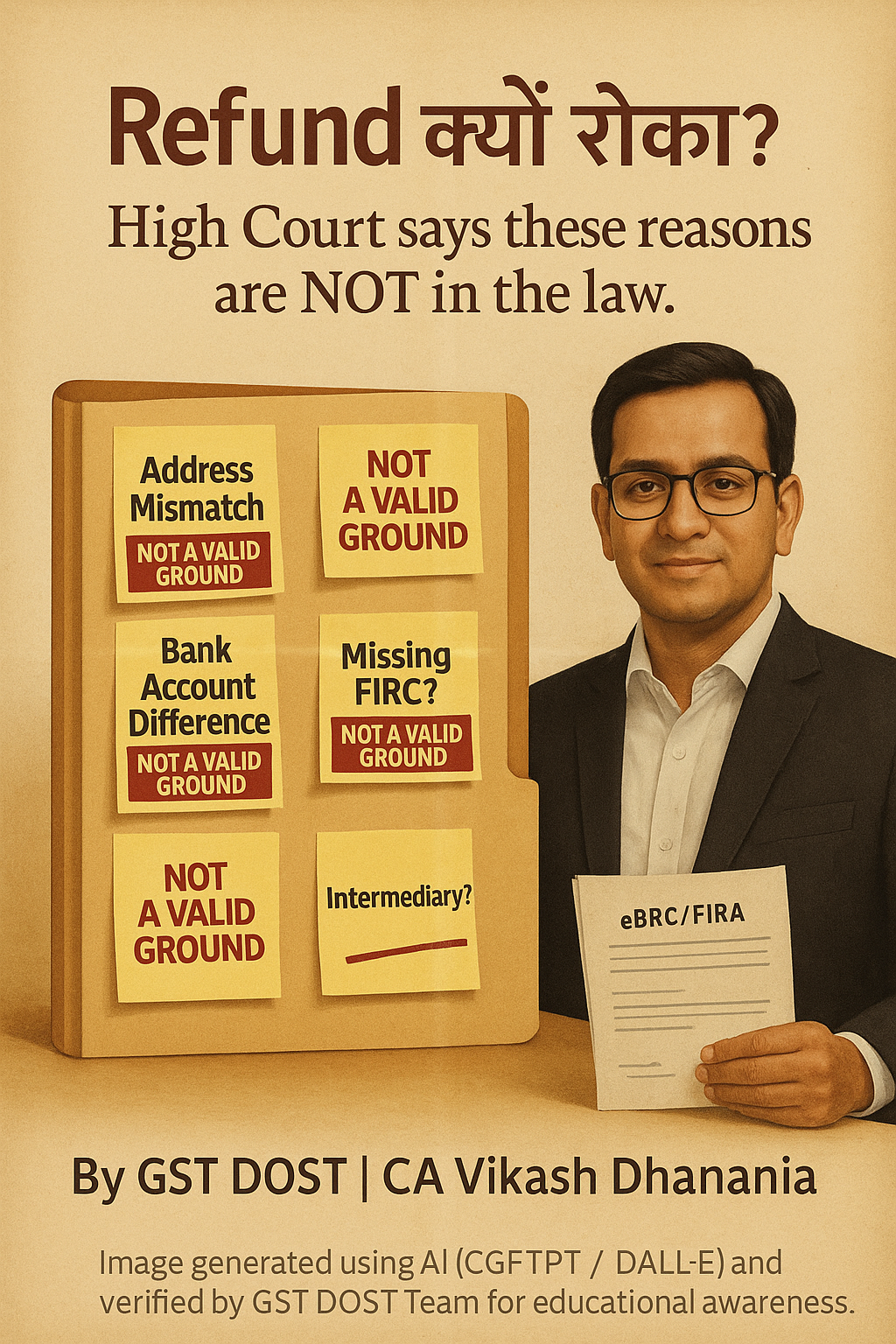
You didn’t give eBRC/FIRC.
-
Your beneficiary address in the FIRA is shown as Gurgaon, not Bengaluru.
-
The purpose of remittance says “intercompany receipt”—looks doubtful.
-
The invoice showed one bank account; the FIRA showed another.
-
You are providing intermediary services, not exports.
Based on this, the appellate authority reversed the refund order.
The adjudicating authority issued a recovery.
And the taxpayer landed in the High Court.
Legal Issue
At the heart of the case is a simple question:
“Can refund of unutilized ITC on export of services be denied on the basis of assumptions, mismatched administrative details, or incorrect interpretation of “intermediary services?”
And a deeper question:
“Does 'common sense' override the actual law?
Arguments
The judgment doesn’t list detailed verbal arguments, but the sequence is clear.
Petitioner said:
We submitted eBRCs and FIRAs. Proof of foreign remittance was already on record. We exported services on a principal-to-principal basis and are not intermediaries.
Department said:
You didn’t submit eBRC/FIRC. Your FIRA shows another address. The purpose doesn’t match. The account number looks different. And you are an intermediary.
Most of these were observations rather than legal arguments—based more on “suspicion” than statute.
⚖️ High Court’s Decision
On 06 November 2025, the Karnataka High Court delivered a detailed order.
And it did not mince words.
1. The Court found the factual basis of the department’s order plainly wrong.
The Court noted that Mavenir had submitted eBRCs/FIRCs, and the documents were on record in the refund proceedings itself.
So the primary ground—"documents not submitted"—collapsed.
2. RBI had discontinued FIRCs. So demanding it was irrelevant.
The Court relied on RBI Circular No. 74 dated 26.05.2016.
FIRC was no longer issued. FIRAs/eBRCs were valid.
This is where “common sense” often clashes with the law. Officers still demand FIRC because “aisa hi hota tha.”
But the law had already changed.
3. Address mismatch is not a legal ground.
The FIRA showed a Gurgaon address, but the company operates from Bengaluru.
The Court held that this is merely an administrative address used for global financial systems. It has no legal impact on the validity of export receipts.
4. Bank account number mismatch is not a ground either.
Two different account numbers appeared—one on the invoice and one on the FIRA.
Both were the taxpayer’s accounts.
This cannot invalidate export realisation.
5. “Intermediary” reasoning was wrong: the services were principal-to-principal.
The Court scrutinised the agreements. They showed:
-
Mavenir developed software.
-
Mavenir controlled the coding, testing, and documentation.
-
Mavenir delivered the services itself.
There was no third party involved, no brokering, no arranging.
And the Court relied on CBIC’s own Circular No. 159/15/2021, which requires three parties for intermediary services.
Here, there were only two.
6. Refund orders were valid; later review was unjustified.
The High Court held that the refund sanction orders were correct.
The later appeal, SCNs, and recovery were illegal and arbitrary.
Final Direction:
The Court quashed all orders (Annexures A, B, S, T, W, X) and directed the department to grant refund with interest within two months.
Reasoning (Simple Breakdown)
The Court essentially said:
-
GST refunds cannot be denied on assumptions.
-
Administrative discrepancies are not grounds for rejecting real exports.
-
If the law requires eBRC/FIRA, and they are submitted, the refund cannot be reopened.
-
"Intermediary" is a narrowly defined concept—not every cross-border service provider falls under it.
-
Once a refund order is properly passed, reversing it requires strong legal grounds, not “common-sense doubts.”
This judgment is a reminder that GST works on legal sense, not “intuition.”
Important Message for Every Business Owner
-
Document everything. Keep eBRC, FIRA, contracts, and replies — these saved the taxpayer.
-
Don’t fear mismatches. Addresses, purpose fields, or bank references may differ. If exports are genuine, the law supports you.
-
Understand “intermediary” properly. If you provide the service yourself, you’re not an intermediary.
-
Challenge unfair orders. The High Court quashed everything here. Justice is possible.
-
Refund reviews can be wrong. Just because the department reopens a case doesn’t mean they’re right.
Why This Matters
This ruling sends a clear message across GST offices:
Refund cannot be denied or taken back on guesswork.
Every taxpayer exporting services can rely on this judgment when facing similar objections:
Address mismatch, purpose mismatch, or the dreaded “intermediary” label without basis.
Conclusion
What began as a simple refund claim turned into a maze of assumptions.
But the High Court stepped in and reminded everyone of a simple truth —
GST refunds cannot be treated like puzzles or guesswork. They flow from the law.
And somewhere, this judgment feels reassuring.
It tells every honest exporter:
“You did your part. The law will do its part.”
At GST DOST, we believe exactly in this balance—compliance, fairness, and clarity.
And we’re here to help you walk that path.
“📞 Need help with a similar refund dispute or intermediary allegation? Connect with GST DOST for expert, practical assistance.
FAQ
Q1: What was the dispute in this case?
The dispute was whether the taxpayer’s refund of unutilized ITC on export of services could be denied based on alleged non-submission of eBRC/FIRC, mismatched administrative details, and a claim that the taxpayer was an intermediary.
Q2: How did the High Court rule?
The Court held that all documents were already on record, the reasons given by the department were incorrect, and the taxpayer was not an intermediary. It quashed all orders and directed a refund with interest.
Q3: What is the meaning of “intermediary services” in this context?
An intermediary requires three parties—two principals and one facilitator. The taxpayer was directly providing services to its overseas entity and hence was not an intermediary.
Q4: Can refund be denied due to mismatched address in FIRA or mismatched bank account numbers?
No. The Court held these are administrative variations and do not invalidate export realisation.
Q5: If the taxpayer has already submitted the eBRC, can the GST refund still be denied?
No. The High Court made it clear that when eBRC/FIRA is already on record, there is no valid basis to deny or block the refund.
References
-
Mavenir Systems Pvt. Ltd. vs Union of India & Ors.
Karnataka High Court, Order dated 06.11.2025, W.P. No. 15323/2022.
Statutes Cited:
-
Section 54(3), CGST Act—Refund of unutilized ITC
-
Section 2(6), IGST Act—Export of services definition
-
Rule 89(2), CGST Rules—Refund documentation
-
CBIC Circular No. 159/15/2021—Intermediary clarification
-
RBI Circular No. 74 (26.05.2016)—Discontinuation of FIRCs
-
Written by CA Vikash Dhanania | Reviewed by GST DOST Legal Research Team | Updated on 25/11/2025
© GST DOST | When GST gets complicated, we make it simple—saving your time, money, and effort.

CBIC Notifies New Rule 14A – Quick GST Registration Option for Small Taxpayers [News]
[News]
GST Summons Is Not a Punishment — Don’t Panic Before the Law Does [Blog]
Yes, Police Can Attach Bank Accounts in GST Cases. But Only If They Follow the Law [Blog]
Gujarat HC says:“Phone calls don’t count as hearings!”Know your rights under Sec 75(4) [Video]
Know GST Rate of HSN 3926 | GST DOST [Video]

GST DOST, formerly known as My Service Tax, is a specialist GST firm led by experienced professionals — including CA, CS, MBA, and Advocates.
We are fluent in the ever-evolving GST regime and ensure accurate, timely, and actionable advice. Our strength lies not just in technical depth but in the use of AI tools and behavioural intelligence to ensure our clients feel informed, assured, and genuinely supported at every stage.

Powered by: RNJ Consultancy Services