RTI vs GST Confidentiality: Why the High Court Ruled in Favour of Privacy.
GST DOST's BLOG
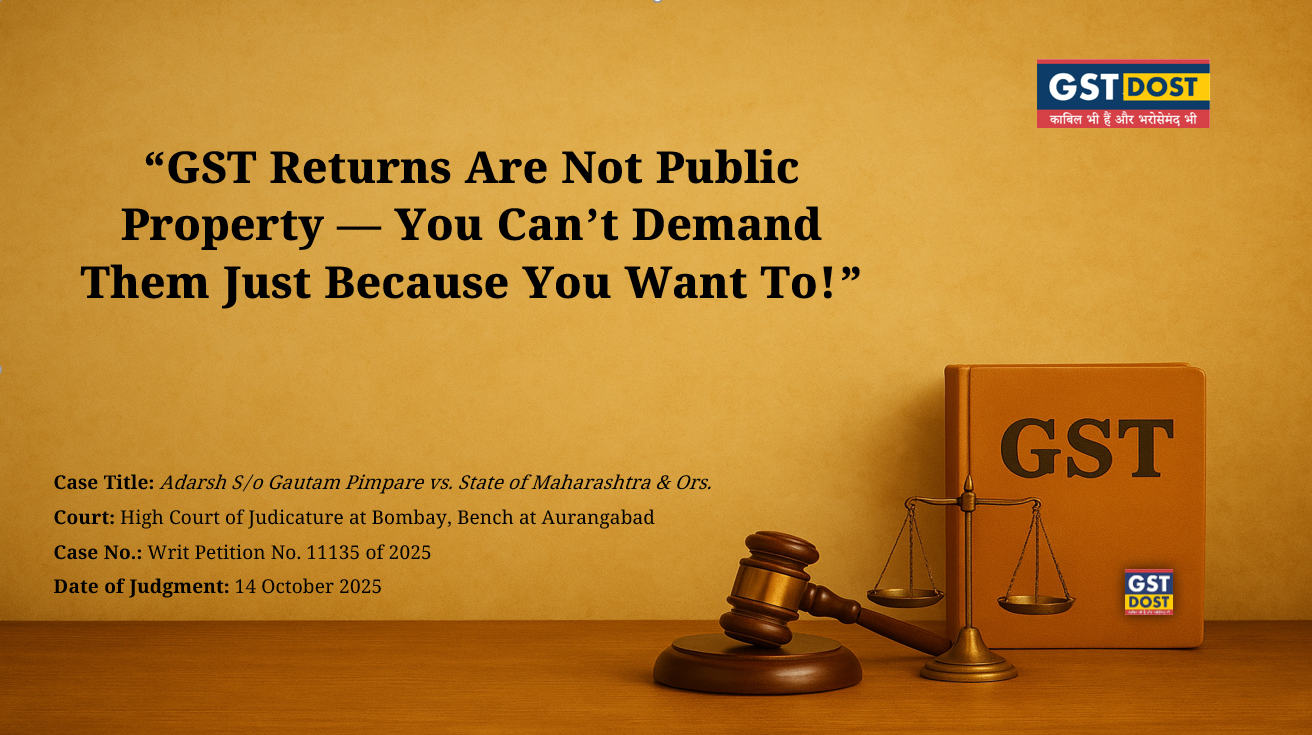
| Ownership | Own | ||
Namaste DOST. 🙏
Can you ask for another business’s GST returns using the Right to Information Act (RTI)? 🤔
That’s exactly what happened in a recent case before the Aurangabad Bench of the Bombay High Court — and the answer was a clear “No.”
This ruling carries a powerful message for taxpayers, RTI applicants, and business owners alike — your GST data is private, protected, and cannot be accessed just because someone is curious.
Let’s understand how this case unfolded and what every entrepreneur should learn from it.
Summary
A citizen from Latur, Maharashtra, filed an RTI application seeking GST return details of six local industries, alleging irregularities in government tenders. The State Tax Department refused, calling it third-party information protected under law. Both first and second appeals were dismissed.
On 14 October 2025, the Bombay High Court upheld the authorities’ stand, holding that GST returns are confidential under Section 158 of the CGST Act and protected by Section 8(1)(j) of the RTI Act. Since no larger public interest was shown, the petition was dismissed.
Facts of the Case
The applicant had sought GST submission details from 2008 to 2023 for six Udgir-based firms engaged in trading and manufacturing activities.
The Public Information Officer (PIO) issued notices to these firms under Section 11 of the RTI Act, inviting their objections. All six objected to disclosure, leading the PIO to reject the request.
The applicant appealed before the First Appellate Authority, which confirmed the rejection, followed by another unsuccessful appeal before the State Information Commissioner. He then approached the High Court, arguing that GST returns are public documents and that officials should not have sought consent from third parties.
Legal Issue
Whether GST return data of private firms can be disclosed under the RTI Act — or whether it is barred under Section 158 of the CGST Act and Section 8(1)(j) of the RTI Act.
Arguments Presented
Petitioner’s Stand:
-
Claimed GST returns are public records, not “personal information.”
-
Objected to the PIO seeking consent from business owners.
-
Asserted that disclosure was necessary to uncover alleged fraud in government contracts.
Department’s Stand:
-
Maintained that GST returns contain confidential tax data belonging to third parties.
-
Pointed out that both Section 11 of the RTI Act and Section 158 of the CGST Act prohibit such disclosure without legal justification.
-
Emphasized that the RTI Act cannot override a special law like the GST Act.
⚖️ High Court’s Decision
Court: Bombay High Court (Aurangabad Bench)
Case No.: W.P. No. 11135 of 2025
Date: 14 October 2025
Judge: Justice Arun R. Pedneker
1️⃣ Section 11 Procedure Upheld
Citing the Supreme Court’s landmark decision in CPIO v. Subhash Chandra Agarwal (2020 5 SCC 481), the Court held that when information relates to a third party, issuing notice under Section 11 is mandatory. The PIO had acted correctly by consulting the concerned businesses.
2️⃣ Section 158 of the CGST Act — Absolute Bar
The Court noted that Section 158(1) specifically bars the disclosure of any returns or documents filed under GST, except for limited purposes like audits, law enforcement, or court orders covered under sub-section (3).
Since the GST Act is a special and later enactment, it prevails over the general RTI Act.
3️⃣ No Public Interest Proved
The petitioner alleged fraud but produced no proof. Mere allegations do not qualify as “larger public interest.” Hence, the Court declined to override confidentiality under the proviso to Section 8(1)(j) of the RTI Act.
Legal Reasoning & Analysis
This judgment draws a clear boundary between transparency and privacy.
While the RTI Act promotes accountability, it cannot be used to pry into private tax records. GST returns contain sensitive financial information and fall under the “personal information” and “commercial confidence” exceptions in Sections 8(1)(d) and 8(1)(j).
Only when a compelling public interest exists — such as confirmed evidence of fraud or corruption — can disclosure be justified. Otherwise, confidentiality prevails.
This balance safeguards both citizens’ right to know and businesses’ right to privacy. It prevents RTI from becoming a tool for harassment or “fishing expeditions” into competitors’ data.
Important Message for Every Business Owner
✅ Understand Confidentiality: Your GST returns are private records and cannot be disclosed under RTI without legal justification.
✅ Respect Third-Party Rights: If someone files an RTI for your GST data, you will receive a notice under Section 11 — always respond and object in writing.
✅ Public Interest Is the Key: Only clear, proven public interest can override privacy protections.
✅ Use RTI Responsibly: Seek information from public authorities, not from another taxpayer’s returns.
✅ Know Your Law: Section 158 of the CGST Act is a specific bar and will always prevail over RTI.
Why This Matters
This judgment reaffirms that tax records filed under GST are confidential and not open to public inspection.
It sets a strong precedent protecting businesses from unwarranted disclosure and clarifies how special laws (like the GST Act) override general laws (RTI).
For RTI activists, it’s a reminder that transparency must operate within legal boundaries.
For business owners, it’s a reassurance that their tax data remains secure under law.
Conclusion
What started as an RTI application to expose alleged fraud ended with a decisive verdict:
Confidential tax data cannot be demanded just because someone wants to see it.
The Bombay High Court has once again affirmed that privacy and transparency must co-exist within the law.
For every honest taxpayer, this is a timely lesson — protect your data, follow the law, and trust that justice stands on your side.
“📞 Need help understanding your rights under GST and RTI?
Contact GST DOST for expert guidance and personalized support.
FAQ
Q1. What was the dispute in this case?
A citizen sought GST return details of six private firms under RTI, which was denied as third-party confidential information.
Q2. How did the High Court rule?
The Court dismissed the petition, holding that Section 158 of the GST Act bars disclosure of returns and that no public interest was proved.
Q3. Can GST returns be disclosed under RTI?
No. They are protected under Section 158 of the CGST Act and Section 8(1)(j) of the RTI Act unless a clear public interest is established.
Q4. What should businesses do if someone seeks their GST data under RTI?
File an objection when you receive notice under Section 11, citing Section 158 of the GST Act for confidentiality.
Q5. Can someone ask for another person’s GST data under RTI?
No. Such information is confidential and can only be shared if required by law or backed by a strong public interest.
References
-
Adarsh s/o Gautam Pimpare v. State of Maharashtra & Ors., Bombay High Court (Aurangabad Bench), Judgment dated 14 October 2025.
-
Central Public Information Officer, Supreme Court of India v. Subhash Chandra Agarwal, (2020) 5 SCC 481.
-
Section 158, Central Goods and Services Tax Act, 2017 – Disclosure of Information by Public Servant.
-
Section 8(1)(j) & Section 11, Right to Information Act, 2005.


CBIC Notifies New Rule 14A – Quick GST Registration Option for Small Taxpayers [News]
[News]
GST Summons Is Not a Punishment — Don’t Panic Before the Law Does [Blog]
Yes, Police Can Attach Bank Accounts in GST Cases. But Only If They Follow the Law [Blog]
Gujarat HC says:“Phone calls don’t count as hearings!”Know your rights under Sec 75(4) [Video]
Know GST Rate of HSN 3926 | GST DOST [Video]

GST DOST, formerly known as My Service Tax, is a specialist GST firm led by experienced professionals — including CA, CS, MBA, and Advocates.
We are fluent in the ever-evolving GST regime and ensure accurate, timely, and actionable advice. Our strength lies not just in technical depth but in the use of AI tools and behavioural intelligence to ensure our clients feel informed, assured, and genuinely supported at every stage.

Powered by: RNJ Consultancy Services