Using More than 1 Mode of Transportation for your Goods? Multimodal Transportation? Know the Right GST Facts!
GST DOST's BLOG
Namaskar!
Do you use more than 1 Mode of Transportation for your Goods?
Are you aware of the appropriate GST Regulatory Framework for such Transportations?
This article covers all the essential things you must keep in mind when using multiple modes of Transportation.
There is a probability that you are making some mistakes with handling GST for such modes of Transportations, but this article will answer all your queries and solve all problems.
What is Multimodal Transportation?
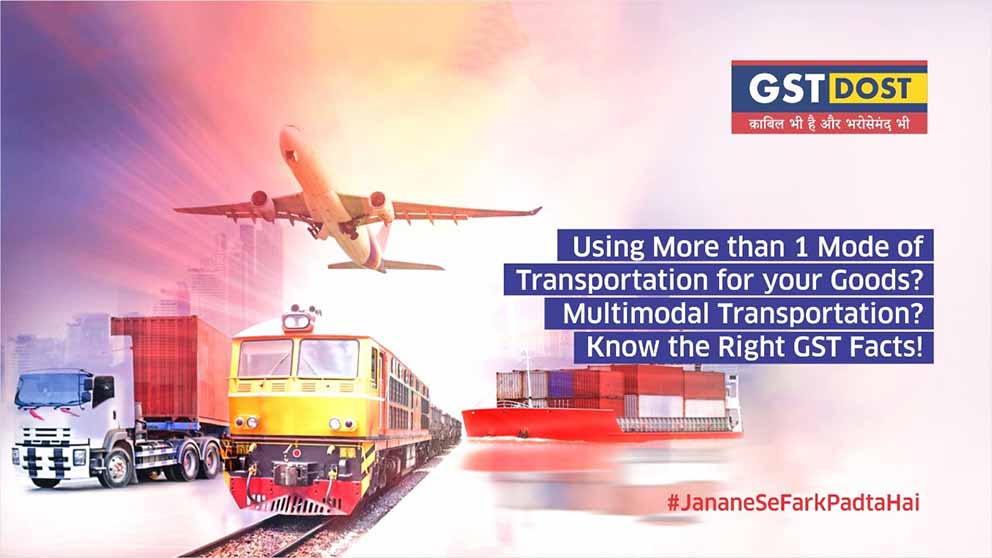
If the complete journey of your Goods involves more than 1 mode of Transportation, it is called Multimodal Transportation.
Let's understand this with an example.
You are transporting sweaters from Kolkata to Shimla. The Transporter first sends the goods using a Goods Train from Kolkata to Kalka Railway station.
He then uses a Truck to transport the goods from Kalka railway station to Shimla.
Let's take another example to understand this.
Let's Suppose a Businessman is Transporting Tiles from Morbi to Agartala.
The Transporter first transports the Tiles via road from Morbi to Navlakhi Port. He then transports them from Navlakhi Port to Haldia Port by water and then to Guwahati by Railways.
After that, he takes the Tiles by road to Agartala. As you can see that the Transporter uses Road, water and Railways as the Mode of Transportation; hence, this way of Transportation is called Multimodal Transportation.

But what if the Mode was the same but different vehicles were used?
A common practice in the Transportation sector is to shift the Goods from one Truck to another during the journey.
In this case, the Mode remains the same, but the vehicles differ.
This kind of activity in transportation is called Transshipment.
This case does not qualify for Multimodal Transportation but is referred to as Multi-vehicle Transportation.
The provisions in GST
However, in GST, a Multimodal Transporter is not referred to with the name Multimodal Transporter!
The provisions for Transporters are defined in CGST Rate Notification 11/2017, which states that the Transporter will charge money in lieu of freight and sign a contract with the customer.
The Transporter will work as the principal and not as a contractor.
Furthermore, according to this notification, the Transporter will have to collect 12% GST as forward charge from the customer.
What to Keep in Mind?
If you are in this Business and are wondering what all should you keep in mind, here are the most important points:
1. The Transportation can be called Multimodal Transportation only if the point of loading and unloading is in India.
Suppose you are Transporting Goods from Kolkata to Kathmandu, and they travel by rail from Kolkata to Bathnaha Railway Station in Nepal and further by road to Kathmandu. This will not be referred to as Multimodal Transportation as the destination of Goods change and unloading are not in India but a foreign country Nepal.
In this case, the transporter neither classify as Goods Transport Agency nor Multimodal Transporter. So he has to charge GST @ 18% on the freight amount received from the customer.
2. Although there is a provision of a Verbal Contract in the Indian Contract Act 1882, you must maintain written contracts.
We say that because the phrase "Enter into Contract" has been used in the GST Notification, and the GST officer can ask you to show the written contract in cases of Assessments, Audits or Investigations.
3. The Customer cannot pay the GST on the Transportation charges in reverse charge as the reverse charge is allowed only in the case of a Goods Transport Agency.
4. Getting caught in the case of Multimodal Transportation is very easy as every time the Mode of Transportation changes, an entry is made in the E Way Bill. Wherever Officers get to see more than 1 entry in the E Way Bill, they will create a Tax Demand citing a case of Multimodal Transportation.

5. Using the SAC Code 9965 in the Tax invoice just like a Transport Agency will make no difference for Multimodal Transporters.
6. Let's assume a case where the Multimodal Transporter hires a Truck from a Third Party for the by road transportation of the Goods.
The reverse charge will be applicable in this case, provided the Truck has been hired from a Goods Transport Agency.
There is no about this fact because CGST Rate Notification 11 & 12 clearly differentiates between a Multimodal Transporter and a Goods Transport Agency.
But the problem arises when the Truck is hired from the Truck owner. This is because the Truck owner will not issue a consignment note.
If we read Notification 12 in detail, we will get to know that the services offered by the Truck owner are exempted, which creates no question of any reverse charge.
However, it is also true that in many cases, Department Officers have been found choosing the route of litigation.
This was our attempt at explaining the complete concept in a concise way!
If you are also facing an issue or confusion related to this matter, feel free to contact the GST DOST team, and we will help you solve all your queries along with providing concrete solutions to your GST worries!!!
T: 9088883000



CBIC Notifies New Rule 14A – Quick GST Registration Option for Small Taxpayers [News]
[News]
GST Summons Is Not a Punishment — Don’t Panic Before the Law Does [Blog]
Yes, Police Can Attach Bank Accounts in GST Cases. But Only If They Follow the Law [Blog]
Gujarat HC says:“Phone calls don’t count as hearings!”Know your rights under Sec 75(4) [Video]
Know GST Rate of HSN 3926 | GST DOST [Video]

GST DOST, formerly known as My Service Tax, is a specialist GST firm led by experienced professionals — including CA, CS, MBA, and Advocates.
We are fluent in the ever-evolving GST regime and ensure accurate, timely, and actionable advice. Our strength lies not just in technical depth but in the use of AI tools and behavioural intelligence to ensure our clients feel informed, assured, and genuinely supported at every stage.

Powered by: RNJ Consultancy Services