
Namaste DOST,
Hair offered by devotees at temples is sold through tenders and e-auctions. The successful bidder pays a lump sum for the right to collect whatever hair is offered during a fixed period. No weight is guaranteed and no price per kilogram is fixed. Temple tender notices have been insisting that bidders pay 18% GST on the bid (para 4.2). Is the bidder buying goods, or buying a right?
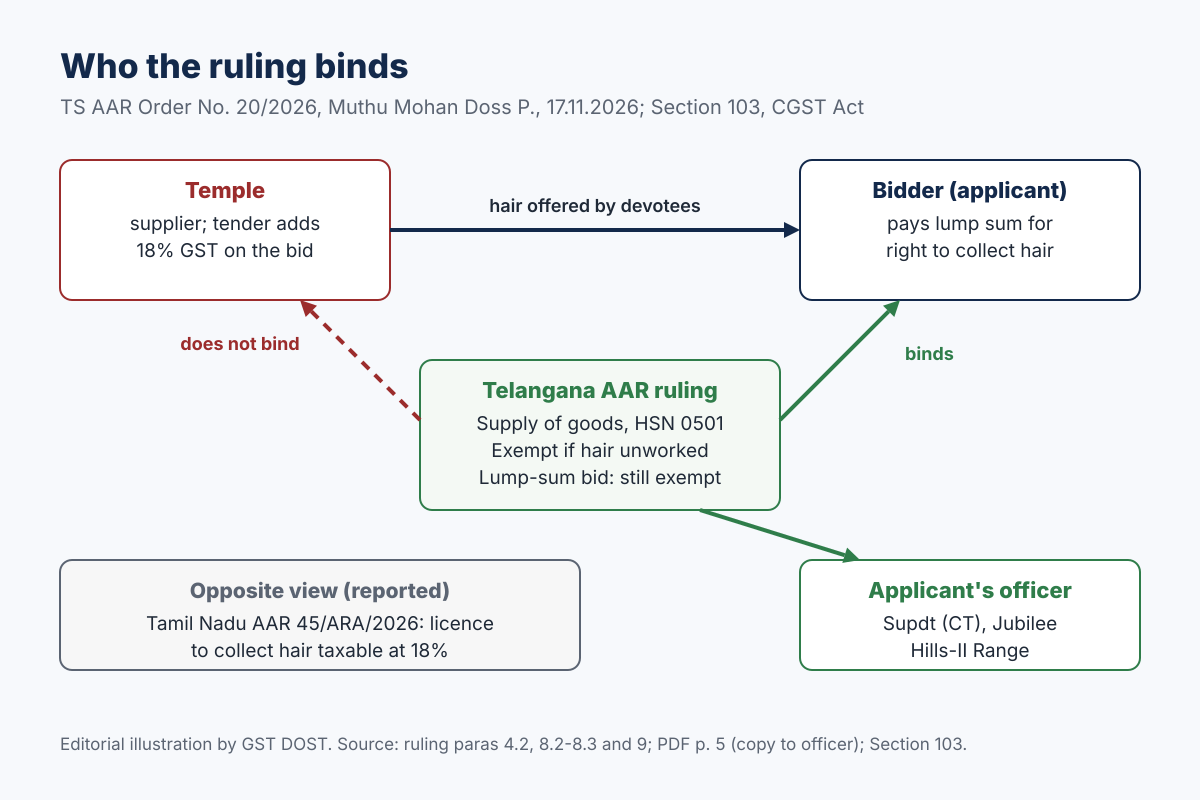
In M/s Muthu Mohan Doss P. (TS AAR Order No. 20/2026, A.R.Com/24/2026, dated 17.11.2026), the Telangana State Authority for Advance Ruling answered that it is a supply of goods under heading 0501, exempt if the hair is unworked, and that the lump-sum structure does not change this (para 9). Two limits matter. An advance ruling binds only the applicant and the officers dealing with him, while the temple charging the tax is the supplier. And in May 2026 the Tamil Nadu AAR took the opposite view on a similar auction, as reported.
What did the bidder ask, and what did the AAR rule?
The applicant, a Hyderabad human hair trader (GSTIN 36AJQPM2007G1ZA), takes part in temple tenders for the right to collect tonsured hair. The hair collected is raw, unworked and unsorted (paras 4.1–4.2).
Which notification did the AAR apply, and for which period?
The applicant relied on Notification No. 2/2017-Central Tax (Rate), Serial No. 30, heading 0501, and the corresponding State and IGST entries (applicant's interpretation, PDF p. 3). The AAR applied Notification No. 10/2025-Central Tax (Rate), Serial No. 20, which exempts intra-State supplies of “human hair, unworked, whether or not washed or scoured; waste of human hair”, and noted that the entry carries no further condition (paras 8.2–8.3).
Notification No. 10/2025-Central Tax (Rate), dated 17.09.2025, superseded Notification No. 2/2017-Central Tax (Rate) and applies from 22.09.2025. The heading and description of the human hair entry are the same in both.
GST DOST's reading
Question 2 asked about the exemption “during the relevant contractual period”, but the ruling names only the 2025 notification. For a tender period that began before 22.09.2025, cite the 2017 entry (Serial No. 30) for that part of the period. The outcome should not differ, because the entry is worded the same, but the ruling itself does not say so.
How did the AAR reach its answer?
The discussion is short. After restating the facts (para 8.1) and the notification (paras 8.2–8.3), the AAR relied on two Madras High Court orders (para 8.3, case law):
- Muthu Mohandoss v. Commissioner, HR&CE, W.P. No. 20200 of 2025, decided 06.06.2025: a temple in Tiruvannamalai District could not insist that bidders in a hair collection auction pay 18% GST, considering the Central Government notification and a circular of the Commissioner of HR&CE. Clause 23 of that tender alone was interfered with.
- W.P. No. 44706 of 2026, dated 02.11.2026, recorded by the AAR as a similar order.
The applicant's own reasoning ran this way: what is paid for and received is the hair; ownership passes on collection; the right to collect is only the way the goods are delivered; and uncertain quantity is a commercial risk, not a service (para 7.1). The AAR accepted the conclusion. Its order does not analyse separately whether the tender grants a licence over temple premises.
What is the strongest reading against this ruling?
As reported, the Tamil Nadu AAR in M/s Rangaraj (Advance Ruling No. 45/ARA/2026, dated 05.05.2026) treated a temple's auction amount for the right to collect devotees' hair as consideration for a licence, a supply of service taxable at 18%. In that view the exemption covers the hair, not the licensing activity. Earlier, in a 2023 case reported as 2023 (11) TMI 777, the Telangana High Court dismissed a bidder's writ against an 18% tender clause, mainly because the bidder had accepted the tender terms and collected hair for months before objecting.
The Telangana AAR's order does not refer to either. The two AAR rulings therefore point in opposite directions on very similar facts, and neither binds anyone beyond its own applicant.
GST DOST's reading
The dispute turns on what the bid buys: the hair (goods) or a licence to enter and collect (service). Tender terms will matter. Clauses granting exclusive use of space inside the temple, deploying the bidder's staff, or fixing a fee unrelated to hair collected make the licence reading stronger. A tender that sells the offered hair as a lot, with title passing on collection, supports the goods reading.
Who is bound, and what can a bidder do with this ruling?
Under Section 103 of the CGST Act, an advance ruling binds only the applicant who sought it, and the concerned or jurisdictional officer in respect of that applicant. The order is addressed to the applicant, with a copy to the Superintendent (Central Tax), Jubilee Hills-II Range (PDF p. 5). It records that an aggrieved person may appeal to the Telangana Appellate Authority for Advance Ruling within 30 days of receipt (PDF p. 5).
The temple, which raises the bill and would be liable for any tax, is not the applicant. The ruling does not bind the temple's own tax officer. In practice, a bidder can place the ruling and the Madras High Court orders before the temple, but cannot compel the temple to drop the 18% clause on the strength of this ruling alone.
Bidders. GST DOST's practice point: object to the GST clause in writing before you bid, citing the exemption entry. The 2023 Telangana High Court case suggests that a bidder who accepts the terms and objects late is in a weaker position.
Accounts and finance (bidder). Record exactly what the tender sells, what the payment is for, and when title to the hair passes. If 18% is charged, keep the tax invoice and your written objection on file.
Temple administrations and their advisers. The temple is the supplier. GST DOST's reading: where the position is contested, the temple can seek its own advance ruling on its tender terms rather than rely on a ruling given to a bidder.
Litigation team. Cite para 9 for the ruling and paras 8.2–8.3 for its basis. Be ready for the Tamil Nadu ruling being cited the other way, and distinguish on the tender terms.
File checklist: bidding for temple hair collection
How to cite this ruling
Name as printed: M/s. Muthu Mohan Doss P., Hyderabad (GSTIN 36AJQPM2007G1ZA).
Authority: Telangana State Authority for Advance Ruling, Hyderabad; Sri Vivekananda Reddy, Additional Commissioner (Central Tax) and Smt. K. Geeta, Additional Commissioner (State Tax). A.R.Com/24/2026; TS AAR Order No. 20/2026 under Section 98(4) of the CGST and TGST Acts; dated 17.11.2026.
Muthu Mohan Doss P., In re, TS AAR Order No. 20/2026 dt. 17.11.2026, paras 8.2–8.3 and 9.
Sources and verification notes
- The ruling: copy used is the reproduction published by JurisHour, a 5-page scanned PDF; facts at PDF pp. 1–2, applicant's interpretation at PDF pp. 2–3, discussion at PDF pp. 3–4, ruling at PDF pp. 4–5. Figures and the notification serial number were checked against the page images.
- Notification No. 10/2025-Central Tax (Rate) dated 17.09.2025, Serial No. 20 (heading 0501), superseding Notification No. 2/2017-Central Tax (Rate): entry text checked against a reproduction of the Gazette copy on 25.11.2026.
- M/s Rangaraj, Tamil Nadu AAR, Advance Ruling No. 45/ARA/2026 dated 05.05.2026: known to us only from reported summaries (Taxscan; Patron Accounting). We have not read the full ruling.
- Telangana High Court, 2023 (11) TMI 777: known to us only from a reported headnote. We have not read the full judgment.
- Section 103, CGST Act (applicability of advance ruling).
- Verification: web check for any appeal against this ruling run on 25.11.2026. Recheck before reliance; the 30-day appeal window had not run out on that date.
If you bid for temple hair collection or advise a temple on its tender terms, GST DOST can review the documents with you through the Contact page on gstdost.com.