
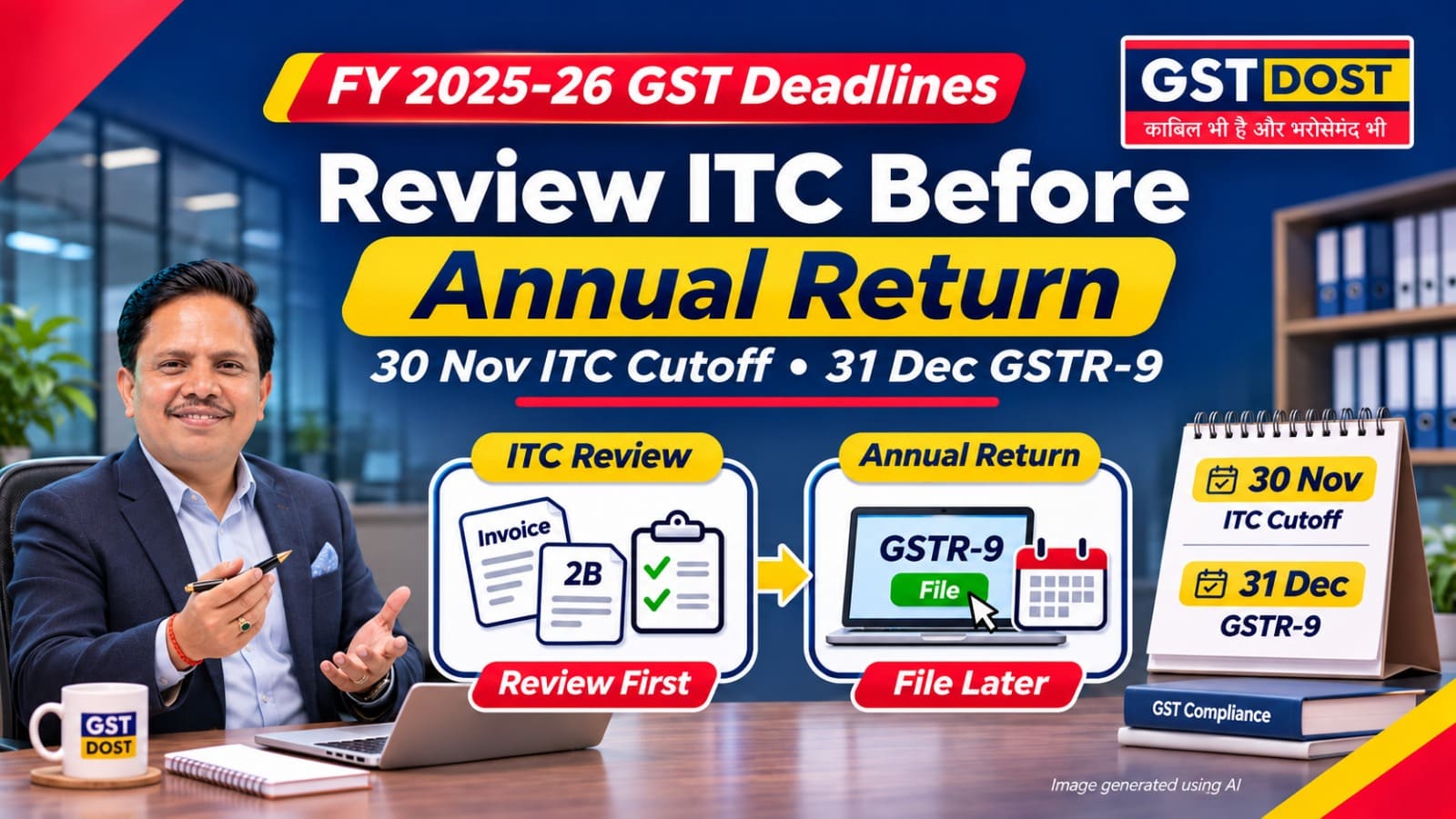
The last date for taking input tax credit (ITC) for FY 2025-26 and the due date for filing the FY 2025-26 annual return are not the same. Treating them as one date can cost a business eligible credit. With 30 November 2026 close, businesses should finish their ITC review first and file GSTR-9 and GSTR-9C after that.
Key takeaways
- ITC cutoff: ITC on FY 2025-26 invoices and debit notes cannot be taken after 30 November 2026, or after the date of filing the FY 2025-26 annual return, whichever is earlier (section 16(4)).
- Annual return: the normal due date for FY 2025-26 GSTR-9 (and GSTR-9C, where required) is 31 December 2026, unless extended.
- Filing GSTR-9 early ends the ITC window early. Do not file it before the ITC, credit note and amendment review is complete.
- The same 30 November 2026 date also applies to GST credit notes for FY 2025-26 supplies and to most corrections of FY 2025-26 details in GSTR-1.
- A deadline is not a reason to claim. Every credit must still meet sections 16 and 17.
Time-sensitive: 30 November 2026
The ITC must be taken in a GSTR-3B that is actually filed on or before 30 November 2026. For a monthly filer, that is generally the October 2026 return, due by 20 November 2026. For a quarterly (QRMP) filer, the October-December 2026 quarter return can be filed only after the quarter ends, so FY 2025-26 credits generally need to have been taken in a return already filed. Check your own filing position now.
1. What section 16(4) says
Under section 16(4) of the CGST Act, a registered person cannot take ITC on an invoice or debit note after the 30th day of November following the end of the financial year to which it relates, or after furnishing the relevant annual return, whichever is earlier.
| Situation | Last date for taking FY 2025-26 ITC |
|---|---|
| FY 2025-26 annual return not filed before 30 November 2026 | 30 November 2026 |
| FY 2025-26 annual return filed before 30 November 2026 | The date of filing the annual return |
This is a time limit, not a permission to claim whatever is in the purchase ledger. All other conditions continue to apply, including possession of a tax invoice, the invoice appearing in GSTR-2B (section 16(2)(aa)), receipt of goods or services, payment of tax by the supplier, payment to the supplier within the prescribed time, and the blocked-credit list in section 17(5). Special situations covered by sections 16(5) and 16(6) should be examined separately.
2. The annual return: who files what
| Aggregate turnover in FY 2025-26 | General annual return position |
|---|---|
| Up to Rs. 2 crore | Exempt from filing the annual return (Notification No. 15/2025-Central Tax dated 17 September 2025, for FY 2024-25 onwards) |
| Above Rs. 2 crore and up to Rs. 5 crore | GSTR-9 required |
| Above Rs. 5 crore | GSTR-9 and a self-certified reconciliation statement in GSTR-9C required (rule 80(3)) |
The thresholds apply to aggregate turnover, which is computed on an all-India basis for the PAN, not for a single GSTIN. Composition taxpayers, input service distributors, non-resident taxable persons and certain other categories have their own requirements.
- GSTR-9C is self-certified. A separate CA-certified GST audit report is no longer required.
- The portal is open. GSTN has enabled GSTR-9 and GSTR-9C for FY 2025-26. The filing option appears only after all GSTR-1 and GSTR-3B returns for the year are filed.
- Reporting relaxations: certain table-level relaxations in GSTR-9 and GSTR-9C have been extended to FY 2025-26 onwards by a notification dated 26 October 2026. Check the current form instructions before filing.
- The exemption does not extend the ITC deadline. A business below Rs. 2 crore that does not file GSTR-9 is still bound by 30 November 2026 for taking FY 2025-26 ITC.
3. GSTR-9 and GSTR-9C are one annual return
CBIC Circular No. 246/03/2025-GST dated 30 January 2025 clarifies that, where GSTR-9C is required, the complete annual return consists of both GSTR-9 and GSTR-9C. Filing GSTR-9 alone does not complete the return. Late fee under section 47(2) is not levied separately for each form; it runs from the due date until the complete annual return, including GSTR-9C, is filed. Plan both forms together.
4. A simple illustration
A manufacturer is reviewing its FY 2025-26 purchase invoices in November 2026 and finds three cases:
| Invoice | Position | What to do |
|---|---|---|
| Invoice A | Eligible ITC already taken | Reconcile and keep the evidence |
| Invoice B | ITC not yet taken; appears eligible | Verify all conditions and take it in a GSTR-3B filed by 30 November 2026 |
| Invoice C | Credit blocked under section 17(5) | Do not claim, whatever the deadline |
The finance manager says: "GSTR-9 is due only on 31 December, so we can decide on these invoices in December." That mixes up the two deadlines. By December, Invoice B's credit would be time-barred. And if the team files GSTR-9 on, say, 20 November, the ITC window would close on that date. This is a hypothetical illustration.
5. Other FY 2025-26 actions with the same 30 November date
- Credit notes (section 34(2)): credit notes for FY 2025-26 supplies must be declared by 30 November 2026 or the date of filing the annual return, whichever is earlier.
- GSTR-1 corrections (section 37(3)): errors or omissions in FY 2025-26 outward supply details can generally be rectified up to the same date.
- Filed GSTR-3B cannot be revised. Any omission has to be corrected through a later GSTR-3B within the time limits.
Proposals under discussion: the GST Council, in its 57th meeting on 8 October 2026, recommended amending sections 16, 37 and 39 to align the time limits for GSTR-1, GSTR-3B and ITC, and CBIC has invited public comments on a related mechanism. These are proposals. Until the law is amended, the present time limits apply.
6. Action points for businesses
- Do not file the FY 2025-26 annual return yet.Now
Complete the ITC, credit note and GSTR-1 correction review first. Filing GSTR-9 before 30 November 2026 closes the window early. - Reconcile the purchase register with GSTR-2B.This week
Run the full-year reconciliation and list credits not yet taken, with the reason for each. - Verify each unclaimed credit.This week
Check the invoice, GSTR-2B, receipt of goods or services, payment and section 17(5). Claim only what is eligible. - Take eligible credit in a return filed by 30 November 2026.By 30 Nov
For monthly filers, generally the October 2026 GSTR-3B. Do not leave it to the last day, in case of portal or payment issues. - Issue pending credit notes and GSTR-1 corrections.By 30 Nov
Review year-end discounts, returns and rate or value errors for FY 2025-26 supplies. - Act on pending IMS records.This week
Clear pending or rejected records relating to FY 2025-26 so that the credit position is clean. - Then prepare GSTR-9 and GSTR-9C together.December 2026
Use audited or final accounts, reconcile turnover, tax and ITC, and file before 31 December 2026.
7. Action points for GST professionals
- Send clients a 30 November reminder now.
Cover ITC, credit notes and GSTR-1 corrections, and ask them not to file GSTR-9 before the review is complete. - Check QRMP clients separately.
Confirm whether any FY 2025-26 credit can still be taken in a return filed by 30 November 2026. - Keep the cutoff and eligibility separate.
Advise on each credit under sections 16 and 17 first; the time limit only decides when it can be taken. - Examine reclaims and special cases individually.
Credits reversed earlier and reclaimable, and cases under sections 16(5) and 16(6), need specific examination. - Plan GSTR-9 and GSTR-9C as one filing.
Late fee runs till both are filed where GSTR-9C is required. - Track the proposed amendments.
Watch for the Council's recommended changes to sections 16, 37 and 39, but advise on the law as it stands.
8. Five-minute self-check
Ask your finance manager or GST professional to answer YES, NO or NOT SURE:
| # | Question | Response |
|---|---|---|
| 1 | Have all FY 2025-26 purchase and expense invoices been reviewed? | |
| 2 | Has the purchase register been reconciled with GSTR-2B for the full year? | |
| 3 | Are unclaimed but possibly eligible credits listed separately? | |
| 4 | Have section 16 conditions been checked for each of them? | |
| 5 | Have blocked credits under section 17(5) been excluded? | |
| 6 | Do we know which GSTR-3B we will file by 30 November 2026? | |
| 7 | Are FY 2025-26 credit notes and GSTR-1 corrections done? | |
| 8 | Have we held back GSTR-9 until the review is complete? | |
| 9 | Do we know whether we must file GSTR-9 and GSTR-9C? | |
| 10 | Is the GSTR-9 and GSTR-9C working being prepared together? |
A NO or NOT SURE is a signal to review, not proof of non-compliance.
9. Documents to keep ready
- Purchase and expense registers for FY 2025-26, invoice-wise, with supplier GSTINs and tax amounts.
- GSTR-2B for each month and the IMS action history.
- Filed GSTR-3B returns with acknowledgements, showing ITC taken, reversed and reclaimed.
- Supplier invoices and debit notes supporting the credits selected.
- ITC eligibility working under sections 16 and 17.
- Turnover working at PAN level to decide the annual return requirement.
- Financial statements and GST reconciliation for GSTR-9 and GSTR-9C.
- Exception sheet listing eligible, ineligible and pending items, with the person responsible.
10. What if you find a problem?
| Situation | Suggested next step |
|---|---|
| An eligible FY 2025-26 invoice was missed | Verify the documents and conditions and take the credit in a GSTR-3B filed by 30 November 2026. |
| Invoice is in the books but not in GSTR-2B | Section 16(2)(aa) is not met. Follow up with the supplier; do not claim only to meet the date. |
| Credit is blocked under section 17(5) | Do not claim it. |
| FY 2025-26 annual return already filed | The ITC window closed on the filing date. Examine the position with your advisor. |
| GSTR-9C is required but not started | Start the reconciliation now so that both forms are filed by 31 December 2026. |
| Old-year, reclaimed or special-situation credit | Obtain case-specific advice instead of applying the general cutoff mechanically. |
11. Official sources
- CGST Act, 2017: section 16 (including sub-sections (2), (4), (5) and (6)), section 17(5), section 34(2), section 37(3), section 44 and section 47(2).
- CGST Rules, 2017: rule 80 (annual return and GSTR-9C).
- Notification No. 15/2025-Central Tax dated 17 September 2025: exemption from filing the annual return for aggregate turnover up to Rs. 2 crore, FY 2024-25 onwards.
- Circular No. 246/03/2025-GST dated 30 January 2025: complete annual return and late fee for delayed GSTR-9C.
- GSTN advisory dated 13 October 2026: GSTR-9 and GSTR-9C for FY 2025-26 enabled on the portal.
- Press release on the recommendations of the 57th GST Council meeting, 8 October 2026 (proposals only).
The Act, Rules, notifications and circulars are available on taxinformation.cbic.gov.in and cbic-gst.gov.in; advisories on gst.gov.in.
Scope of this article: the article explains the general time limits for FY 2025-26 as on the review date. No extension of the section 16(4) date or the annual return due date had been notified on that date. Individual records have not been examined.
One small step for today: ask your GST manager to list three FY 2025-26 invoices on which ITC has not been taken, check each for eligibility, and decide which GSTR-3B, filed by 30 November 2026, will carry the credit.
Need help before 30 November 2026?
GST DOST offers a focused FY 2025-26 ITC Cutoff and Annual Closing Health Check. The review covers:
- Full-year purchase register and GSTR-2B reconciliation, and the list of credits still to be taken
- Eligibility of each credit under sections 16 and 17
- Pending credit notes and GSTR-1 corrections for FY 2025-26
- GSTR-9 and GSTR-9C preparation and filing
The objective is a legally supportable ITC position and a complete annual return. We do not promise additional credit or refunds.
Disclaimer: This article is for general information only and reflects the position as understood on the review date mentioned above. It is not legal advice and does not create a professional relationship. ITC eligibility and time limits depend on the facts of each case. Please obtain professional advice before acting on this article.
GST DOST | GST Reconciliation, Annual Return and Professional Advisory