Your Head Office Pays for Services Used by Branches in Different States. Is the GST Input Tax Credit Being Distributed Correctly?
GST DOST's BLOG
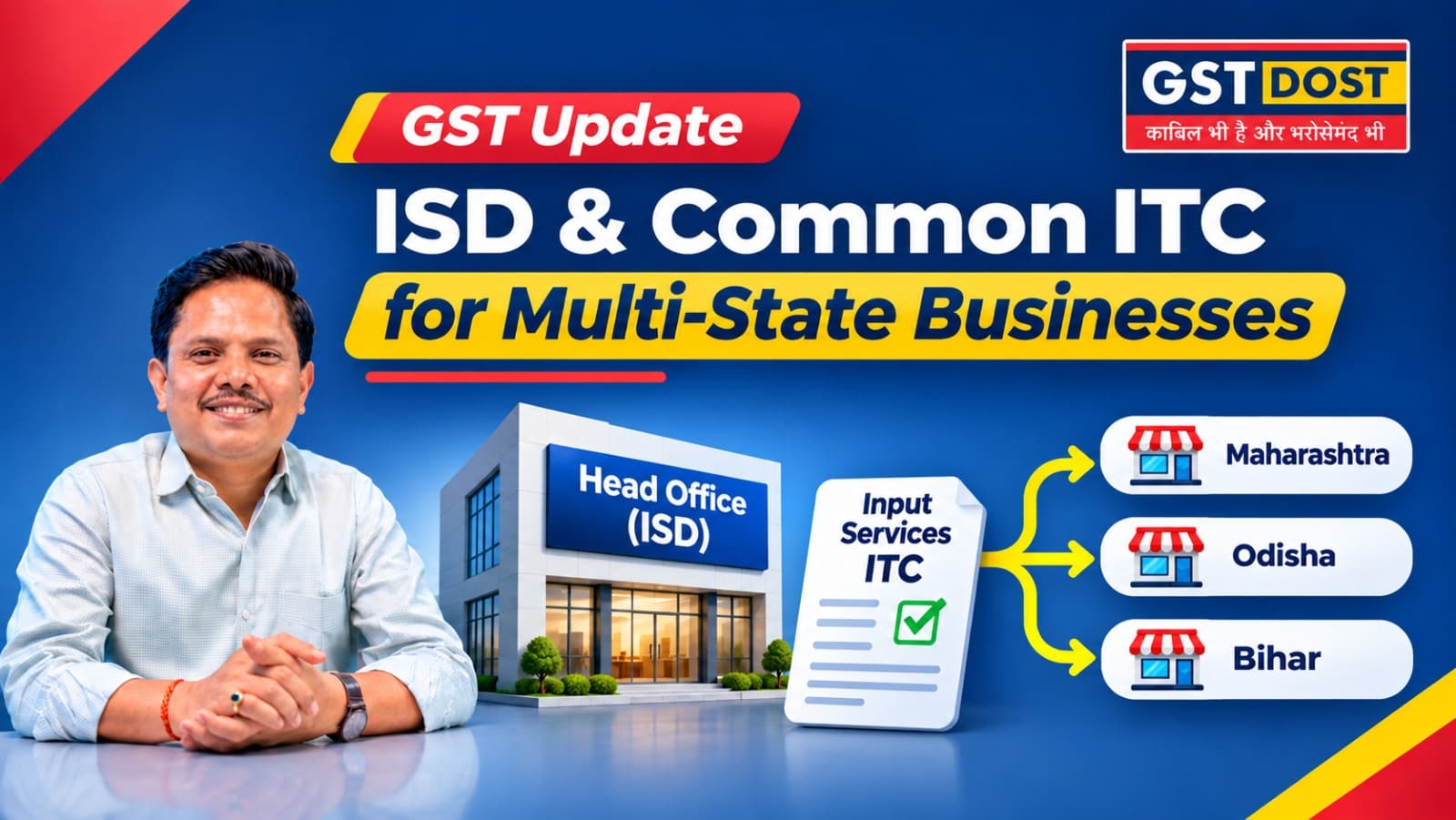
Businesses having multiple GST registrations under the same PAN should check whether input-service invoices received centrally for other registrations are being handled through the Input Service Distributor (ISD) mechanism, which is mandatory from 1 April 2025.
Latest update (October 2026): On 26 October 2026 CBIC issued Circular No. 260/06/2026-GST clarifying seven issues on the ISD mechanism. The same day, Notification No. 05/2026-Central Tax amended the ISD-related CGST Rules with effect from 1 November 2026. Both are explained in Section 7 below.
A company may operate from several States. Its Head Office may be in Kolkata, with branches, offices, factories or retail outlets in Maharashtra, Odisha, Bihar, Assam or other States.
The Head Office may receive invoices for services that benefit more than one GST registration. Examples include central advertising campaigns, shared technology subscriptions, professional consultancy, software services and other business-support services.
The important GST question is:
If the Head Office receives a tax invoice for a service benefiting other GST registrations, how should the eligible ITC reach those registrations?
The amended ISD provisions answer this question.
1. What Does the Law Require?
- Finance Act, 2024 (8 of 2024): Section 11 amended the definition of "Input Service Distributor" in Section 2(61) of the CGST Act, and Section 12 substituted Section 20. Notification No. 16/2024-Central Tax dated 6 August 2024 brought both sections into force from 1 April 2025.
- Section 20(1), as substituted: an office of the supplier that receives tax invoices for input services, including invoices for services taxable under reverse charge under Section 9(3) or 9(4), for or on behalf of distinct persons referred to in Section 25, must register as an ISD under Section 24(viii) and distribute the ITC on those invoices.
- Finance Act, 2025: amended Section 2(61) and Section 20 to also refer expressly to reverse-charge supplies under Section 5(3) and 5(4) of the IGST Act, with effect from 1 April 2025.
- Rule 39 of the CGST Rules: amended by Notification No. 12/2024-Central Tax dated 10 July 2024. Notification No. 09/2025-Central Tax dated 11 February 2025 brought these amendments into force from 1 April 2025. Rule 39 was amended again by Notification No. 05/2026-Central Tax with effect from 1 November 2026.
What Is an Input Service Distributor?
An ISD is an office that receives input-service invoices for or on behalf of distinct GST registrations of the same business and distributes the related ITC through the statutory mechanism.
ISD registration is a separate registration under Section 24(viii). It does not create a separate business. Its purpose is to distribute input-service credit among the relevant registrations.
2. A Simple Business Example
Imagine a retail company headquartered in Kolkata. It operates stores in West Bengal, Odisha and Bihar, each with its own GSTIN.
The company engages an advertising agency to promote its products in all three States. The agency issues its tax invoice to the Kolkata office. The advertising benefits the stores registered under the different GSTINs.
The Finance Manager asks:
"Can we simply claim the entire GST credit in the Kolkata registration?"
Where the invoice is received for or on behalf of the Odisha and Bihar registrations as well, the law from 1 April 2025 requires the credit to be distributed through the ISD mechanism. The company should:
- identify the registrations to which the service is attributable,
- ensure that it has an ISD registration,
- ask vendors to raise invoices for such services on the ISD GSTIN, and
- distribute the credit under Section 20 and Rule 39.
The fact that Kolkata paid the invoice does not, by itself, entitle Kolkata to keep all the ITC.
This is a hypothetical example.
3. How Is the Credit Distributed?
Rule 39 prescribes the method. The treatment depends on which registration or registrations the service is attributable to.
| Situation | Treatment under Rule 39 |
|---|---|
| Service attributable to one specific registration | Credit is distributed only to that registration. |
| Service attributable to more than one registration (including all of them) | Credit is distributed among those registrations, pro rata on the basis of each one's turnover in its State or Union territory during the relevant period, compared with the total turnover of all such registrations. |
| Eligible and ineligible ITC | Identified and distributed separately. |
| Timing | Credit available for distribution in a month is distributed in the same month. Circular No. 260/06/2026-GST explains what "available for distribution" means (see Section 7). |
Rule 39 defines the "relevant period". It is the preceding financial year if all such recipients had turnover in that year. Otherwise, it is the last quarter, before the month of distribution, for which turnover details of all such recipients are available.
An equal split is not a method provided in Rule 39. A shared service benefiting three registrations cannot simply be divided into three equal parts. The turnover-based ratio applies.
4. Does Every Head Office Expense Need ISD?
No.
First, the ISD mechanism applies only to input services. Goods purchased by the Head Office, such as stationery, are outside it.
Second, a service used only by the Kolkata office does not become a common service just because the company also operates in other States.
Businesses should distinguish between four categories:
- services used only by the office that receives the invoice,
- services attributable to one or more other GST registrations,
- services benefiting several registrations, and
- services the Head Office itself supplies to its other registrations, for example management or support functions performed by its own employees.
The last category is a supply between distinct persons (Section 25(4) read with Schedule I). That is a separate question from ISD distribution of third-party input-service credit.
Circular No. 199/11/2023-GST dated 17 July 2023 discussed ISD and cross-charge at a time when ISD was optional. Its observations on input services procured from third parties should now be read with the amended Section 20, which is mandatory from 1 April 2025.
The correct treatment starts with identifying who receives and who uses the service.
5. What About Reverse-Charge Services?
Substituted Section 20 expressly covers services taxable under reverse charge under Section 9(3) and 9(4) of the CGST Act. After the Finance Act, 2025, it also covers Section 5(3) and 5(4) of the IGST Act.
Under Rule 39(1A), a registered person having the same PAN and State code as the ISD may transfer this reverse-charge credit to the ISD by issuing an invoice, credit note or debit note under Rule 54(1A). The ISD then distributes it under Rule 39(1).
Before 1 November 2026, Rules 39(1A) and 54(1A) referred to "common" input services. Notification No. 05/2026-Central Tax omitted that word. The rules now refer to input services attributable to one or more distinct persons.
Not every reverse-charge transaction must go through ISD. Each service, its tax liability, its recipient and the statutory conditions must be examined.
6. What Return Does an ISD File?
An ISD files FORM GSTR-6. The due date under Section 39(4) read with Rule 65 is the 13th day of the following month, subject to any extension notified.
The GST Portal's GSTR-2B guidance explains that ISD credit reported in GSTR-6 is reflected in the recipient's GSTR-2B. The recipient should reconcile this credit with its own records and ITC eligibility.
From 1 November 2026, Notification No. 05/2026-Central Tax also provides that suppliers' invoice details are made available to the ISD in FORM GSTR-6A, and it revises FORM GSTR-6.
Important: GSTR-6 does not replace the normal returns of the business's regular GST registrations.
7. The October 2026 Changes
Circular No. 260/06/2026-GST dated 26 October 2026
The Circular clarifies seven issues on the ISD mechanism. In brief:
- Multiple ISDs in one State: there is no bar on more than one ISD registration within a State or Union territory. Each registrant that receives input-service invoices for or on behalf of distinct persons, and has to distribute that credit under Section 20, must obtain its own ISD registration.
- Eligibility, recovery and penalty: recipients must satisfy the conditions of Sections 16 and 17. Credit distributed in excess is recoverable from the recipients with interest under Section 21, with the amount determined under Section 73, 74 or 74A. An ISD that distributes credit in contravention of Section 20 is liable to penalty under Section 122(1)(ix).
- "Available for distribution in a month": credit reflected in GSTR-6A becomes available for distribution once the ISD ascertains that it is prima facie eligible. It must then be distributed in that month, with eligible and ineligible credit identified separately and reported in GSTR-6.
- Reversals: the ISD must distribute the entire available credit to the recipients to whom it is attributable. Any reversals under Section 17(1), 17(2) or 17(4) are made by the recipients, not by the ISD.
- Rule 54(1A) transfers and turnover: invoices, debit notes and credit notes issued under Rule 54(1A) to transfer credit to the ISD are not outward supplies. They are excluded from "turnover in State or turnover in Union territory" under Section 2(112), and from adjusted total turnover for refunds, but must still be reported in GSTR-1.
- Net ITC for refunds: credit transferred under Rule 54(1A) is not ITC on inward supplies of the transferring registration, so it is not part of "Net ITC" under Rule 89(4) or 89(5).
- No reversal by the transferor: the transferring registration is not required to reverse, under Section 17(1), 17(2) or 17(4), the credit it transfers to the ISD. It must pass the entire reverse-charge credit to the ISD. If it later receives distributed credit as a recipient, reversal provisions apply to it in that capacity.
Notification No. 05/2026-Central Tax dated 26 October 2026 (ISD changes effective 1 November 2026)
- Rule 36: amended so that ITC distributed by an ISD is also covered by the documentary requirements.
- Rule 39(1)(i): the words "or central tax" inserted after "input tax credit of integrated tax".
- Rules 39(1A) and 54(1A): the word "common" omitted, as explained in Section 5.
- Rule 60: suppliers' invoice details also made available to the ISD in FORM GSTR-6A.
- FORM GSTR-6: certain tables and instructions revised.
Businesses should review their ISD process, GSTR-6 reporting, Rule 54(1A) documents and refund computations against these changes.
8. Why This Matters to Your Business
A company may have several GST registrations under one PAN, and its Head Office may pay for common professional services. Its accounting software may book the entire expense at the Head Office, but the GST treatment needs separate examination.
An incorrect process can lead to:
- credit being kept in the wrong registration,
- excess credit being recovered from recipients with interest under Section 21, and
- a penalty on the ISD under Section 122(1)(ix).
At the same time, not every expense booked at the Head Office needs ISD distribution.
The objective is correct credit allocation, not an increase in total ITC.
9. Who Should Review This?
This advisory is relevant to businesses operating through multiple State-wise GST registrations under the same PAN, such as:
- retail chains
- FMCG companies
- manufacturing groups
- pharmaceutical distributors
- jewellery chains
- footwear retailers
- other multi-State businesses
Such businesses should particularly review input-service invoices received centrally for more than one GST registration.
A business with only one GST registration under its PAN has no distinct persons among whom to distribute credit, so the ISD question does not arise for it in the same way.
10. Check This Today: 5-Minute Self-Check
Ask your Finance Manager to answer YES / NO / NOT SURE.
| Checkpoint | Response |
|---|---|
| Does our business have multiple GST registrations under the same PAN? | |
| Does one office receive input-service invoices benefiting other GST registrations? | |
| Have we identified common advertising, software and consultancy expenses? | |
| Have we verified the actual recipient and beneficiary of each such service? | |
| Where required, do we have an ISD registration, and are vendors invoicing on the ISD GSTIN? | |
| Is credit distributed on the Rule 39 turnover ratio, not an equal split? | |
| Have reverse-charge services, and their Rule 54(1A) transfer documents, been identified? | |
| Are Rule 54(1A) transfers excluded from turnover and Net ITC in our refund workings? | |
| Have the 1 November 2026 rule changes and Circular No. 260/06/2026-GST been reflected in our process? | |
| Have GSTR-6 and the recipients' GSTR-2B been reconciled? | |
| Is one responsible person reviewing the process? |
A NO or NOT SURE answer does not by itself mean non-compliance. It identifies a point that may need verification.
11. What Documents Should You Keep Ready?
- GST Registration Master: all GSTINs under the PAN, including the ISD registration, showing the distinct-person structure.
- Common Input-Service Invoices: invoices for advertising, consultancy, technology and other services received centrally.
- Service Agreements: agreements showing the nature of the service, the contracting parties and the registrations that benefit.
- ISD Distribution Records: ISD invoices, distribution workings and the basis of allocation.
- Turnover Working: State-wise turnover for the relevant period used in the Rule 39 ratio.
- GSTR-6, GSTR-6A and Recipient GSTR-2B: returns and credit reconciliations.
- Reverse-Charge Documentation: reverse-charge payment records and the Rule 54(1A) invoices, debit notes or credit notes used to transfer credit to the ISD.
12. Legal References: Official Primary Sources
Finance Act, 2024 (8 of 2024), Sections 11 and 12: amended the definition of ISD in Section 2(61) and substituted Section 20 of the CGST Act.
Notification No. 16/2024-Central Tax dated 6 August 2024: appointed 1 April 2025 as the date of commencement of Sections 11 and 12 of the Finance Act, 2024.
Finance Act, 2025: inserted references to Section 5(3) and 5(4) of the IGST Act in Section 2(61) and Section 20 of the CGST Act, with effect from 1 April 2025.
Notification No. 12/2024-Central Tax dated 10 July 2024: amended Rule 39 and inserted Rule 39(1A).
Notification No. 09/2025-Central Tax dated 11 February 2025: brought the Rule 39 amendments into force from 1 April 2025.
Notification No. 05/2026-Central Tax dated 26 October 2026: CGST (Amendment) Rules, 2026. Its ISD-related amendments to Rules 36, 39, 54(1A) and 60 and to FORM GSTR-6 take effect from 1 November 2026.
Circular No. 260/06/2026-GST dated 26 October 2026: clarification on issues pertaining to Input Service Distributor.
CGST Act, 2017: Sections 2(61), 20, 21, 24(viii), 25, 39(4) and 122(1)(ix).
CGST Rules, 2017: Rules 39, 54(1A), 60 and 65.
GST Portal: GSTR-2B User Guide: explains how ISD credit reported in GSTR-6 appears in the recipient's GSTR-2B.
Source Note: This advisory reflects the law as amended up to Notification No. 05/2026-Central Tax and Circular No. 260/06/2026-GST, both dated 26 October 2026. For the official text, refer to the CBIC GST website (cbic-gst.gov.in) and the CBIC Tax Information Portal (taxinformation.cbic.gov.in).
One Small Improvement for Today
Ask your Finance Manager to pick one centrally received advertising, software or consultancy invoice and identify which GST registrations actually benefited from that service. If more than one registration benefited, check whether the invoice was received on the ISD GSTIN and distributed under Rule 39.
Need Professional Support?
Businesses with multiple GST registrations may benefit from a focused GST ISD & Common Input-Service Credit Health Check.
The review can examine selected central expense invoices, beneficiary registrations, ISD applicability, Rule 39 distribution workings, Rule 54(1A) transfers and the October 2026 changes.
The objective is to establish the correct GST treatment and identify genuine compliance requirements.
GST DOST | GST Advisory, ITC Reconciliation & Professional Support

CBIC Notifies New Rule 14A – Quick GST Registration Option for Small Taxpayers [News]
[News]
Your Head Office Pays for Services Used by Branches in Different States. Is the GST Input Tax Credit Being Distributed Correctly? [Blog]
Motor Vehicle Leasing: Can Road Tax, Insurance and FASTag Recoveries Be Kept Outside GST? [Blog]
Gujarat HC says:“Phone calls don’t count as hearings!”Know your rights under Sec 75(4) [Video]
Know GST Rate of HSN 3926 | GST DOST [Video]

GST DOST, formerly known as My Service Tax, is a specialist GST firm led by experienced professionals — including CA, CS, MBA, and Advocates.
We are fluent in the ever-evolving GST regime and ensure accurate, timely, and actionable advice. Our strength lies not just in technical depth but in the use of AI tools and behavioural intelligence to ensure our clients feel informed, assured, and genuinely supported at every stage.

Powered by: RNJ Consultancy Services