Q5: Can GST become payable when TDS is deducted under Section 194R?
Yes. If the benefit or perquisite is received in return for a business activity, it can be treated as “consideration” under GST, and GST may become payable.

No Breadcrumbs
YOU ARE HERE Home > Blogs > If TDS Is Deducted Under Section 194R, GST Liability May Also Arise
| Ownership | Own | ||
Namaste DOST!
Today’s story begins with something many businesses take lightly — those free gifts, foreign trips, and perquisites manufacturers often hand out to their dealers. They feel harmless. Even flattering.
But an Advance Ruling from Tamil Nadu quietly reminds us: nothing is really “free” in tax law.
So let’s open this file together and see what happens when TDS under 194R enters the picture… and GST follows right behind it.
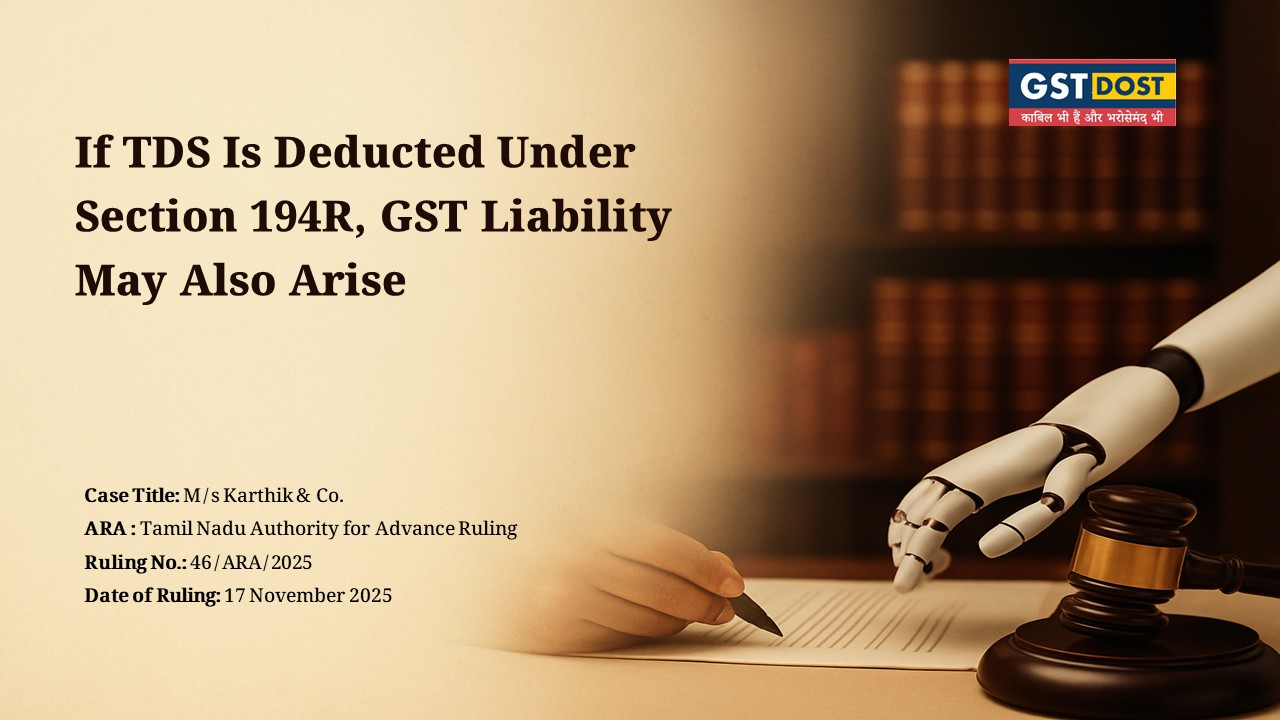
This case involved a paint dealer who received non-monetary benefits such as gifts, compliments, and foreign tour packages from paint manufacturers. Since the manufacturers deducted TDS under Section 194R, these perks appeared as income in the dealer’s Form 26AS. To stay compliant, the dealer issued GST tax invoices on the value of these perks. But the manufacturers claimed GST was not applicable because these benefits were not a “supply”.
The Tamil Nadu AAR examined whether such non-monetary benefits, when subjected to TDS under Section 194R, constitute consideration for a supply under GST. The AAR held yes — the dealer was providing support services (sales promotion), and the non-cash benefits were the consideration received. Therefore, GST was payable, and the invoices issued were valid.
In essence, If 194R treats it as income, GST may treat it as a supply.
M/s Karthik & Co., a wholesale and retail dealer of paints, operated as a franchisee for major paint manufacturers. As part of the business relationship, manufacturers frequently rewarded the dealer — and sometimes their painter-customers — with:
These benefits were not paid in cash. But the manufacturers still deducted 10% TDS under Section 194R of the Income Tax Act, and the value appeared in the dealer’s Form 26AS.
To stay compliant, the dealer raised GST tax invoices for the value of these perks.
The manufacturers disagreed.
They argued: “These are just incentives… not a supply under GST. Why invoice us?”
The dealer approached the Tamil Nadu Authority for Advance Ruling, seeking clarity.
The core question was simple but powerful:
“ When a dealer receives non-monetary benefits and TDS is deducted under Section 194R, does this amount to a ‘supply’ under GST requiring tax to be paid?
Or in other words:
“ Do gifts, tour packages, and incentives become consideration for a service?
This is where the story gets interesting.
The manufacturer’s stance (as conveyed by the applicant):
The dealer’s view:
The Tamil Nadu AAR issued a clear and detailed ruling.
First, it reaffirmed what Section 194R means:
If a person provides any benefit or perquisite relating to business or profession, TDS must be deducted.
And once deducted, this appears as income of the recipient.
From a GST angle, this matters.
AAR held that these non-monetary benefits are indeed “consideration” for a service.
That service?
Sales promotion / augmentation of sales, performed by the dealer for the manufacturer.
The AAR then applied Section 7 of the CGST Act:
A supply exists when—
All three existed.
And so:
This is a taxable supply of support services.
The tax invoices raised by the dealer are valid.
GST is payable.
Let’s break the reasoning down in simple language.
Section 2(31) says consideration may be monetary or otherwise.
A foreign tour package is definitely “otherwise.”
The dealer promoted the manufacturer’s products.
The manufacturer rewarded the dealer.
Something for something — a classic business exchange.
When manufacturers cut 194R TDS, they assert:
“This is income given for business.”
GST simply replies:
“If it is income, it is likely consideration. And if it’s consideration, it’s supply.”
Since consideration wasn’t monetary, valuation must follow Rule 27.
The AAR concluded:
Use the value declared in the 194R TDS certificate.
Because the dealer didn’t receive any additional payment, GST can be treated as inclusive under Rule 35.
Simple. Logical. And a little eye-opening.
A free tour may turn into a taxable service if 194R applies.
If your Form 26AS shows 194R benefits, check your GST liability.
Gifts, vouchers, and incentives may count.
One cannot treat something as income while the other denies it as supply.
If incentives are performance-linked, GST may step in. Keep records clean.
This ruling sends a quiet signal across industries:
The Income Tax and GST systems are increasingly interconnected.
A treatment under one law can influence interpretations under another.
For businesses that routinely receive incentives, this is a moment to pause and reassess compliance.
What looked like a harmless reward — a foreign trip, a gift, a compliment — turned into a full-blown GST question. But the AAR made the answer simple: if you earned it through business performance, it’s not free.
And honestly DOST, this feels right.
Tax law may be complicated, but the logic behind it shouldn’t keep you awake at night.
At GST DOST, our mission is simple — help you navigate these intersections with clarity, calm, and confidence.
“📞 Need help with a similar case? Contact GST DOST for personalised support.
The dispute was whether non-monetary benefits received by a dealer — on which TDS under Section 194R was deducted — constitute a taxable supply under GST.
The AAR held that these benefits were consideration for support services, and GST invoices issued by the dealer were valid.
When it is linked to business performance and treated as income (especially via 194R TDS), it becomes consideration for a service.
The value of supply is the same as the value shown in the 194R TDS certificate, as per Rule 27.
Written by CA Vikash Dhanania | Reviewed by GST DOST Legal Research Team | Updated on 02/12/2025.
© GST DOST | When GST gets complicated, we make it simple—saving your time, money, and effort.

CBIC Notifies New Rule 14A – Quick GST Registration Option for Small Taxpayers [News]
[News]
GST Summons Is Not a Punishment — Don’t Panic Before the Law Does [Blog]
Yes, Police Can Attach Bank Accounts in GST Cases. But Only If They Follow the Law [Blog]
Gujarat HC says:“Phone calls don’t count as hearings!”Know your rights under Sec 75(4) [Video]
Know GST Rate of HSN 3926 | GST DOST [Video]
GST DOST, formerly known as My Service Tax, is a specialist GST firm led by experienced professionals — including CA, CS, MBA, and Advocates.
We are fluent in the ever-evolving GST regime and ensure accurate, timely, and actionable advice. Our strength lies not just in technical depth but in the use of AI tools and behavioural intelligence to ensure our clients feel informed, assured, and genuinely supported at every stage.

Powered by: RNJ Consultancy Services