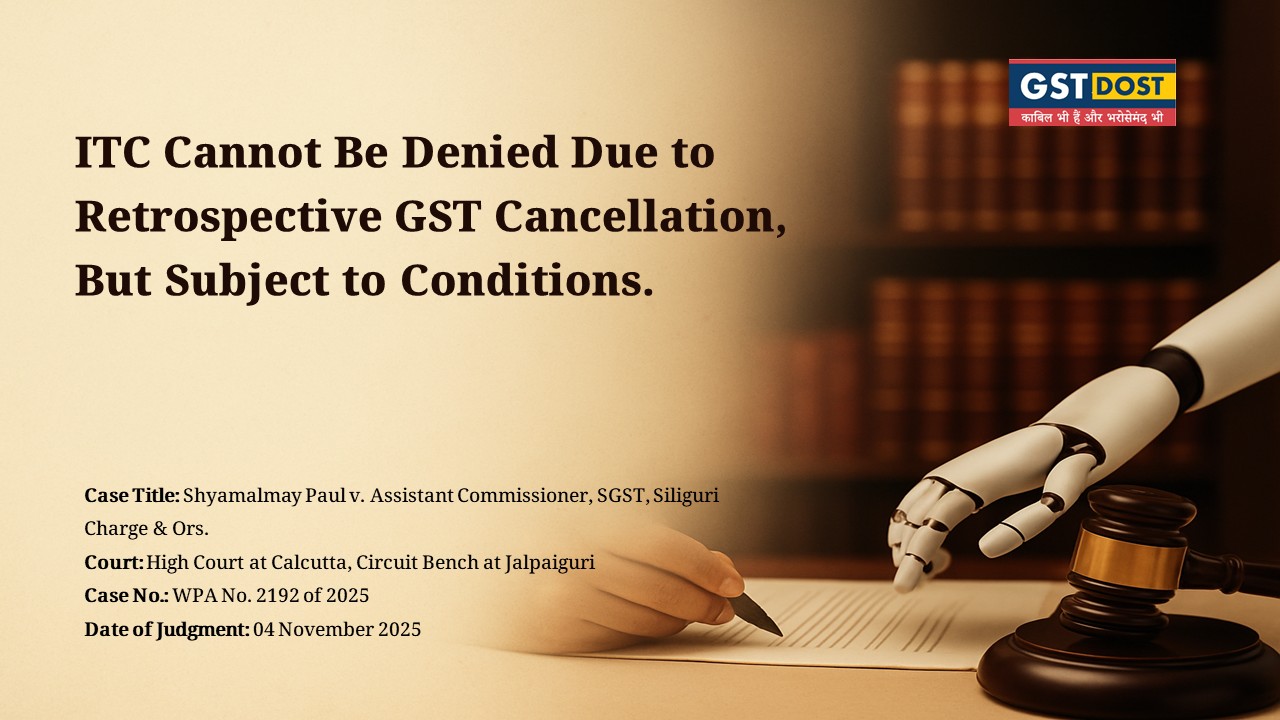
ITC Cannot Be Denied Due to Retrospective GST Cancellation, But Subject to Conditions
GST DOST's BLOG
Namaste DOST!
Think about this for a second. You buy goods. You pay through bank. You keep invoices, e-way bills, transport proofs. Months later, a notice lands on your desk saying: “Your supplier’s GST was cancelled retrospectively. Reverse your ITC.”
Sounds unfair? The Calcutta High Court thought this issue deserved a closer, more honest look.
Summary
This case deals with Input Tax Credit (ITC) denial due to retrospective cancellation of a supplier’s GST registration. The taxpayer was issued a show cause notice under Section 73 of the GST law for multiple discrepancies. Most issues were resolved in his favour, except one: ITC claimed on purchases from a supplier whose GST registration was cancelled later with retrospective effect.
The taxpayer argued that the purchases were genuine and supported by documents such as invoices, e-way bills, transport records, bank statements, and ledgers. However, the appellate authority rejected the appeal mainly because the invoices were dated after the effective date of cancellation.
The Calcutta High Court held that retrospective cancellation of a supplier’s GST registration cannot, by itself, be the sole ground to deny ITC. Since the appellate order failed to explain why the taxpayer’s documents were not acceptable, it was set aside as a non-speaking order, and the matter was sent back for fresh consideration.
Facts of the Case
The taxpayer, a registered person under the West Bengal GST law, received a show cause notice under Section 73(1) for the financial year 2019–20. The notice alleged four discrepancies and proposed tax, interest, and penalty.
The taxpayer replied with explanations and documents. When the adjudication order was passed under Section 73(9), three discrepancies were accepted. Only one issue remained—the alleged wrong availment of ITC on purchases from suppliers whose GST registrations were cancelled retrospectively.
Aggrieved by the demand, the taxpayer filed an appeal under Section 107. The appellate authority dismissed the appeal and affirmed the adjudication order.
What mattered most was this: the appellate authority itself recorded that the taxpayer had produced tax invoices, e-way bills, transport documents, bank statements, and party ledgers. Still, the ITC was denied on the ground that the supplier’s registration stood cancelled retrospectively.
That single point brought the matter before the High Court.
Legal Issue
The core legal question was simple but powerful:
Can ITC be denied to a purchaser only because the supplier’s GST registration was cancelled later with retrospective effect, even when documents show genuine purchases and movement of goods?
Arguments by the Parties
The taxpayer argued that the appellate authority failed to consider the documents already on record. According to him, ITC was denied mechanically, without examining whether the transactions were genuine or whether goods had actually moved.
The tax department contended that the burden of proving ITC eligibility lies on the taxpayer. It also pointed out that the taxpayer did not appear for personal hearing before the appellate authority, despite opportunities.
Both sides stood firm. The court had to decide where fairness truly lay.
⚖️ Court’s Decision
The Calcutta High Court carefully examined the appellate order. And here is where things got uncomfortable for the department.
The Court noted that the appellate authority had acknowledged the existence of supporting documents. Yet, it did not explain why those documents were insufficient to prove a bona fide transaction or actual movement of goods.
Instead, the ITC was denied on a single reasoning: the invoices were issued after the effective date of retrospective cancellation of the supplier’s GST registration.
The Court made a crucial observation:
Retrospective cancellation of registration of the supplier cannot be the sole ground for denying Input Tax Credit to the purchaser.
The Court also observed that it was not the department’s case that the supplier’s registration was invalid on the date when supplies were actually made.
Because the appellate authority failed to give reasons and merely affirmed the adjudication order, the High Court held that the order was a non-speaking order.
Legal Reasoning & Analysis
A non-speaking order is like a verdict without a voice. It tells you the result, but not the “why”.
The High Court stressed that appellate authorities are not rubber stamps. If documents are on record, the authority must apply its mind, examine them, and explain why they do or do not establish ITC eligibility.
Retrospective cancellation may raise suspicion. But suspicion is not proof.
The Court also clarified that even if a personal hearing was missed, the authority still had a duty to deal with the materials already available on record. Ignoring them was not an option under the law.
In short, conditions matter. ITC is not automatic. But denial must be reasoned, lawful, and evidence-based.
Important Message for Every Business Owner
-
Retrospective GST cancellation alone is not enough to deny ITC. Authorities must look deeper.
-
Documents are your shield. Invoices, e-way bills, transport records, and bank proofs matter.
-
Demand a speaking order. If ITC is denied, the authority must explain why your evidence fails.
-
Attend hearings, but don’t panic if one is missed. Your written record still deserves consideration.
-
Appeals are serious proceedings, not a formality. Courts expect reasoning, not repetition.
Why This Matters
This ruling sends a clear signal. ITC denial cannot be mechanical or based on shortcuts. Retrospective cancellation raises questions, yes. But answers must come from facts, not assumptions. For genuine taxpayers, this judgment reinforces faith in judicial correction.
Conclusion
GST compliance often feels like reading a map upside down in the dark. One wrong turn, and anxiety kicks in. This case reminds us that fairness still has a place in taxation.
ITC cannot be denied just because a supplier’s registration was cancelled later. But conditions apply. Evidence matters. Reasoning matters. And silence from authorities does not.
Know your rights. Keep your records clean. And when something feels wrong, it probably is.
📞 Need help with ITC denial or retrospective GST cancellation issues? Contact GST DOST for personalised support.
FAQ
Q: What was the dispute in this case?
A: The dispute was about ITC denial due to retrospective cancellation of the supplier’s GST registration.
Q: How did the High Court rule?
A: The Court set aside the appellate order as a non-speaking order and directed fresh adjudication with proper reasoning.
Q: Can a buyer lose ITC if the seller’s GST is cancelled later?
A: Not automatically. This case confirms that retrospective cancellation alone cannot be the sole ground for ITC denial.
Q: Does ITC automatically lapse if the supplier’s GST registration is cancelled later?
A: No. The Court held that ITC cannot be denied solely on the basis of retrospective cancellation of the supplier’s GST registration.
Q: What should taxpayers do if they receive an ITC denial notice?
A: Respond in writing, submit all supporting documents, and seek professional advice to protect your rights.
References
-
Case: Shyamalmay Paul v. Assistant Commissioner, SGST, Siliguri Charge & Ors. – Calcutta High Court, Circuit Bench at Jalpaiguri
-
Statutory Provisions Referenced:
-
Section 16, CGST Act, 2017 – Conditions for availing ITC
-
Section 73 and Section 107, CGST/WBGST Act, 2017
-
Written by CA Vikash Dhanania | Reviewed by GST DOST Legal Research Team | Updated on 23/12/2025.
© GST DOST | When GST gets complicated, we make it simple—saving your time, money, and effort.


CBIC Notifies New Rule 14A – Quick GST Registration Option for Small Taxpayers [News]
[News]
GST Summons Is Not a Punishment — Don’t Panic Before the Law Does [Blog]
Yes, Police Can Attach Bank Accounts in GST Cases. But Only If They Follow the Law [Blog]
Gujarat HC says:“Phone calls don’t count as hearings!”Know your rights under Sec 75(4) [Video]
Know GST Rate of HSN 3926 | GST DOST [Video]

GST DOST, formerly known as My Service Tax, is a specialist GST firm led by experienced professionals — including CA, CS, MBA, and Advocates.
We are fluent in the ever-evolving GST regime and ensure accurate, timely, and actionable advice. Our strength lies not just in technical depth but in the use of AI tools and behavioural intelligence to ensure our clients feel informed, assured, and genuinely supported at every stage.

Powered by: RNJ Consultancy Services